Wound String Tension Calculator
Estimate string pull from pitch, scale length, finished gauge, core size, wrap metal, and winding style
Calculation Breakdown
| Parameter | Value | Metric Value | Calculation Role |
|---|
| String Use | Typical Gauge | Scale | Pitch | Usual Tension Range |
|---|---|---|---|---|
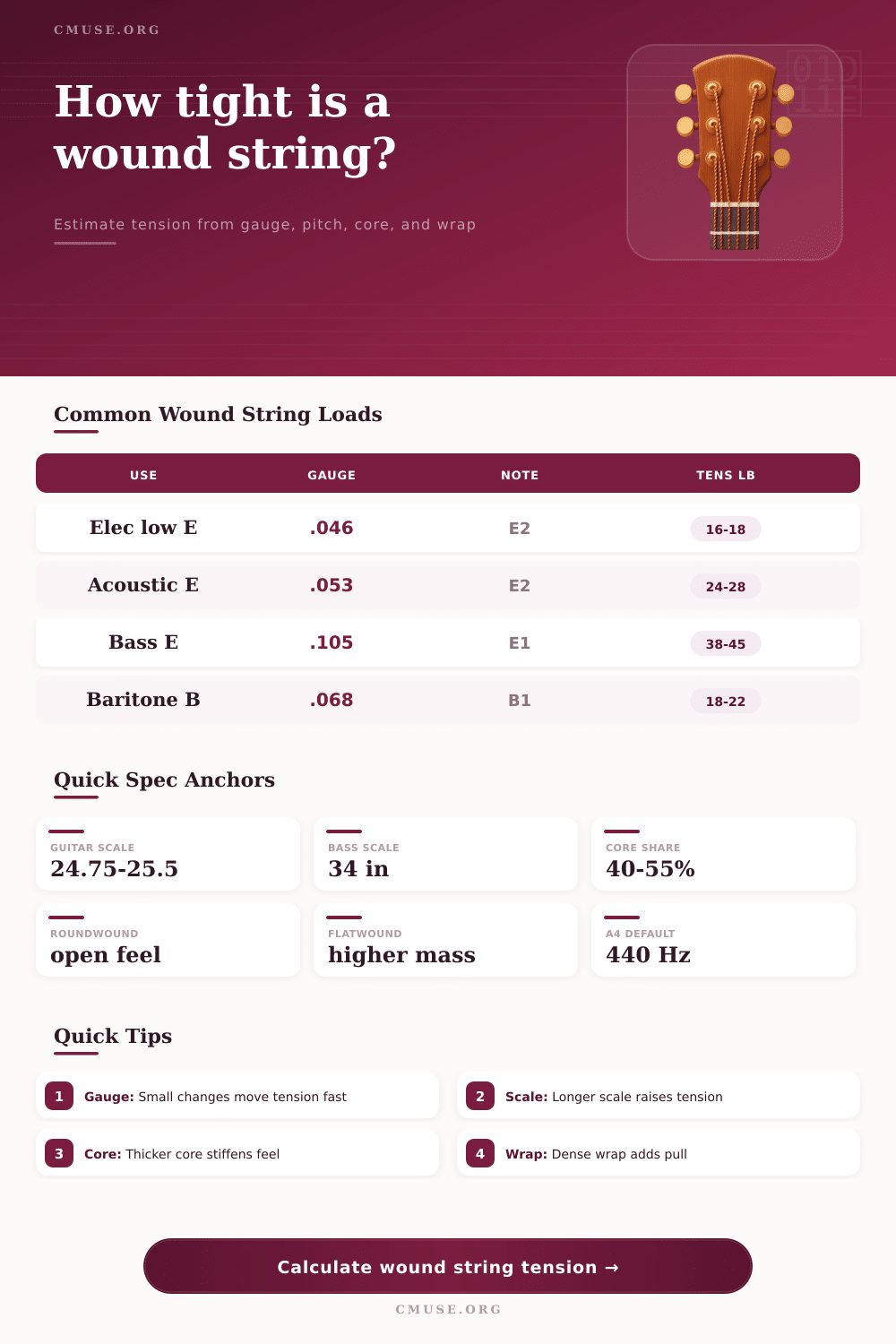
| Electric guitar low E | .046 in / 1.17 mm | 25.5 in / 648 mm | E2 | 16-18 lb / 71-80 N |
| Electric guitar D string | .026 in / 0.66 mm | 25.5 in / 648 mm | D3 | 16-19 lb / 71-85 N |
| Jazz wound G | .020 in / 0.51 mm | 24.75 in / 629 mm | G3 | 15-19 lb / 67-85 N |
| Acoustic low E | .053 in / 1.35 mm | 25.4 in / 645 mm | E2 | 24-28 lb / 107-125 N |
| Baritone low B | .068 in / 1.73 mm | 27 in / 686 mm | B1 | 18-24 lb / 80-107 N |
| Long-scale bass E | .105 in / 2.67 mm | 34 in / 864 mm | E1 | 38-45 lb / 169-200 N |
| Wrap Material | Density Used | Common Placement | Tension Effect |
|---|---|---|---|
| Nickel-plated steel | 0.283 lb/in³ / 7.83 g/cm³ | Electric guitar and bass | Middle reference |
| Pure nickel | 0.321 lb/in³ / 8.90 g/cm³ | Vintage electric sets | Slightly heavier wrap |
| Stainless steel | 0.289 lb/in³ / 8.00 g/cm³ | Bright electric sets | Close to steel |
| Phosphor bronze | 0.319 lb/in³ / 8.83 g/cm³ | Acoustic guitar | Higher mass at gauge |
| 80/20 bronze | 0.316 lb/in³ / 8.75 g/cm³ | Acoustic guitar | Higher mass at gauge |
| Silver-plated copper | 0.323 lb/in³ / 8.94 g/cm³ | Classical basses | Dense wrap on light core |
| Style | Wrap Fill Factor | Typical Use | Modeling Note |
|---|---|---|---|
| Roundwound | 0.74 | Most electric and bass strings | Open helical wrap with visible gaps |
| Flatwound | 0.90 | Jazz guitar, bass, smooth feel | More metal fills the outer layer |
| Half-round | 0.82 | Reduced finger noise | Between round and flat mass |
| Tape wound | 0.62 | Bass and mellow electric sets | Outer tape reduces metal share |
| Classical wound | 0.72 | Nylon-core bass strings | Dense wrap on low-density core |
| Note | MIDI | Frequency at A4 440 | Common Wound String |
|---|---|---|---|
| E1 | 28 | 41.20 Hz | Bass low E |
| B1 | 35 | 61.74 Hz | 7-string or baritone low B |
| D2 | 38 | 73.42 Hz | Drop D guitar |
| E2 | 40 | 82.41 Hz | Guitar low E |
| A2 | 45 | 110.00 Hz | Guitar A string |
| D3 | 50 | 146.83 Hz | Guitar D string |
| G3 | 55 | 196.00 Hz | Wound G option |
| Core Ratio | Gauge Example | Estimated Core | Best Fit |
|---|---|---|---|
| 35-40% | .105 bass | .037-.042 in | Flexible, wrap-heavy bass strings |
| 42-48% | .046 guitar | .019-.022 in | Common electric wound strings |
| 48-55% | .053 acoustic | .025-.029 in | Firm acoustic and flatwound feel |
| 30-42% | .036 classical | .011-.015 in | Nylon-core wound strings |
Change a set of strings and suddeny your guitar can seem bigger or smaller than it did. Maybe it seems like fretboard reacts differently to the neck pulling in different directions. Is something wrong with the instrument? Or did you just make a mistake? It’s one of those variables that come up a lot in the luthier conversation.
We talk about pickups and wood species, but not much about how hard those wires is pushing against the scale length. String tension isn’t just a number. It’s the interaction of the manufacturer of the string interacting physicaly with geometry of your instrument.
How String Tension Affects Your Guitar
How so? The pull is estimated (above) based off not only on the note you are trying to play, but also on other factors like scale length. Low E strings of 0.046 gauge will feel the same no matter if it’s on a Mustang, a Les Paul or a Stratocaster. That is where mistake is made with many set-ups.
Physics doesn’t concern itself with brand allegiance. To produce the exact same sound at the end of string means the longer string must be under greater tension. Check out the reference tables that come bundled with the interface and you’ll notice how much tighter an acoustic E string is then its equally-tuned-for-frequency electric companion. It is a small detail perhaps, but it is relevant the next time you commit to tightening those neck adjustment screws.
The difference between a simple calculation of tension and a practical one rests on how string itself is built. A wound string isn’t just a rod. It’s a composite material with a core and a winding around that core. Each of those elements will provide something special to the overall stiffness and mass of the string. Knowing that, we ask for the core diameter expressed as a percent of total gauge.
That number has a dramatic effect on the feel. Generally speaking, a larger core diameter mean more steel in the middle. This makes the string stiffer and increases tension compared to a string with less core and more winding. Two strings made to the same gauge can feel totally different under your hands. One string may resist movement while the other flexes easily. Basically you’re trading off between rigidity and flexibility and don’t even realize you’re doing it.
One might think it’s all about how tightly the string is wrapped around a core, but it also matters what its made from. Different metals has different densities: pure nickel, phosphor bronze, stainless steel, and nickel plated steel, to name a few. That’s taken into account by the tool so that it calculates exact amount of weight per unit. If it’s a heavier material (e.g., silver, some bronzes) and there is no change to the gauge, then it will weigh more but not increase tension proportionally. That enables the luthier to produce a string that feels sluggish and heavy enough for jazz but won’t snap off your bridge pins. On the other hand, stainless steel can be durable, bright, and change the harmonic content of the vibrating string.
Not just that it’s tight, but what kind of tightness do you get? There’s one other wrinkle: winding style. Roundwound strings has gaps between their coils, which means they have less metal density than flatwounds. The calculator compensates for this difference by calculating how much metal actualy exists in its wrap layer. Flatwounds are smoother feeling because you can pack more metal in an equal amount of space. This affects both the sound and how it feels. You sacrifice some high end sparkle, but the sound will be focused and warm with less buzzing on the frets. It is a tradeoff of comfort versus articulation.
These things is overlooked by most players until it go wrong and something starts sounding odd or breaks. When they go to purchase a set of strings they base that decision on what color code they like or who endorses them. Then they ask why the guitar’s neck relief is out of spec or the intonation has shifted.
Knowing how tension affects your guitar allows you to anticipate how it will respond to alternative tuning profiles or even changes in hardware. A high-tension string may be too much for someone who plays lightly with very light fingertips. That person would of require a heavier gauge to keep up the tension if they were going to drop tune substantially.
It’s not about having perfect mathematical balance either. No. A guitar is a piece of glued together wood. It is a living instrument that breathes in and out with changing temperatures and humidity levels. But when you know what’s happening, you gain control over it.
You no longer guess when your guitar seems to be floppy or stiff. Instead, you begin to realize that by changing the pitch, or scale length, or even the gauge of string, you have a tension lever to pull. And once you understand how these elements work together, the act of setting up the instrument begins to shift from problem solving to creating character.
Change a set of strings, do some math, and your guitar now feels just right.