Wind Chime Note Calculator
Calculate tuned tube lengths from note frequency, material stiffness, density, diameter, wall thickness, end allowance, and free-free tube overtone behavior.
🎵 Quick Presets
Wind chime tubes behave like free-free bending beams, not air columns. The calculator uses f = beta^2/(2*pi*L^2) times sqrt(EI/rhoA), with hollow-tube section data.
📏 Tube and Tuning Inputs
🎚 Tuned Tube Set
| Tube | Note | Frequency | Cut Length | Blank Length | Suspend Node | First Overtone |
|---|---|---|---|---|---|---|
| Calculate to generate a tuned tube set. | ||||||
📊 Tube Formula Snapshot
⚙ Material Correction Factors
| Material | E Modulus | Density | Relative Factor | Chime Character |
|---|---|---|---|---|
| Aluminum 6061-T6 | 68.9 GPa | 2700 kg/m3 | 1.00x | Balanced, common, long sustain |
| Aluminum 6063-T5 | 69.0 GPa | 2690 kg/m3 | 1.00x | Smooth tubing, clean overtones |
| Yellow Brass | 100 GPa | 8500 kg/m3 | 0.68x | Warmer, heavier, shorter length |
| Copper Tube | 110 GPa | 8960 kg/m3 | 0.69x | Soft attack, heavier damping |
| Mild Steel | 200 GPa | 7850 kg/m3 | 1.00x | Bright and strong when protected |
| Bamboo Tube Approx. | 12 GPa | 700 kg/m3 | 0.82x | Woody, less predictable grain |
🎼 Overtone and Node Data
| Mode | Beta Value | Frequency Ratio | Practical Use |
|---|---|---|---|
| Fundamental bend | 4.730 | 1.000x | Main perceived chime pitch |
| Second bending mode | 7.853 | 2.756x | Prominent high overtone |
| Third bending mode | 10.996 | 5.404x | Bright shimmer component |
| Fourth bending mode | 14.137 | 8.933x | Upper metallic ring |
| Suspension node | 0.224 L | from end | Drill here to preserve sustain |
| Strike area | 0.50 L | near center | Often strongest for the root |
📝 Scale and Set Comparison
| Tuning Set | Intervals | Typical Tubes | Sound Result |
|---|---|---|---|
| Major pentatonic | 1 2 3 5 6 8 | 5 to 8 | Consonant, open, hard to clash |
| Minor pentatonic | 1 b3 4 5 b7 8 | 5 to 8 | Darker but still stable |
| Major scale | 1 2 3 4 5 6 7 8 | 7 to 8 | More melodic direction |
| Hirajoshi color | 1 2 b3 5 b6 8 | 5 to 7 | Open, suspended, reflective |
| Whole-tone | 1 2 3 #4 #5 b7 | 6 to 8 | Dreamy, symmetric shimmer |
🏡 Common Wind Chime Builds
| Project | Tube Profile | Root | Set | Build Note |
|---|---|---|---|---|
| Small window chime | 0.75 in aluminum | A4 | 5 tubes | Short lengths, bright and quick |
| Garden hanging chime | 1.00 in aluminum | G3 | 6 tubes | Medium pitch with long sustain |
| Deep porch chime | 1.50 in aluminum | C3 | 6 tubes | Longer stock and wider hanger |
| Warm brass chime | 1.00 in brass | E3 | 5 tubes | Shorter but much heavier tubes |
| Bass patio chime | 2.00 in aluminum | A2 | 5 tubes | Very long tubes; check clearance |
In order to build a wind chime that creates a sustained musical note, an understanding of the vibrations that occur within the metal tubes of the wind chime is require. The wind chime creates its sounds in response to the metal tubes bending like a beam that is free-free when the wind pass through the chime. The length of the metal tubes that are use in the chime, as well as the placement of the suspension points for the chime, determines the pitch of the resulting sound.
If the suspension points is placed at the vibration nodes of the metal tubes, the chime will continue to create its sound for a long period of time after being struck. If, however, the suspension points are not placed at these vibration nodes, the chime will cease to create its sound after a short period of time after being struck. In order to calculate the lengths of each metal tube that will create a desired musical scale for the wind chime, the calculator allow for the input of the metal type that is to be utilized in the chime, the diameter of the metal tubes, the wall thickness of the metal tubes, and the musical scale to be utilized by the chime.
How to Build and Tune a Metal Wind Chime
Each of these different parameters will impact the resultant pitch of the chime. For instance, each metal has a different stiffness, and therefore, each metal will have different lengths of the metal tubes that will result in the same pitch. Additionally, if the diameter or wall thickness of the metal tubes is increased, the metal will have a greater moment of inertia.
An increase in the moment of inertia of the metal will result in a need for a longer length of metal to achieve the same pitch as a short metal tube. Finally, the temperature of the metal will impact the pitch of the chime. Metals have a drop in modulus at higher temperatures, indicating that the temperature at which the metal wind chime is create can impact the pitch of the chime.
Many metal wind chimes use aluminum metal in their construction. Aluminum metal is light enough to allow the chime to respond to the movement of the lightest of breezes. However, metals like brass and steel is also often used to create wind chimes.
The sound created by brass metal wind chimes is warmer than aluminum metal chimes. However, because brass metal is more dense than aluminum metal, the brass metal chime will be shorter in length than an aluminum metal chime with the same pitch. Additionally, the sound created by steel metal wind chimes is brighter than that created by aluminum metal chimes.
Furthermore, because steel metal is more durable than aluminum metal, the steel metal chime will last longer if expose to the outdoors. However, because steel metal is more heavy than aluminum metal, using steel metal for the wind chime will impact the way that the chime is hung. Each of these different metals has its advantage in comparison to the others, and the calculator ensures that an individual doesnt have to perform the calculations of the section properties of the metal themselves prior to building the chime.
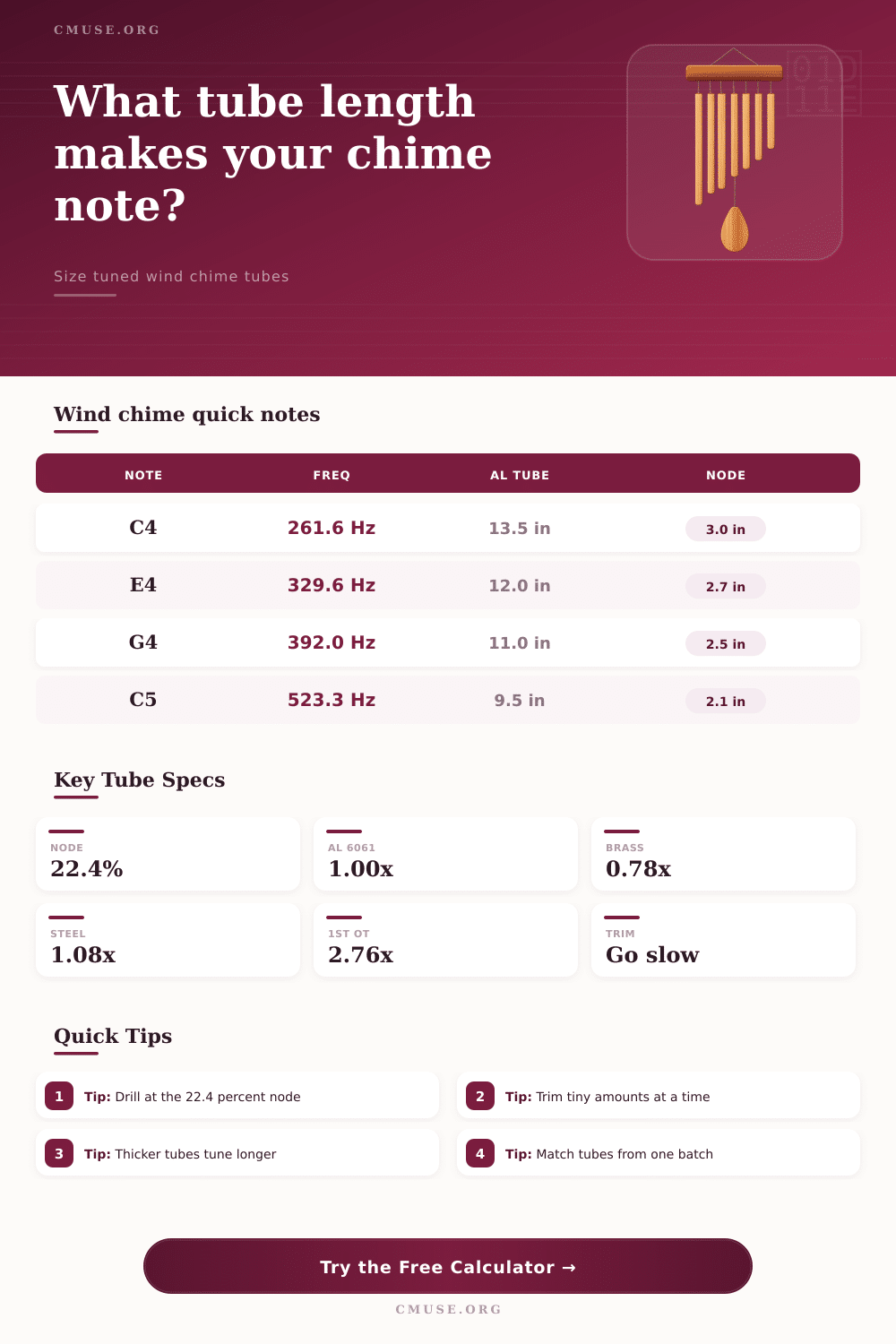
The placement of the suspension points for the metal chime is a critical component of the creation of the chime. The placement of the suspension points will impact the length of time that the chime continues to create its sound. The vibration node for the chime is created at approximately 22.4% of the length of the finished metal chime from each end of the chime.
By drilling the hole for the suspension point at this percentage of the length of the metal chime, the fundamental mode of vibrations will survive the chime. If the suspension point is placed even a small distance away from this percentage of the length of the metal chime, the sustain time of the chime will shorten. The first overtone of the metal chime occur at a ratio of roughly 2.76 times the frequency of the root note of the metal tube, and contribute to the shimmering sound that is created by metal wind chimes.
Choosing a musical scale for the chime is one of the steps in building the chime. A major pentatonic scale is one of the most common scales that is selected for building metal chimes. This scale does not contain intervals between its notes that would create clashing overtones within each metal chime.
A minor pentatonic scale will create a sound to the chime that is darker than a major pentatonic scale. However, the sound that is created by a minor pentatonic scale is still considered to be stable. A whole tone scale will create the metal chime sounding as if it has a float quality.
Such scales are often used in metal chimes that are to be hung in shaded gardens. The calculator that is provided allows individuals to change the musical scales for each metal chime, and to view how each scale will impact the length of each metal tube that is required to be create. Understanding each spread of lengths of metal tubes that will be required to create a certain musical scale for a wind chime is helpful for individuals that may only have a limited amount of metal tubing available to purchase or build their chime with.
The lengths of metal tubing that are purchased from metal suppliers are rarely the exact same lengths as calculated by the calculator. The tubes often have variable wall thickness along the length of the metal tube. Additionally, the metal seams along the metal chime may add stiffness to the metal.
Due to these variables, each metal tube should be cut longer than the calculation suggest. The calculator includes a field for individuals to enter an allowance for metal tubing that may have to be trimmed to each chime in order to ensure that each metal chime resonate to the proper pitch. Beyond the metals and lengths of the metal chimes, another factor that can impact the pitch of the chime is the temperature of the metal after the chime is built.
If the metal chime is tuned to a certain pitch when it is cold, but later hung in the sun, the metal will expand and the pitch will drop. While the drop in pitch is typically small, it can become audible if the metal chime is very large. For these reasons, metal chime builder may choose to retune the metal chime after the first season in which it is exposed to the outdoors.
The percentage of the metal chime that is the vibration node, as well as the ratio of the pitches of each overtone to the root node of the chime, are the same for each metal. These factors is inherent to the bending modes of the metal chimes when they are exposed to a force like the wind. The metals and their properties only impact the absolute length that each chime need to have in order to reach those calculated pitches.
Thus, the calculator can be used for individuals to keep the inherent properties of their music and wind chime while altering the type of tubing that is to be used in their chime. Thus, once the lengths for the metal chime have been calculated and the holes for the suspension points have been drilled, there are still a variety of other choices that can be made for the construction of the chime. For instance, other decisions that can be made with the construction of the chime include the type of metal that will strike each metal chime, the shape of the hanging metal chime, and the distance between each metal chime.
By removing the uncertainty of the lengths of the metal chime, these other decisions can be made for the metal chime.