Whole Tone Scale Calculator
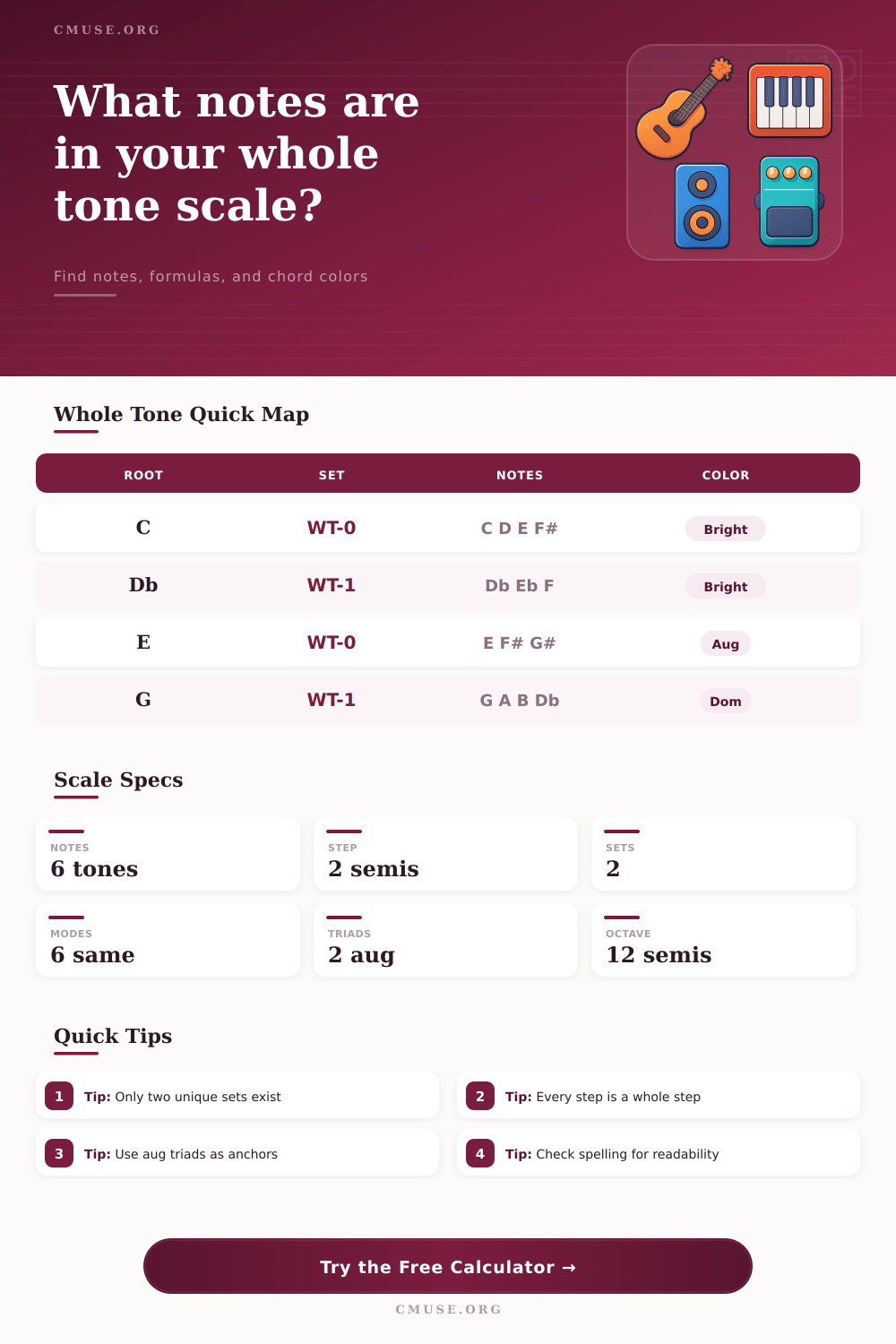
Build either whole-tone collection from any root, choose practical spelling, inspect the six-note formula, compare the complement, and map augmented chord colors for composing, arranging, and practice.
Preset use: Load a real writing or practice scenario, then adjust the root, spelling, octave span, instrument range, and chord focus.
Calculation Breakdown
| Collection | Pitch Classes | Example Spellings | Useful Anchors |
|---|---|---|---|
| WT-0 | 0 2 4 6 8 10 | C D E F# G# A# or C D E Gb Ab Bb | C+, D+, E+, F#+, Ab+, Bb+ |
| WT-1 | 1 3 5 7 9 11 | Db Eb F G A B or C# D# F G A B | Db+, Eb+, F+, G+, A+, B+ |
| Complement rule | Opposite parity | Every missing chromatic pitch forms the other set | Switch sets by moving any note up one semitone |
| Modal rule | Same interval loop | All rotations keep 2-2-2-2-2-2 | No unique modal names are needed |
| Root | Scale Notes | Complement | Common Chord Color |
|---|---|---|---|
| C | C D E F# G# A# | Db Eb F G A B | C augmented, C7#5, C9#5 |
| Db | Db Eb F G A B | C D E F# G# A# | Db augmented, Db7#5 |
| E | E F# G# A# C D | F G A B Db Eb | E augmented, E9#5 |
| G | G A B Db Eb F | Ab Bb C D E Gb | G7#5, G9#5, G whole tone |
| Bb | Bb C D E Gb Ab | B Db Eb F G A | Bb augmented, Bb7#5 |
| Scale Degree | Semitone | Whole-Tone Function | Chord Use |
|---|---|---|---|
| 1 | 0 | Tonic anchor | Root of augmented or altered dominant chord |
| 2 / 9 | 2 | Open upper color | Dominant 9 color without a perfect fifth |
| 3 | 4 | Major third | Defines augmented dominant brightness |
| #4 / b5 | 6 | Tritone color | Dominant alteration and symmetrical tension |
| #5 / b6 | 8 | Augmented fifth | Core augmented-triad identity |
| b7 | 10 | Dominant pull | 7#5, 9#5, and altered dominant voicings |
| Instrument View | Best Window | Practical Output | Reading Note |
|---|---|---|---|
| Piano keyboard | Two-octave run | Alternating whole steps across the octave | Check enharmonic spelling before notation |
| Guitar standard tuning | Compact one-position | Two frets apart on a string, shifting across strings | Use root positions before speed patterns |
| Bass standard tuning | Compact one-position | Symmetric two-fret shapes with register control | Keep low notes clear under altered dominants |
| Bb saxophone part | Upper-register color | Written pitch is a whole step above concert pitch | Transpose concert roots carefully |
| Violin family strings | Full span from inputs | Even shifts and augmented arpeggio anchors | Use position markers for clean intonation |
The whole tone scale contain six different note, and all of the intervals between those notes within the scale are whole steps. Most musical scale contain seven notes, but the whole tone scale only contains six notes. Because the whole tone scale only moves in whole steps, there is no major or minor sound to the scale.
The whole tone scale is symmetrical, and this symmetry of the scale create a sound that is ambiguous and floating. Many musician use the whole tone scale within jazz music and within film music. There is two distinct whole tone collections within the scale, and each collection contain every chromatic pitch within that collection.
How the Whole Tone Scale Works
The calculator will determine which whole tone collection you will use based off your selection of root note. Furthermore, the calculator will shows you an complement set for the scale and the number of augmented triads that exist within that collection of whole tone notes. The way that you spell the notes within the whole tone scale is essential for the player.
If the player is reading music that use flats, the player will process flats more quickly. However, if the player is reading music that uses sharps, then that player will process the sharp notes more easy. The calculator will allow you to choose between sharp notes, flat notes, mixed notes, or automatic note selection.
Although the sound of the scale will not change, the player can read the notes more quick by selecting the proper spelling. Within the whole tone scale, each mode sound the same due to the even interval between each note. The chord color under the whole tone scale will change depending on what note you start the scale on.
For instance, if you started the whole tone scale on the third degree and played it over a dominant seventh chord, you will get a sharper five sound. The degree selector will change the starting point for the scale, but the collection of whole tone notes will remain the same. The settings for the instrument range and practice window will allow you to make the whole tone scale more practical for playing.
For guitar player, the range will be limited to one position on the guitar fretboard. For piano players, the notes will span two octaves. The output from the calculator will change based on the instrument that you choose to display the whole tone scale for.
This will make the whole tone scale more practical for playing on you’re chosen instrument. The symmetry of the whole tone scale may cause the player to overuse this scale. Long even runs of the scale may sound mechanical since each interval within the scale sound the same.
To avoid this sound, many musician use augmented triad within their playing. The tables on this calculator will assist you in understanding the various augmented triads and there function within the whole tone scale. One of the most common mistake that musicians make with the whole tone scale is to treat it as if it is a seven-note scale.
If you use a passing tone within the whole tone scale, you will break the symmetry of the scale. If you use one of the scale notes as a leading tone to the next note in the scale, you will break the symmetry of the scale. Within the whole tone scale, you should of accept the limit of six notes.
Each note that is missing from the scale belong to the other whole tone collection. The two collection are merely one semitone apart from each other. The whole tone scale is most effective when used as a temporary color within a musical composition.
Using the scale over a dominant chord will create tension for the listener. That tension can then be resolved into a more stable chord for the listener. The calculator will display to you the note that will be used in the whole tone scale along with any chord anchor for that scale.
Once you understand the two whole tone scale collections and the augmented triads within each collection, youll be able to effectively use the whole tone scale by choosing the proper timing and placement for each note within the scale.