Whammy Dive Pitch Calculator
Estimate the dived note, pitch ratio, bridge travel, tremolo range, and return-to-pitch accuracy for guitar whammy bar dives.
| Bridge type | Typical dive range | Recovery behavior | Best whammy use |
|---|---|---|---|
| Vintage 6-screw Strat trem | 400-700 cents | ±8 to ±15 cents | Blues dips, classic dives |
| Modern two-point trem | 500-900 cents | ±5 to ±10 cents | Smooth lead dips |
| Floyd Rose locking trem | 1200-2400 cents | ±2 to ±6 cents | Octave bombs, squeals |
| Bigsby vibrato | 80-250 cents | ±5 to ±12 cents | Chord shimmer |
| Jazzmaster/Jaguar vibrato | 150-350 cents | ±7 to ±14 cents | Wide offset dips |
| Kahler cam trem | 800-1600 cents | ±3 to ±8 cents | Controlled deep dives |
| Wilkinson VS-style trem | 600-1100 cents | ±4 to ±9 cents | Flutter and modern dips |
| Drop amount | Cents | Frequency ratio | Musical result from E4 |
|---|---|---|---|
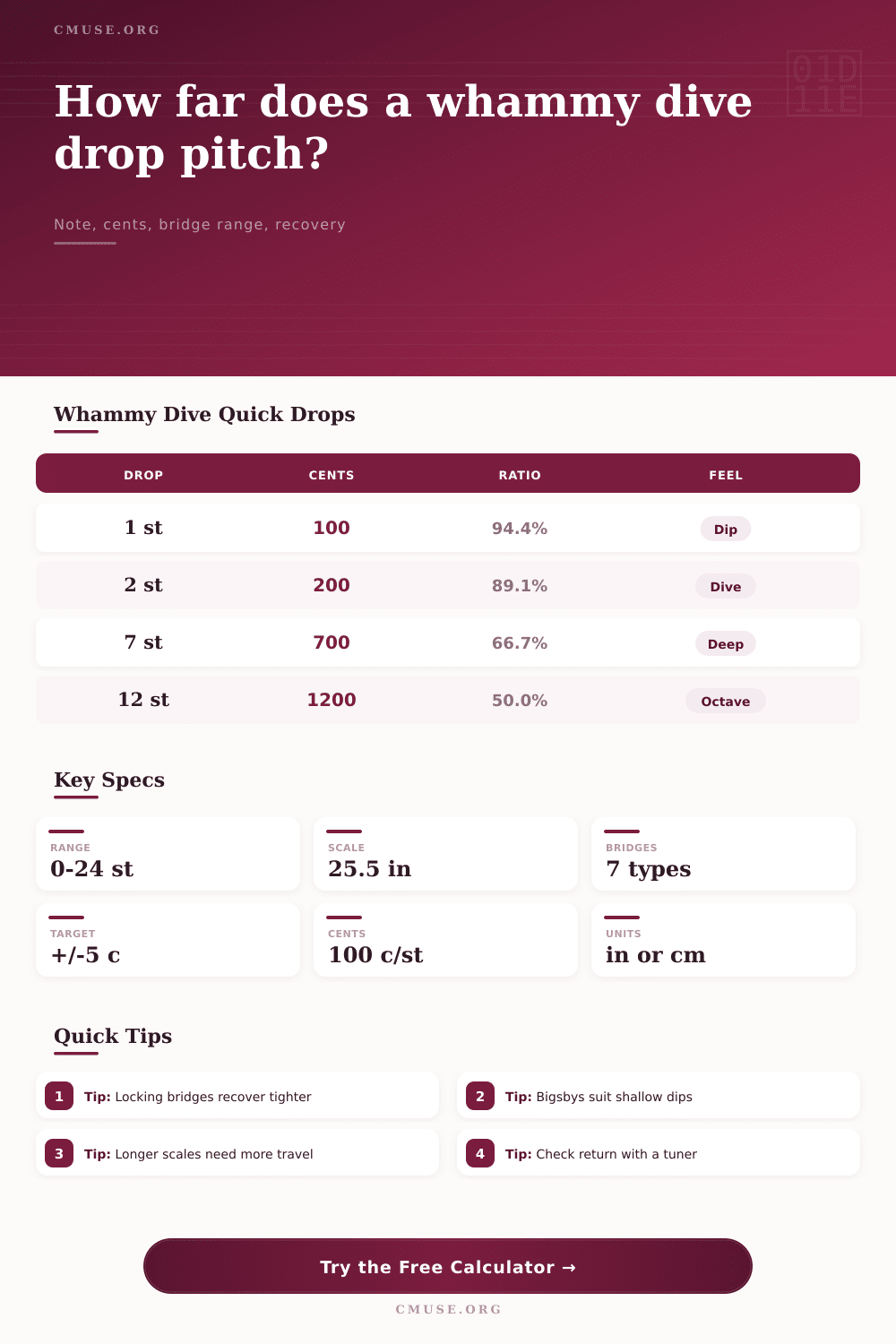
| Half step | 100 | 94.39% | D♯4 / E♭4 |
| Whole step | 200 | 89.09% | D4 |
| Perfect fourth | 500 | 74.92% | B3 |
| Perfect fifth | 700 | 66.74% | A3 |
| Octave dive | 1200 | 50.00% | E3 |
| Two-octave dive | 2400 | 25.00% | E2 |
| Instrument scale | Length | Travel feel | Dive planning note |
|---|---|---|---|
| Short scale guitar | 24.0 in / 61.0 cm | Less arm travel | Fast dips feel sensitive |
| Gibson-style scale | 24.75 in / 62.9 cm | Moderate travel | Good for smooth semitone dips |
| Fender-style scale | 25.5 in / 64.8 cm | Reference travel | Common Strat and offset baseline |
| Baritone scale | 27.0 in / 68.6 cm | More arm travel | Needs extra range for same cents |
| Long baritone scale | 30.0 in / 76.2 cm | Highest travel | Deep dives can bottom out early |
| Preset | Start note | Drop target | Bridge choice |
|---|---|---|---|
| Surf E4 two-step dip | E4 | 200 cents to D4 | Vintage Strat trem |
| Strat G4 deep dive | G4 | 700 cents to C4 | Vintage Strat trem |
| Floyd E4 octave bomb | E4 | 1200 cents to E3 | Floyd Rose locking trem |
| Bigsby B3 chord sag | B3 | 100 cents to A♯3 | Bigsby vibrato |
| Jazzmaster A4 shoegaze dip | A4 | 250 cents near F♯4 | Jazzmaster/Jaguar vibrato |
| Kahler C5 lead plunge | C5 | 900 cents to D♯4 | Kahler cam trem |
How a whammy bar works. Unless you know the tension, scale length, and leverage on your dive, it’s going to be muddy. Not only that but sometimes, you’ll keep your guitar sharp and has to retune when ready to play again.
This calculator takes away all guesswork in finding out whether or not your set-up can pull off whatever music you’re thinking about. How far do you need to push the bar? What type of bridge does your guitar have? This calculator use all those details to find the exact note you’re going to get.
How to Use This Whammy Bar Calculator
When most player consider dive depth they do so in terms of semitones. However, cents and physical travel distance matter to the mechanism. That half step dip is not the same as a three-tone plunge. This happens because of amount of tension being released by string. It also depends on distance the bridge must move backwards before meeting backplate of guitar. These are the variables that make a difference, all represented by the input fields.
Your starting point is set at octave and starting note. To further focus on accuracy, there are field for semitones and cents drop. If you want to dive down hard on clean perfect fifth or land softly on a sloppy microtone in-between two notes, you can dial it in here.
Tremolo system choice is also key. Not all tremolo systems is mechanically equal. Some tend to bind with limited range like a vintage six screw Stratocaster tremolo. Others offer huge dives with accurate return, like a double-locking system. All of this are considered in the calculator’s estimate of how far you might go.
The other variable is scale length. Because as the string moves through the span its tension changes more gradualy over distance; hence longer scales necessitate increased arm travel to produce same amount of pitch drop. To play the same note on a long-scale baritone guitar requires far greater physical push than an offset with short scale. In other words, if the range isn’t accounted for it can mean you’re going to bottom out the bridge sooner.
The third factor here is string gauge. Heavier strings makes shallow dips feel stiff and deep dives feel dangerous. These factors go into the tool to give you a real view of what your bridge will recover from and where in its range it can be used. The numbers take shape when viewed in context, like looking at the reference tables. Two hundred cents is about all that a Bigsby vibrato was designed to do; it’s a subtle shimmer. Twelve hundred or more cents is not out of the question for a locking trem. Attempting to make a Bigsby perform an octave dive will strip your intonation and have you retuning each and every chord.
How close do you get back to tuning? That’s what the recovery accuracy metric reveals. For lead playing, you’re generally okay with a variance of plus or minus five cents. Any bigger than ten cents and you’ll be aware of how the pitch sag on sustained notes.
For those looking for quick recreations of classic tones, the presets built into the interface are a time saver. Load up an octave bomb for metal or a surf rock dip and see whether it’ll work with your current guitar setup right off the bat. If you see that your dive won’t even come close to the typical range of the bridge, then it’s time to either change some strings or loosen up your spring tension before trying it out.
It would of been better to know what your equipment can handle on-screen than to find out when your string snaps during a solo. Getting this stuff under your belt changes random experimentation into purposeful tone crafting. Control is just as much a part of the whammy dive as depth. There’s no point in diving if you don’t know exactly what’s coming out the other end.
String tension, hand position, bridge, all must be known deeply so you can operate confidentely. The bar stops feeling like a loose lever. Instead it feels like an extension of your fingers. You’re not fighting the guitar anymore; you’re playing it. That first choke on the nut is now just a memory. In its place is something smooth and predictable, pitch bends that land precisly where you’d intended.