Warmup to Workout Time Ratio Calculator
Plan musician practice load by balancing warmup minutes, technique work, repertoire time, intensity, fatigue, and instrument demands.
Session Breakdown
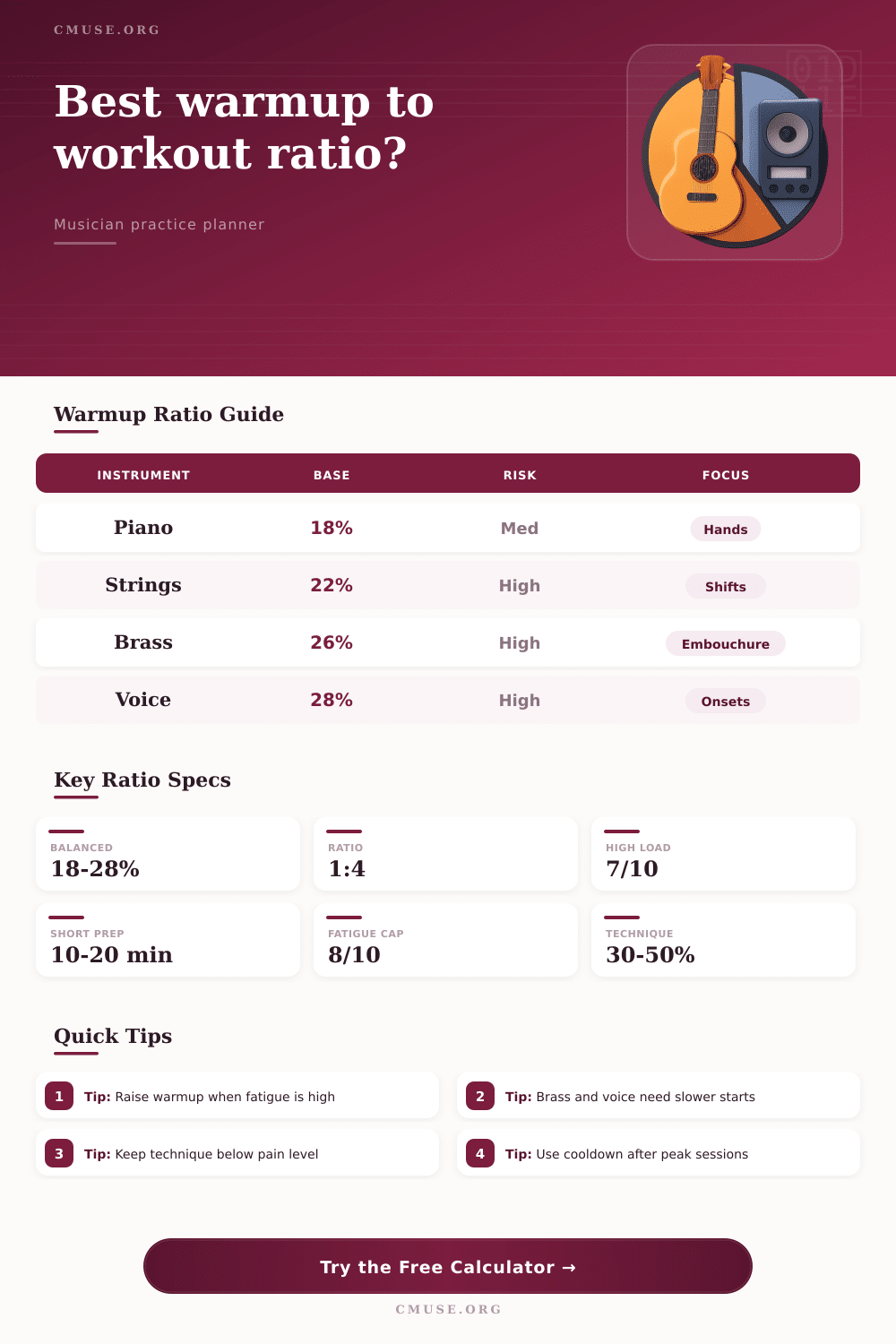
| Instrument family | Base warmup target | Primary stress point | Planning note |
|---|---|---|---|
| Piano / keyboard | 16-22% of workout | Fingers, wrist, forearm | Scale speed should rise gradually before octave or repeated-note work. |
| Violin / viola | 20-27% of workout | Left hand, bow arm, neck | Slow shifts and bow changes make the first 10 minutes more useful. |
| Cello / double bass | 22-30% of workout | Shoulder, back, large shifts | Use open strings and easy extensions before heavy thumb or position work. |
| Guitar / bass | 16-24% of workout | Frets, picking hand, posture | Sync right and left hands before bends, barre work, or fast passages. |
| Woodwind | 21-29% of workout | Breath, embouchure, fingers | Long tones and middle-register slurs usually precede articulation drills. |
| Brass | 24-34% of workout | Lips, air support, range | Higher range or loud playing pushes the warmup ratio upward quickly. |
| Voice | 25-36% of workout | Vocal folds, breath, resonance | Start with gentle phonation before sustained high, loud, or text-heavy work. |
| Percussion | 17-25% of workout | Wrists, shoulders, rebound | Move from rebound control to power, speed, or large-instrument movement. |
| Session load | Intensity and fatigue | Suggested ratio | Use when |
|---|---|---|---|
| Light maintenance | Intensity 1-4, fatigue 1-3 | 1:6 to 1:5 | Short review, easy reading, slow technique, or relaxed tone work. |
| Balanced practice | Intensity 4-6, fatigue 2-5 | 1:5 to 1:4 | Normal daily work with both technique and repertoire in the same block. |
| Heavy technical day | Intensity 6-8, fatigue 4-7 | 1:4 to 1:3 | Speed, range, endurance, big leaps, loud dynamics, or difficult passages. |
| Peak or tired day | Intensity 8-10 or fatigue 7-10 | 1:3 to 1:2.5 | Performance day, recording day, recovery practice, or accumulated load. |
| Preset scenario | Warmup | Workout split | Why the ratio changes |
|---|---|---|---|
| Piano audition run | 24 min | 40 technique / 80 repertoire | Long repertoire pass with high accuracy pressure and repeated starts. |
| Violin orchestra rehearsal | 25 min | 35 technique / 95 repertoire | Bow arm endurance, shifting, and a long ensemble call raise the baseline. |
| Brass gig prep | 28 min | 20 technique / 65 repertoire | Embouchure and range work need a slower ramp than the minutes suggest. |
| Voice recital day | 32 min | 18 technique / 70 repertoire | Vocal fatigue risk makes gentle onset and resonance work more important. |
| Woodwind doubling call | 26 min | 28 technique / 75 repertoire | Instrument switches add embouchure and finger setup time. |
| Technique share | Repertoire share | Ratio clue | Adjustment idea |
|---|---|---|---|
| Under 25% | Mostly repertoire | Warmup can stay moderate | Add targeted pattern work only for the hardest passages. |
| 25-45% | Balanced | Use the instrument baseline | Have warmup mirror the main motions used later in the workout. |
| 45-65% | Technique-heavy | Add 2-6 warmup minutes | Keep the first technical pass slow enough to remain relaxed. |
| Over 65% | Drill-focused | Warmup becomes protection | Break the workout into smaller waves with short resets between them. |
This protects your method because it eliminates any guess work in terms of preparing for performance. To see how long you should be warming up try our tool below. The calculator handle the math for you once you plug in your instrument type and intended intensity.
Musicians generaly estimate their preparation time either by habit or by how much daylight they have left. Neither is a reflection of physical reality. Try out our calculator now and see if you really have enough time to prepare for job in hand.
Why You Need a Good Warm-up
So the concept here is this: Warmup IS practice. It is the part of the workout that prepares the body to stay safe during the risky part. You plan on working hard in your practice, leaping around, playing fast, and using lots of muscle? Then you should increase the ratio of warmup to workout. If all you’re doing is running through some easy piece, then maybe ten minutes of scales is fine. Now the load isn’t as much than it would be if you were pushing for endurance or range.
The body doesn’t know what you intend to do, only how much it has been asked to do. The baseline differs based off the instrument too. For example, because the tissues they involve can take longer to recover and are more delicate, brass and vocal performers typically requires a larger ratio. Likewise, where a pianist may benefit most from working on their finger independence, a violinist could gain more from extra focus on how they use their bow arm. These instrument specific requirements is accounted for by the tool without having to remember each individual physiological detail.
What it will also consider is how fatigued you feel right now. This is often the most ignored factor when thinking about practice planning. If you haven’t been sleeping well or just came home from work, your normal warmup could be half of what you should of really be doing that day. The intensity flags are important because unprimed nerves and cold muscles don’t respond well to shock loads. The calculator will probably tell you that if you want to play high and loud for a long time, add more warmup minutes. That’s not soft on yourself; it’s physics and biology. You’re basically priming the machine before asking it to rev its engine at full speed.
When you see practicing in this light, it makes sense: the reference table on the page reveals that as an athletic event rather than a mental download, the ratio targets shifts (one-to-three for peak performance days versus one-to-six for easy listening). It also changes the balance in terms of technique work, which can’t be practiced safely on cold finger. If you’re doing a lot of fast runs or arpeggio drills during your session, that’s technique work and that counts towards the total workload that needs to be warmed up. You can use the tool to help determine whether the technique share is too high given the amount of prep time allotted. Seeing those numbers out of whack is a clue to back off the tech demand or add more time to the warmup until you’re properly primed. It becomes a feedback loop for sustainable playing.
It also gets lost in recovery days, where the lingering fatigue isn’t evident until pushed past its limits. Your body is dealing with accumulated fatigue from a lack of rest, and it’s impacting your performance. This one consider recent rest history, adjusting the recommendations based on what the body needs. It’ll help avoid the common trap of assuming every Tuesday = every Saturday, despite what your body says. Establishing a baseline is harder than just collecting data, but it makes it easier to trust your intuition instead of fighting it.
Your preparation ration is a form of long term preservative. Not only do you intend to sound good today but in ten years’ time as well. The mechanics by which you create the music can’t afford to wear out so match your preparation with real need. That quiet prelude to performance remains enjoyable but now leads somewhere safe. You’ve prepared yourself physically for what you’re going to ask of your body.