Volume Pot Loading Calculator
Estimate how volume pot value, pickup impedance, tone pot and cap, cable capacitance, and parallel loads shape passive guitar and bass high end.
🎛Real Circuit Presets
🎸Pickup And Control Values
Pot Loading Estimate
📊Live Spec Grid
🔌Reference Pot Loads
| Control Layout | Typical Pickup | Nominal Load | Practical Effect |
|---|---|---|---|
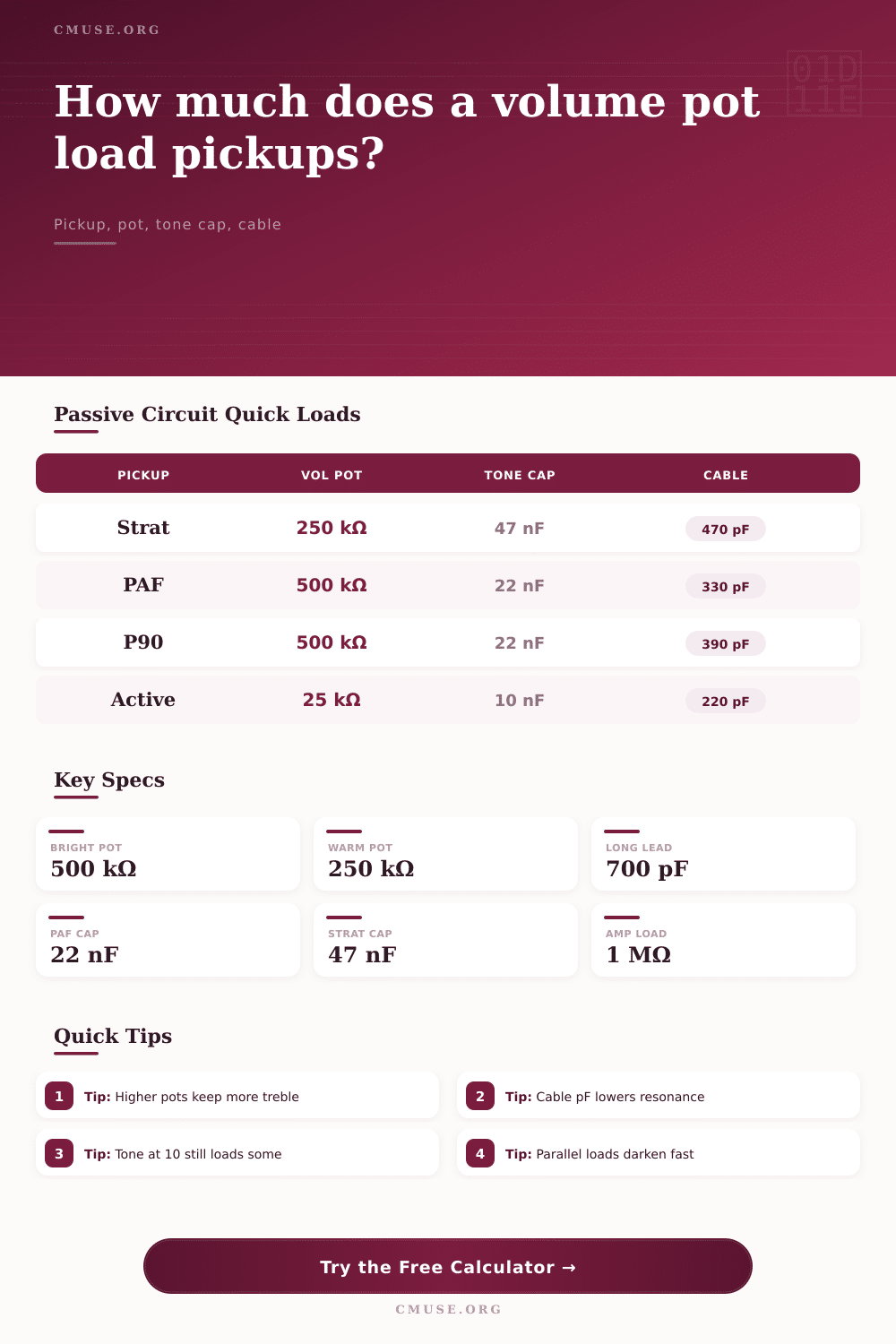
| 250 kΩ volume, 250 kΩ tone | Strat or Tele single coil | About 125 kΩ before amp input | Smooths ice-pick highs and damps resonance |
| 500 kΩ volume, 500 kΩ tone | PAF, P90, Filter'Tron | About 250 kΩ before amp input | Keeps more upper mid bite and pick edge |
| 1 MΩ volume, no-load tone | Very dark passive pickups | Near 1 MΩ with a tube amp | Raises damping resistance for maximum brightness |
| 25 kΩ volume into buffer | Active guitar or bass | Low control resistance, low source impedance | Stable high end because the preamp drives the cable |
💡Tone Cap And Cable Data
| Part Value | Common Use | Electrical Role | Audible Direction |
|---|---|---|---|
| 10 nF tone cap | Bright humbucker rolloff | Higher reactance at guitar frequencies | Leaner, less bassy tone sweep |
| 22 nF tone cap | Humbuckers and P90s | Balanced treble bypass to ground | Classic warm rolloff without excess mud |
| 47 nF tone cap | Strat, Tele, many bass circuits | Lower reactance for stronger high cut | Darker at low tone settings |
| 200 pF cable | Short low-capacitance lead | Raises resonant frequency | Clearer, tighter top end |
| 700 pF cable | Long or high-capacitance lead | Lowers resonant frequency | Softer attack and earlier rolloff |
📝Pickup Starting Points
| Pickup Family | Impedance Range | Inductance Range | Common Pot Pairing |
|---|---|---|---|
| Vintage Strat single coil | 5.6 kΩ to 6.5 kΩ | 2.0 H to 2.8 H | 250 kΩ volume and 250 kΩ tone |
| Tele bridge single coil | 6.5 kΩ to 8.5 kΩ | 2.8 H to 4.0 H | 250 kΩ or 500 kΩ by brightness target |
| Vintage PAF humbucker | 7.2 kΩ to 8.8 kΩ | 4.0 H to 5.5 H | 500 kΩ volume and 500 kΩ tone |
| P90 single coil | 7.5 kΩ to 9.5 kΩ | 5.0 H to 6.5 H | 500 kΩ volume, 250 kΩ for smoother rigs |
| Active bass preamp output | 0.5 kΩ to 2.0 kΩ | Use 0.1 H estimate | 25 kΩ or 50 kΩ controls after buffer |
🎯Cutoff And Resonance Reading
| Estimate | Low Reading | Middle Reading | High Reading |
|---|---|---|---|
| Effective load | Below 100 kΩ: heavy damping | 100 kΩ to 300 kΩ: normal passive range | Above 300 kΩ: brighter and more open |
| Pickup resonance | Below 2.5 kHz: warm or dark | 2.5 kHz to 4.5 kHz: familiar guitar range | Above 4.5 kHz: glassier top end |
| RC cutoff | Below 20 kHz: cable and load are audible | 20 kHz to 60 kHz: normal passive loading | Above 60 kHz: little simple RC loss |
| Q estimate | Below 0.7: very damped peak | 0.7 to 1.5: controlled resonance | Above 1.5: stronger resonant emphasis |
ℹPractical Notes
So you changed the pickups, retuned the strings, inspected your amp’s tubes. Still, something isnt right. The tone sounds off, either too muffled or not as sharp as it should of be. Something must be wrong with the wiring… And that is the problem; you don’t want to mess up an unknown factor by starting to guess.
More likely than not, the issue involve the interaction between the pickup coil and the volume pot, tone controls and cable that loads it. It’s a behind-the-scenes circuit interaction that determines if your guitar sounds more dark or bright. Every passive magnetic pickup acts like a generator with its own internal resistance and inductance, i.e., they behaves as an electric circuit. Connecting them to whatever follows the jack plug alters that electric signature based off the impedance on the receiving end. Pot values, cable capacitance, input load and source impedance combine to provide the result. It demonstrates just how much treble your system removes before you solder anything.
How Guitar Wiring Affects Your Tone
It all begins with the volume potentiometer. A 500 kilohm pot loads single coil pickups less heavily then a 250 kilohm version. A 250 kilohm pot rolls off high frequencies faster, creating that classic warm Stratocaster sound. But if left uncompensated elsewhere, it can make your bright humbuckers sounding dull. With this tool, you’re able to experience both situations side-by-side without having to switch out any of your hardware.
So here you’re seeing how switching from a 250 kilohm to 500 kilohm pot restores clarity to your passive humbucker rig. Or you could experience what might make a vintage PAF pickup sound too brittle with a 1 megohm pot.
Many players are unaware that cable capacitance can be a major reason for tone problems. High-capacity cable is typically inexpensive and if there’s a long run of it, it will dampen the resonance peak of your pickups. It’s that resonance peak that provides the musical richness and character of your guitar’s voice. Adding capacitance lowers that resonance peak to the point where you experience a loss of attack and definition. As little as a couple hundred picofarads can make a dramatic change in tonal balance.
The next level of complication comes by adding a tone control, as they are never completely disconnected from the circuit. Even turned all the way up to ten, they will have some shunting of higher frequencies to ground via the potentiometer and its tone capacitor. That additional loss add up over time against other loads in the system. The calculator uses this residual loading to provide a more precise brightness index. This helps explain why it is sometimes better to roll off the tone slightly instead of leaving it wide open on heavily loaded circuits.
Pickups are dynamic transducers; they interact with the loads placed upon them. They are not just a single piece unto themselves. Many players makes the mistake of concentrating solely on the pickup. In reality, substituting a different cable can have a greater impact on tone than replacing a pickup from the same family. There is a reason behind this, and that reason comes down to simple electronics. By doing so, you change the total amount of resistance and capacitance present in the system. It becomes an LCR circuit and the coil resonate at a new frequency dependent on these parameters. This changes the location of the fundamental harmonic in relation to the cutoff of the filter.
Now, I’m no electrical engineer, so don’t worry, you’re not going to have to become one to handle all of this. Effective load represents how hard the circuit is fighting the coil. Cutoff estimates represent where your highs begin to roll off. And resonance is where your tonal peak are. When your effective load is really low, you’ll lose sustain and hear some compression. When it’s too high, you may get some fizz or other unwanted noise. The sweet spot comes from finding a balance between these elements and the impedance of your amp’s input.
Most tube amps offer a fairly transparent 1 Megohm of input impedance. Pedals that is in your chain will frequently have far lower input impedances though. Active buffers and analog overdrive effects in particular tend to be quite low. Even with perfectly good guitar wiring, they can make your signal suddenly dark. With the tool you can include any other parallel loads that may exist as well.
Suddenly the parts of your signal chain become real decisions regarding how clear the sound is. You’ll see where there might be hidden bottleneck in your signal chain. Not all great tone is created with great gear. The electrical environment, defined by wiring choices, shapes your sound just as much as the pickups themselves. A knowledge of how these components interact, caps, pots and cables, gives you control over the frequency spectrum prior to preamp.
The key lies in knowing exactly what’s being measured on the other side of the panel. When you know how the numbers relate to real world tone, you’re no longer guessing. You’re designing. The signal path isnt an accidental compromise; it’s a conscious choice.