Voltage Gain dB Calculator
Convert audio or electronics voltage gain into dB, voltage ratio, output level, attenuation, headroom margin, power ratio, and multi-stage gain totals.
Voltage gain uses the 20 log rule: select a real signal chain starting point, then adjust the voltages, impedance, stage trims, and clipping reference to match your circuit or audio path.
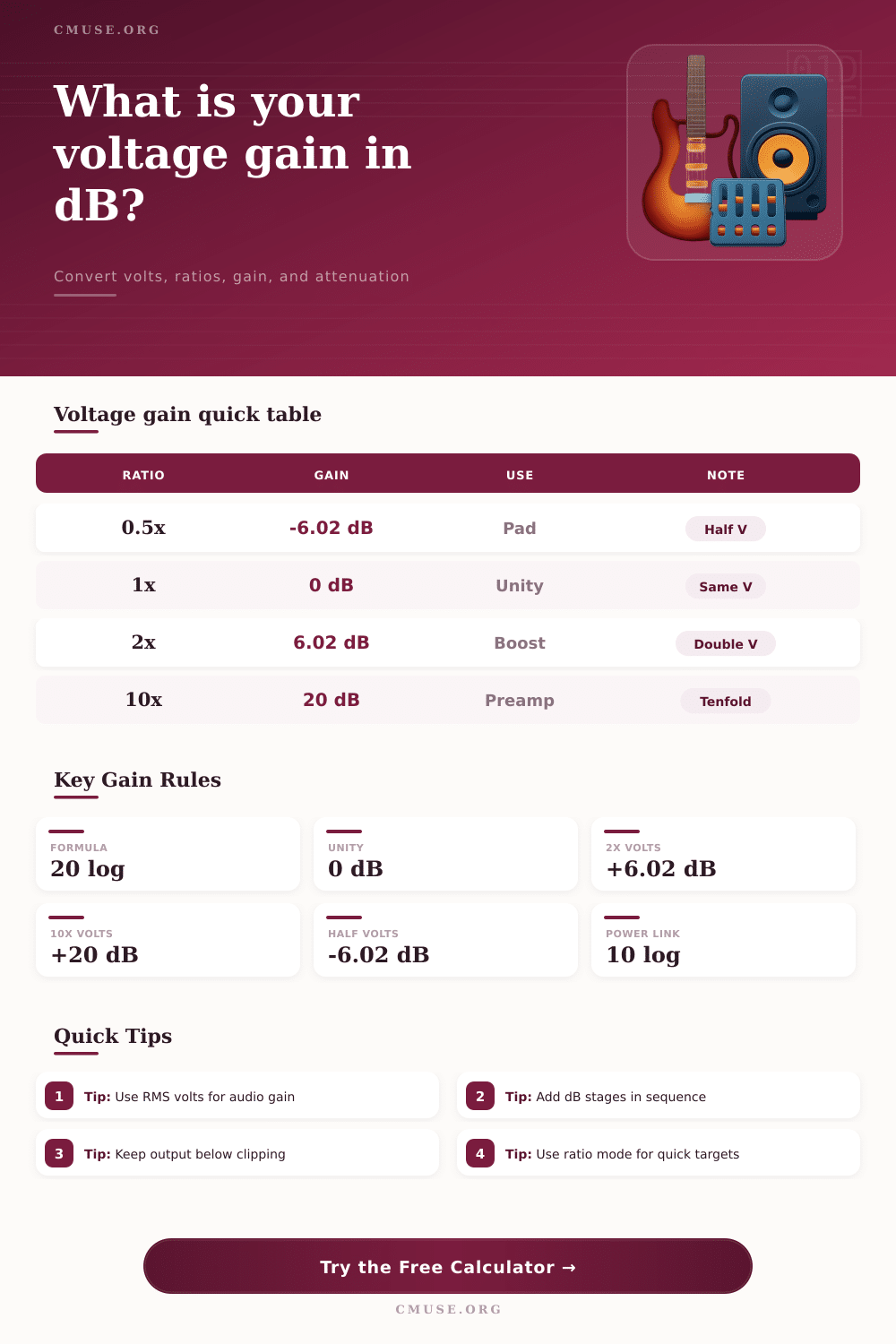
Formula: voltage gain in dB = 20 x log10(output voltage / input voltage). Power ratio uses the same load assumption and is shown for comparison only.
| Voltage ratio | Gain in dB | Power ratio | Typical signal-chain meaning |
|---|---|---|---|
| 0.100x | -20.00 dB | 0.010x | Heavy pad or attenuator before a hot input. |
| 0.250x | -12.04 dB | 0.063x | Moderate instrument or synth attenuation. |
| 0.500x | -6.02 dB | 0.250x | Half-voltage pad or trim move. |
| 1.000x | 0.00 dB | 1.000x | Unity gain with unchanged voltage. |
| 2.000x | 6.02 dB | 4.000x | Double voltage boost in a line or pedal stage. |
| 3.162x | 10.00 dB | 10.00x | Noticeable gain lift or makeup stage. |
| 10.00x | 20.00 dB | 100.0x | Strong preamp or active line amplifier gain. |
| 100.0x | 40.00 dB | 10000x | Microphone preamp gain for low-level sources. |
| Reference level | Voltage RMS | dBV | Where it appears |
|---|---|---|---|
| -60 dBV | 0.001 V | -60.00 dBV | Very low microphone or sensor signal. |
| -40 dBV | 0.010 V | -40.00 dBV | Quiet microphone preamp input region. |
| -20 dBV | 0.100 V | -20.00 dBV | Instrument pickup or low consumer source. |
| -10 dBV | 0.316 V | -10.00 dBV | Consumer line-level reference. |
| 0 dBV | 1.000 V | 0.00 dBV | Convenient voltage reference for gain math. |
| +4 dBu | 1.228 V | 1.79 dBV | Professional line-level nominal reference. |
| +18 dBu | 6.150 V | 15.78 dBV | Common analog interface headroom region. |
| +24 dBu | 12.28 V | 21.79 dBV | High-headroom studio hardware output. |
| Preset | Input voltage | Output voltage | Main gain | Use case |
|---|---|---|---|---|
| Unity Line Stage | 1.000 V | 1.000 V | 0.00 dB | Checking a buffer, interface loopback, or line amp. |
| Consumer to Pro | 0.316 V | 1.228 V | 11.79 dB | Raising -10 dBV gear toward +4 dBu equipment. |
| Mic Preamp 40 dB | 0.010 V | 1.000 V | 40.00 dB | Low microphone signal to line-level region. |
| Passive Pad Loss | 1.228 V | 0.1228 V | -20.00 dB | Reducing hot line level before a sensitive input. |
| Modular Attenuator | 5.000 V | 1.000 V | -13.98 dB | Scaling modular synth voltage to safer line input. |
| Headroom margin | Voltage status | Practical reading | Action |
|---|---|---|---|
| 18 dB or more | Very open | Plenty of voltage room for transients. | Gain can usually be raised if noise floor needs it. |
| 12 to 18 dB | Comfortable | Good studio operating zone for line-level work. | Keep the trim unless noise or clipping says otherwise. |
| 6 to 12 dB | Watch peaks | Usable but transient-heavy sources may get close. | Lower output trim or raise the clipping reference. |
| 0 to 6 dB | Tight | Signal is close to target or clipping voltage. | Reduce gain before printing or feeding another stage. |
| Below 0 dB | Over limit | Output exceeds the entered clipping or target voltage. | Use attenuation, a lower preamp setting, or more headroom. |
Voltage gains in decibels is a figure that you use to manage the communications between two piece of audio gear. Voltage gain in decibels help to ensure that the signal between the two devices are clean and doesnt contain distortion or noise. Microphones tend to create signals with a small amount of voltages.
Line inputs, however, requires more voltage than microphones creates. Without voltage gain in decibels, the signal from microphones may contain hiss on record, or may clip. Voltage gain in decibels use decibels because the human hearing function on a logarithmic scale.
What Is Voltage Gain in Decibels?
Human hearing do not perceive the same change in raw voltage as a change in volume. The calculator allow people to enter the voltages of the input and output device to calculate the voltage gain in decibels of the signal. The resulting voltage gain in decibels is the same unit that can be found on mixing console faders and preamp knobs.
In order to calculate voltage gain in decibels correctly, both the input voltage and the output voltage must use the same type of voltage measurement. For example, the voltage from an oscilloscope may be a peak reading, but the voltage from an audio device may be the RMS value of the signal. Using these two different types of voltage measurements may lead to incorrect calculation of the voltage gain in decibels.
Therefore, people must make sure that both voltages are of the same type prior to using the calculator. Otherwise, the voltage gain in decibels will not match the volume that is heard or as measured by audio meter. Impedance is another factor that can impact voltage gain in audio device.
Impedance is a measurement of the resistance of a circuit to the flow of current. The higher the impedance, the more voltage is need to push the current through the circuit. The calculator includes an approximate calculation of the power ratios in case the device can handle the resulting voltage ratios.
For example, the output impedance of a guitar pedal may change with the impedance of the line output device. Stage trim and pads can also be used to manage voltage gain in audio gear. For example, a microphone preamp may provide 40 decibel of gain, but a pad may be used to reduce 6 decibels of gain.
The decibel calculations of these stage trims and pads can be entered into the calculator to calculate the total voltage gain for the audio chain. Adding decibels will increase the total gain. However, negative decibels will reduce the total gain.
Headroom is the amount of margin between the calculated output of a signal and the voltage that will cause clipping. The reference table provide examples of the voltage gain in decibels of common audio devices and equipment. For example, the table may indicate that many consumer audio devices produces around 20 decibel of gain.
A signal with only a few decibels of headroom will clip and distort if loud sound (like vocals or drums) are played. Gain staging is a process that is performed each time with a new audio source. For example, ribbon microphones typically require more gain than active DI box.
The gain required by a performer will change if they increase the volume at which they play the guitar. The calculator can be used often to calculate the gain that will achieve the desired output without clip. Each stage of audio gear will add some noise to the signal.
Early gain will allow for a greater signal-to-noise ratio because the signal will be less vulnerable to the noise added by the later stages of the audio gear. Increasing the gain later in the audio gear will amplify the noise that all of the previous stage of the audio gear has added. Therefore, voltage gain in decibels will indicate the total gain of all the devices in the audio gear chain, but will not indicate where to place each stage.
Power relationships are based on a logarithmic scale, but use ten times the logarithm rather than twenty times the logarithm. This is most important for device like amplifiers whose output power is rated in decibels. A second use of the calculator is to determine if an audio device can handle a certain load with its headphone.
The voltage gain in decibels is the most important number, though. Voltage gain in decibels can be used to manage audio gear within audio chain. The voltage gain in decibels should always be considered a total gain that must remain within the limitations of each device in the audio chain.
By considering the voltage gain in decibels as a running total, people can more easily make decisions regarding pads, trims, and headroom.