Voicing Spread Interval Calculator
Measure lowest-to-highest chord span, register fit, chord-tone coverage, and close or open voicing character.
♫Voicing Presets
🎼Chord And Range Inputs
📊Current Voicing Spec Grid
📘Voicing Spread Reference
| Spread Class | Semitone Span | Octave Span | Typical Use |
|---|---|---|---|
| Cluster | 1 to 7 | Under 0.6 | Color tones, suspense, dense keyboard writing |
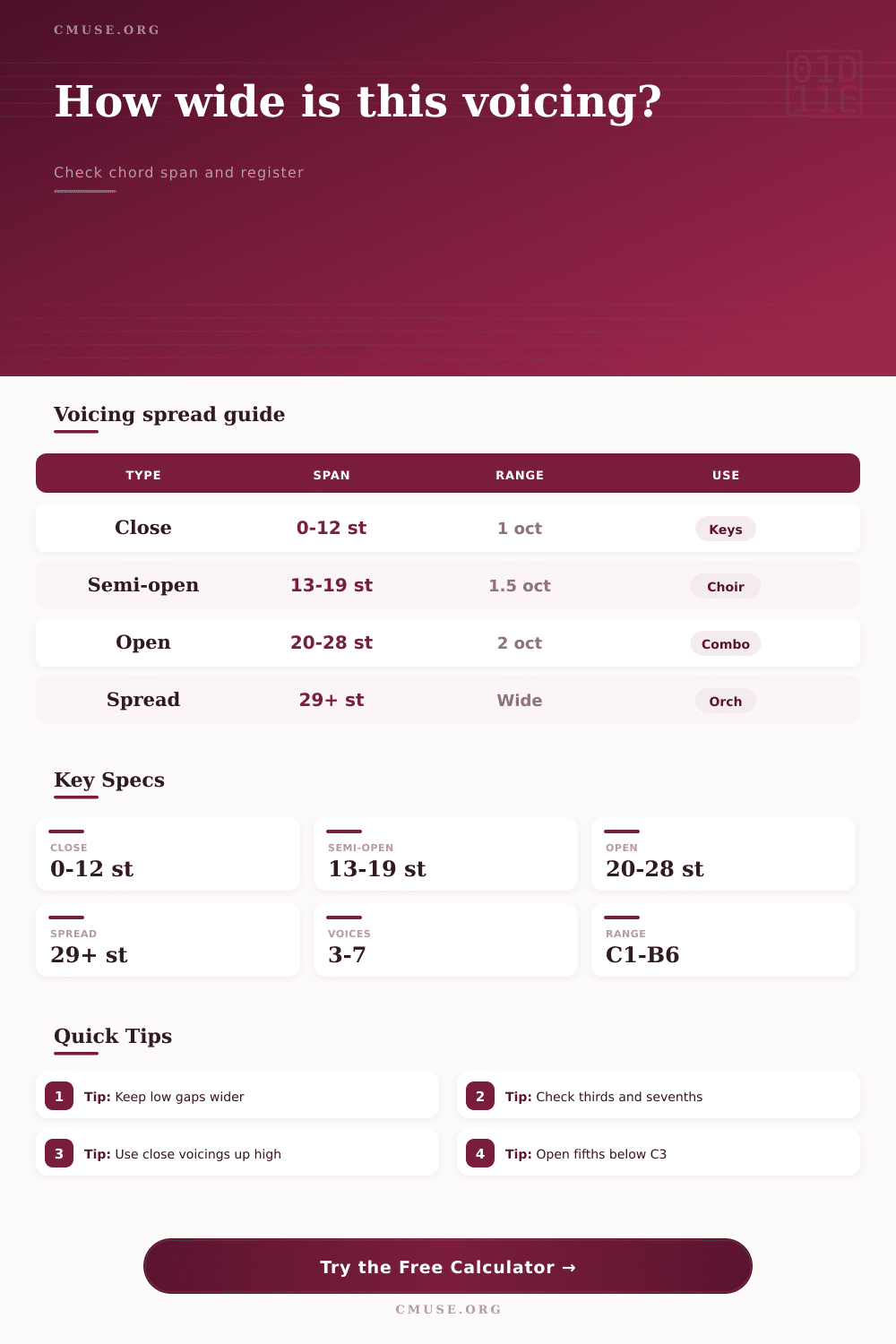
| Close position | 8 to 12 | About 1 octave | Block chords, tight upper-structure voicings |
| Semi-open | 13 to 19 | 1.1 to 1.6 | Choir, small ensemble, compact piano voicings |
| Open position | 20 to 28 | 1.7 to 2.3 | Jazz piano, horn pads, guitar-friendly spacing |
| Wide spread | 29 to 42 | 2.4 to 3.5 | Orchestration, cinematic pads, two-hand piano |
| Extended spread | 43 or more | More than 3.5 | Layered sections, large register contrast |
♯Chord Tone Interval Table
| Tone Role | Major / Dominant | Minor / Diminished | Voicing Note |
|---|---|---|---|
| Root | 0 semitones | 0 semitones | Anchors chord identity unless omitted by style |
| Third | 4 semitones | 3 semitones | Defines major, minor, or suspended color |
| Fifth | 7 semitones | 6 or 7 semitones | Often doubled or omitted in dense jazz voicings |
| Seventh | 10 or 11 semitones | 9, 10, or 11 semitones | Creates guide-tone pull with the third |
| Ninth | 14 semitones | 13 or 14 semitones | Best treated as an upper color above the third |
| Eleventh / Thirteenth | 17 / 21 semitones | 17 / 20 or 21 | Needs enough spread to avoid muddy seconds |
🎹Register Bands
| Register | MIDI Range | Note Range | Spacing Guidance |
|---|---|---|---|
| Low pad | 36 to 55 | C2 to G3 | Use wider intervals, especially fifths and tenths |
| Left hand | 40 to 60 | E2 to C4 | Keep thirds from stacking too low |
| Piano mid | 48 to 72 | C3 to C5 | Close, drop-2, and open shapes all translate well |
| Guitar comp | 40 to 76 | E2 to E5 | Four to six notes with practical gaps |
| Horn section | 53 to 81 | F3 to A5 | Semi-open and drop-2 spreads read clearly |
| High voices | 60 to 88 | C4 to E6 | Close tensions sound cleaner in this band |
🔀Style And Preset Comparison
| Style | Target Span | Inner Gap Aim | Best Fit |
|---|---|---|---|
| Cluster | 1 to 7 semitones | 1 to 2 | Upper register color or dissonant scoring |
| Close position | 8 to 12 semitones | 2 to 5 | Block chords and locked-hand piano voicing |
| Drop-2 | 16 to 26 semitones | 3 to 8 | Guitar, brass, sax section, jazz piano |
| Drop-3 | 20 to 31 semitones | 4 to 10 | Deeper guitar and piano left-hand spread |
| Quartal | 15 to 30 semitones | 5 to 7 | Modern modal harmony and suspended colors |
| Wide spread | 29 to 42 semitones | 6 to 14 | Two-hand voicings and orchestrated pads |
📝Practical Voicing Tips
If distance from top note to bottom note in a chord is not right then chords can sound muddy and lack depth. It’s not usually a matter of what notes you choose to play as much as the distance from one to another. We spend hours discussing scales, and theory amongst musicians but very little on actual physical distance of a voicing. It matters a lot.
The calculator above do all the maths for you for range and roots so no need to try and work out conversions or coefficients. The width of a chord give it character. Notes close together in a single octave are dense and immediate. You might use this for upper-register color and maybe a sense of suspension, as the detail sounds important. Bring these close voices down to bass register though, and they become a blob. The low frequencies has long wavelengths that easily overlap. Stack your thirds below middle C, and you will lose definition. Each tone need space to breathe.
Why Space Between Notes Matters
Spread the notes out over an octave or more, and the ear can then hear the harmony clearly. Bands are also key, as knowing where and how to place any given chord in context is vital. What works perfectly played in the middle register of the piano may not hold together when moved an octave or two lower in the left hand as a bass line. By laying out your chord across a range of different possibilities (from a horn section to a guitarist playing a comping line), the tool allow you to see how it will work. Is it going to work acoustically within the space you’ve designated? Does it span enough to be heard clearly but not so much that it’s difficult to play beneath the finger tips?
Drop-two voicings is popular with guitarists because they are easy to play beneath the fingers but still provide enough separation to allow a sense of openness. With their instruments positioned closer together than a pianist’s hands, horns have even greater requirements for space; otherwise, they tend to bleed into one another. The page reference table show typical uses based off span length. Widening a voicing can also be affected by chord tone coverage. You may find that you can’t get the root, third, fifth, seventh, ninth, and thirteenth in a comfortable hand shape so some notes need to go!
The calculator consider what key tones are available inside the boundaries you select. Most importantly for a voicer is the guide tones, the third and the seventh, as they determine the quality of the chord. Lose either one of those and harmony becomes anonymous. Bass can fill the gap where the root should of been. You can often drop the fifth, too. But the third and seventh really matter. If they’re lost, then you’ve not got a minor seven at all but an accidentally created major chord.
Space is another matter of style. The open position chords spanning over an octave (or more) are common in jazz pianos. This creates a lush sound with large spaces between the hands. Contrast this with a choir whose harmonic parts are commonly in four parts and rarely exceed one and a half octaves apart as they blend together. Stretch those out too much and suddenly the voices becomes individual soloists instead of a cohesive block. That’s what the calculator matches against. Are you after a wide orchestral pad or tight cluster?
Managing clarity and energy is key to good voicing. Having too wide a spread can cause a feeling of disconnection between chords that aren’t necessarily leading logically from one to another. Conversely, having too little spread will result in muddiness particularly in lower registers. What you want is enough width to allow the harmonics to ring out but with enough cohesion to anchor the ear. It is a small detail but it matters. If harmony sounds right and each note can be heard, what was once a cluster of keys becomes music. That balance transforms a correct chord into a professional arrangement.