Voice Type Calculator
Compare lowest and highest comfortable notes, tessitura, range span, and passaggio clues against classical voice-type ranges for practical singer classification.
🎤 Named Range Presets
⚙ Range, Tessitura, and Passaggio Inputs
📊 Current Voice Spec Grid
🎼 Classical Voice-Type Comparison
| Voice Type | Typical Range | Tessitura Focus | Passaggio Area | Fit Score |
|---|
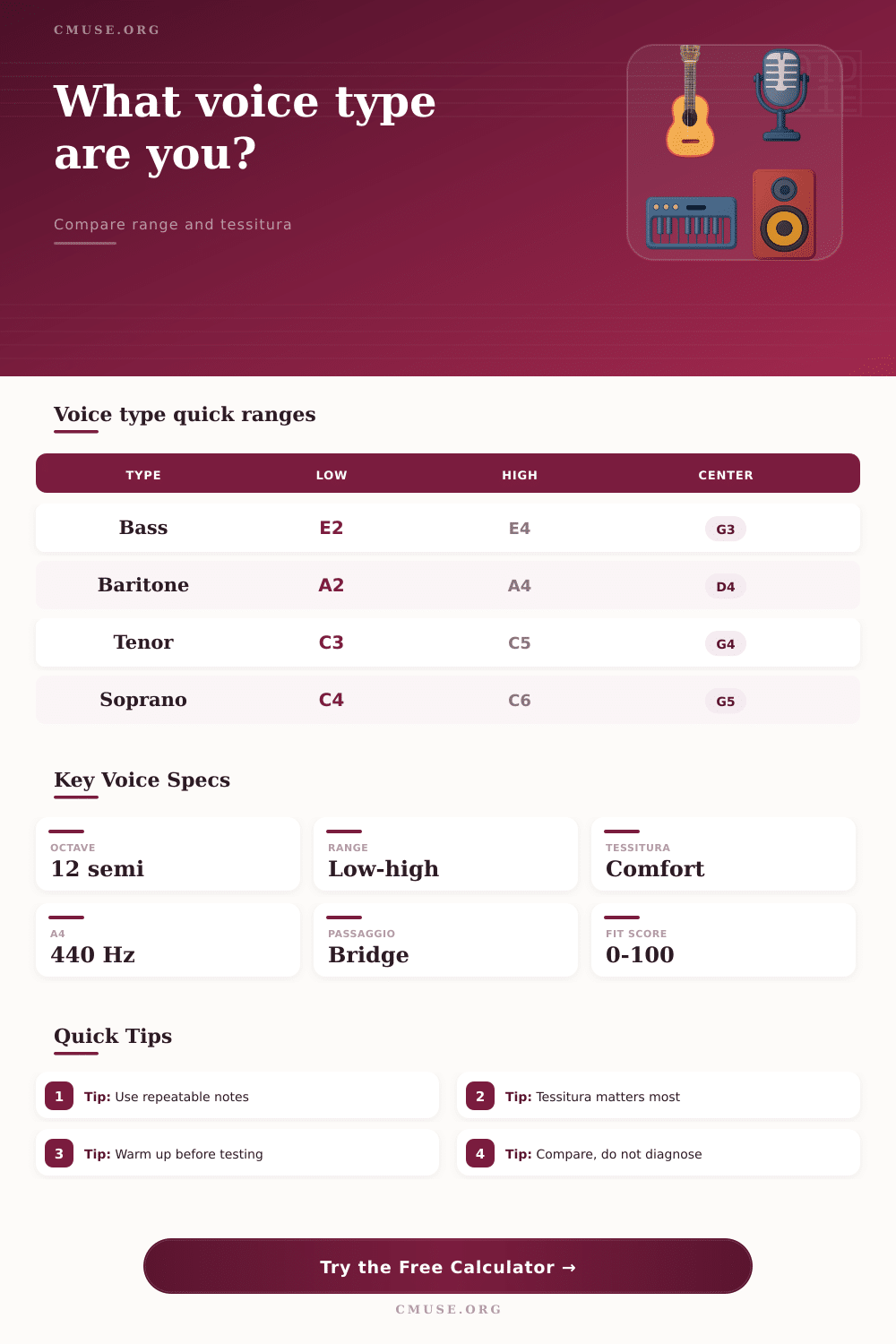
🎙 Standard Range Reference
| Type | Low | High | Center | Common Use |
|---|
🔀 Preset Range Table
| Preset | Comfort Range | Tessitura | Passaggio | Closest Type |
|---|
📋 Passaggio and Frequency Table
| Checkpoint | Note | Frequency | Interval From C4 | Meaning |
|---|
A voice type calculator is an tool that allows singer of all ages to determine the classification of their voice. Using a voice type calculator is a helpful tool because determining one’s voice type can be a complex process. Many singer believe that the highest note that a singer can reach are the determining factor in categorizing an individual singer’s voice into a specific voice type.
However, this is not the case; the highest note that a singer can produce is not the only factor that determines an individual’s voice type. A voice type calculator gather multiple data points about an individual singer to determine the voice type that best suit the singer’s vocal abilities. The first data point that a singer provide to a voice type calculator is their vocal range.
How a Voice Type Calculator Helps Singers
A singer’s vocal range is the range of notes that an individual can comfortabley singing. Notes that a singer can sing repeatedly without strain are consider to be the singer’s comfortable notes. A singer may be able to reach the highest and lowest notes that their voice can produce after performing a warm-up routine for their vocal cords; however, those high and low notes are not part of an individual’s vocal range.
A voice type calculator considers the entire vocal range for an individual; however, it also recognizes that the middle portion of a singer’s vocal range is more important than the highest and lowest notes that they can produce. The second data point that a singer provides to a voice type calculator are their tessitura. Tessitura is the portion of a singer’s vocal range where they spend the majority of their singing efforts.
Tessitura is the portion of an individual’s vocal range that they naturaly sing in; they may have a vast vocal range, but their tessitura may be relatively narrow. By determining an individual’s tessitura, a voice type calculator can determine which musical roles an individual can produce and their choral part. Finally, the third data point that a singer provides to a voice type calculator is their passaggio notes.
Passaggio notes are the vocal notes that connect one portion of a singer’s vocal range to another portion of their vocal range. These notes allow singers to transition from one register of their vocal range to another. They also provide clues as to whether an individual vocalist have a tenor, baritone, soprano, or mezzo-soprano voice type.
A voice type calculator uses passaggio notes to help separate vocal types that has similar ranges. Additionally, the voice type calculator also allows for vocal weight and vocal timbre to be entered. Vocal weight determine how heavy or light an individual’s voice is.
This can act as a tiebreaker for singers whose vocal ranges are similar but whose vocal weights indicates a different vocal type. For example, an individual may have the vocal range of a light vocalist but possess the vocal weight of a heavy vocalist. Vocal timbre is another factor that can impact an individual’s vocal type, which is why the voice type calculator also allow for this factor to be entered.
Additionally, the voice type calculator provides a snapshot of an individual’s vocal type at a specific moment in time. However, vocal type isnt permanent. Vocal training can alter an individual’s tessitura or passaggio notes.
Therefore, if an individual change their training or vocal technique, their results from the voice type calculator can change as well. Thus, the voice type calculator is a tool to be used for comparison only. These reference tables feature the standard vocal range and passaggio notes for each classical vocal category.
These tables can be used to compare an individual’s vocal trait to the standard traits of each vocal type. The voice type calculator compares an individual’s vocal traits to the data in these tables to provide an individual with an understanding of the reasons that two individuals with the same vocal range can have different vocal types. For example, the two individuals might have different tessituras or weight.
The ultimate goal of utilizing a voice type calculator is to assist an individual with vocal types in choosing musical repertoire and choral singing parts. By understanding an individual’s vocal traits, an individual can better avoid singing music that may strain their voice. If an individual’s comfortable vocal notes, tessitura, passaggio notes, and vocal weight all indicates one vocal category, then they can use this information to determine their vocal career’s starting point.
By using the voice type calculator, an individual can better plan their vocal training and music performance.