Voice Leading Calculator
Compare two SATB voicings, measure total motion, and spot crossings, parallels, and common tones fast.
Enter note names like C5 or Bb4. If you switch to MIDI mode, the calculator converts every voicing automatically.
Enter note names with optional octaves. Missing octaves default to SATB ranges.
🏊 Source chord
🎺 Target chord
Voice map
Theory checks
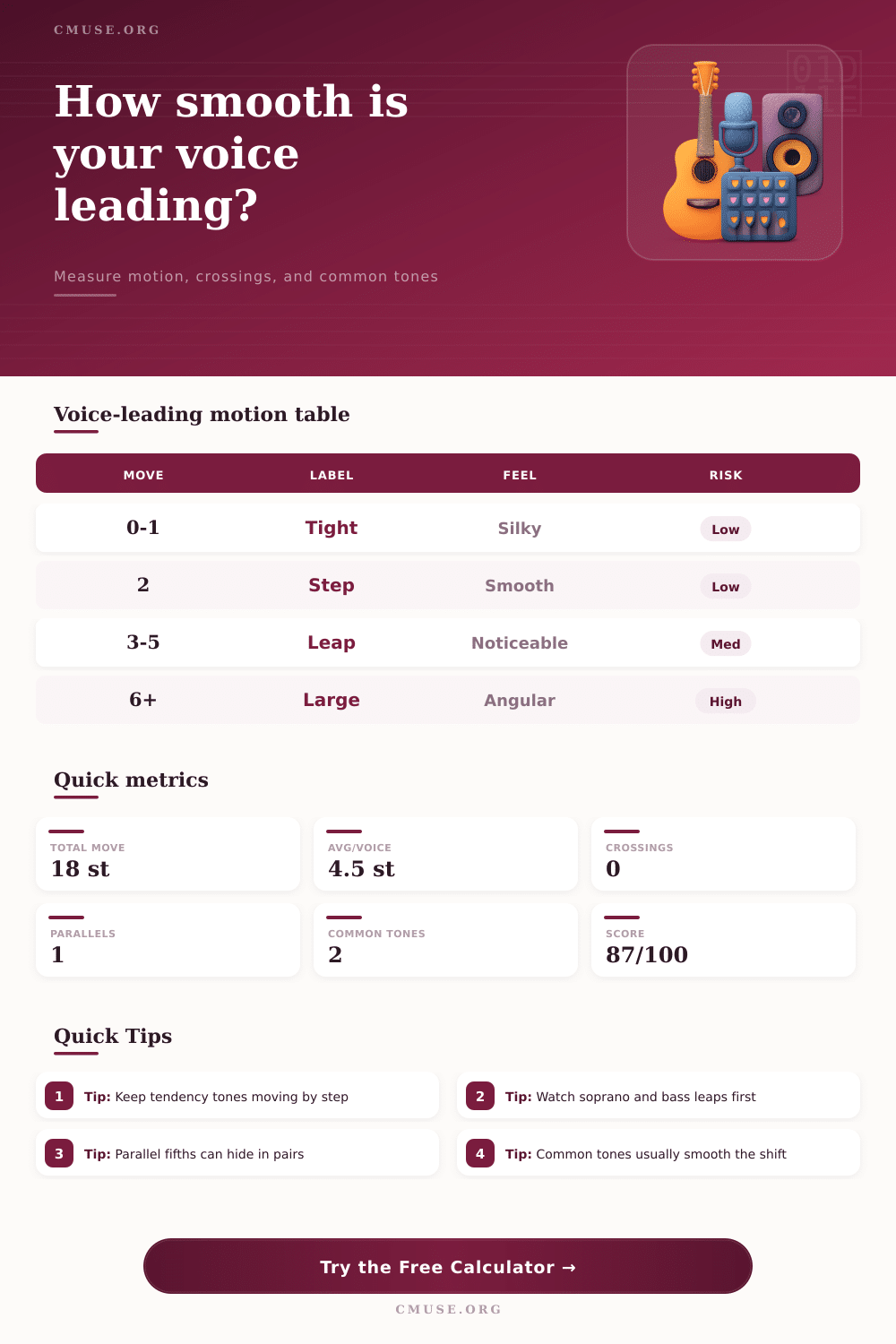
| Motion size | Label | Typical feel | Voice-leading note |
|---|---|---|---|
| 0-1 semitone | Tight | Nearly static | Best for pedals and common tones |
| 2 semitones | Step | Very smooth | Ideal for inner voices and resolutions |
| 3-4 semitones | Small leap | Clear but gentle | Use when the line needs shape |
| 5+ semitones | Large leap | Angular or bold | Watch for balance and recovery |
| Cadence type | Common motion | Typical result | Best use |
|---|---|---|---|
| I-V-I | Shared tones | Stable closure | Hymn and chorale endings |
| ii-V-I | Stepwise inner motion | Clean pull home | Jazz and tonal writing |
| V-vi | One note shifts | Deceptive color | Soft surprise and lift |
| iv-I | Modal inner move | Warm release | Minor-key plagal color |
| Tendency tone | Pull | Usual target | Check |
|---|---|---|---|
| Leading tone | Up a step | Tonic | Resolve it cleanly |
| Chord seventh | Down a step | Third of chord | Avoid leaving it hanging |
| Suspension | Down a step | Prepared note | Keep the preparation intact |
| Common tone | Hold | Same pitch | Great anchor for smoothness |
Close
Open
Spread
Mixed
Voice leading are the process of determining the method of moving each line from one chord to the next chord. Voice leading involves determine the movement of each of the soprano, alto, tenor, and bass lines to ensure that the transition between chords are smooth. When perform correctly, the lines will move smooth from chord to chord; if not, they may appear to clash or move awkward with each other.
For choral arrangement, each voice must move along the shortest path necessary to reach the next note. Both stepwise motions of voices and holding certain note steady can help to achieve smooth voice leading. Common tone are notes that exist within each chord; these notes can act as an anchor for certain voices while other change pitch.
Simple Rules for Smooth Voice Leading
Additionally, each arrangement must also balance the outer voice (soprano and bass) because they are the voices that carry the most musical weight within the piece. Should either the soprano or bass voice have to travel a wide leap, the arranger must arrange contrary motion in the inner voices to compensate. Different musical style will require different approaches to be applied to voice leading.
For instance, close-position hymns will require that each voice move in tight interval (0 to 2 semitones), but spread choir writing allows for wider span. The composer can analyze the motions of each voice with analytical tools. Such tools can alert a composer to any instance of parallel fifths between voices and voice crossing between voices.
Parallel fifths occur when two voices move in the same direction at a perfect fifth interval; these interval are undesirable for voice leading. Voice crossings occur when one voice moves to a note below another voice that was previously higher than it. These intervals are also undesirable when leading voices in a composition.
A digital tool can calculate the smoothness of voice leading for a composition by inputting the first set of SATB voicings and the second set of SATB voicings. Each composer will have to first pick a key and scale (tonic and mode) for the composition; tendency tone have different behaviors within major scale versus minor scales. Tendency tones are tones that exhibit a desire to move in a certain direction within a musical composition; leading tones always have a desire to move upward to the tonic note.
A composer can also select the maximum leap distance between notes for each voice (such as 5 semitones) as well as a “strictness” level that indicates how strict he wish to be to era specific rules regarding voice leading. After inputting the source and target notes for each voice part, the tool will report a total motion score and the average motion that each voice must take to go from the first chord to the second chord. The total motion score will reveal the smoothness of the voice leading for the composition.
For instance, a total motion score of under 20 semitones indicate smooth voice leading, especially if the composition includes two or more common tones. If the average motion between each voice is between 4 and 5 semitones, the composition will have balanced voice leading; steps will dominate the inner voices. However, the composer should also watch the largest leap between any voices.
For instance, if the soprano and bass line each leap 7 semitones, the composition may contain hidden parallel between those two voices. These type of voice leading analysis tools can help composers to find the smoothest possible voicing for their composition by trying different voicings within the song. Each voicing can be swapped out for another and the smoothness score will change according.
For example, the alto voice could be changed from a leap to stepwise motion and the score will change. However, each composition has it’s tendency tones that must be respected. For example, leading tones must move upward, sevenths move downward, and suspended notes must fall in a prepared manner.
By respecting each of these element and utilizing analytical tools to ensure that the composition possesses smooth and pleasing voice leading, the musical voices will arrive together rather than crash into each other.