Vocal Reverb Calculator
Estimate RT60, total absorption, and treatment coverage for vocal booths, lead rooms, choir spaces, and live tracking rooms.
🎧 Vocal Presets
🔧 Vocal Room Geometry
💪 Room Finishes
🔧 Treatment Plan
📊 Vocal Spec Grid
📑 Vocal Reference Tables
| Vocal use | RT60 target | Feel | Best for |
|---|---|---|---|
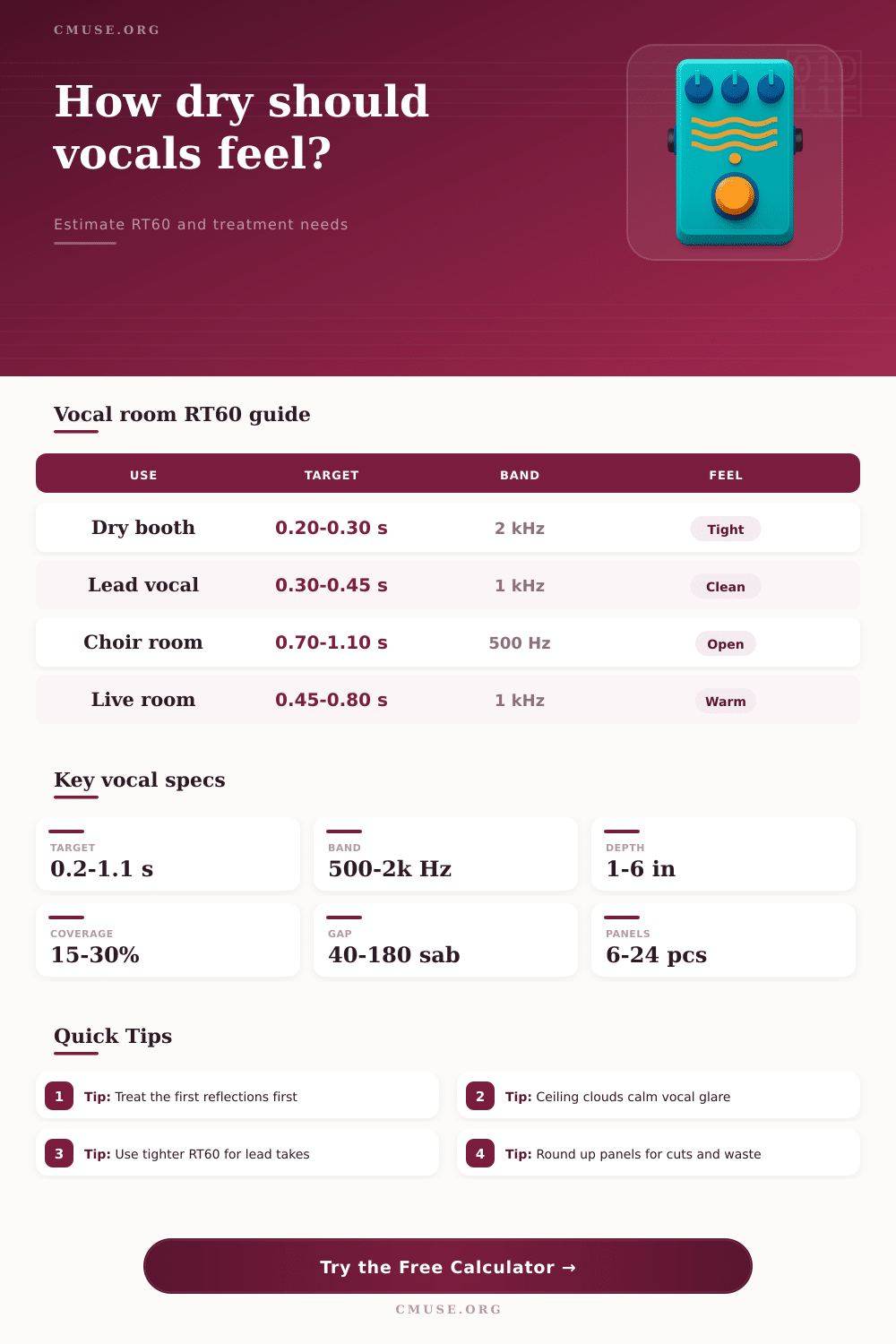
| Podcast vocal booth | 0.25-0.35 s | Tight | Speech |
| Lead vocal control room | 0.25-0.40 s | Focused | Mixing |
| Backing vocal room | 0.50-0.80 s | Natural | Band work |
| Choir live room | 0.70-1.10 s | Open | Ensemble |
| Finish | NRC-ish | Midband alpha | Use |
|---|---|---|---|
| Painted drywall | 0.05 | 0.05 | Vocal shell |
| Carpet on underlay | 0.30 | 0.30 | Dry booth floor |
| Heavy curtain | 0.55 | 0.55 | Vocal wall |
| Acoustic tile | 0.60 | 0.60 | Ceiling cloud |
| Depth | Alpha lift | Low-end shift | Best use |
|---|---|---|---|
| 1 in | Light | Small | Lead takes |
| 2 in | Moderate | Medium | Vocals |
| 4 in | High | Strong | Lead vocal control |
| 6 in | Very high | Deep | Choirs |
| RT60 band | Room feel | Speech | Music |
|---|---|---|---|
| < 0.30 s | Very dry | Clear | Lead vocal |
| 0.30-0.45 s | Tight | Good | Pop vocal |
| 0.45-0.75 s | Controlled | Okay | Backing vox |
| 0.75+ s | Live | Soft | Choir room |
Reverb is the phenomenon where sound reflect off of the surfaces within an environment. By managing the reverb within a vocal booth, you are managing the decay time of the sound within that room. Decay time can be measured in a value known as the RT60 value.
The RT60 value is the amount of time it take for the sound within the vocal booth to even 60 decibels. Understanding this value is important in determining whether the vocals that are recorded within that vocal booth will sound clear or muddily. For vocals performed within a dry vocal booth, the target RT60 will be low; low values are typically under 0.5 second.
How to Fix Reverb in a Vocal Booth
A low RT60 ensure that the sibilance within the vocal booth does not smear. For vocals performed within a choir vocal booth, the target RT60 will be high; high values are typically over 1.0 second. A high RT60 within the vocal booth ensures that the vocal performance by each member of the choir will blend with each other.
In addition to the RT60 value, it is also important to consider the frequency of the sounds that is reflected within the vocal booth. For vocal performances, focus should be placed upon the frequencies between 1 kilohertz and 2 kilohertz. These are the frequencies that contain most of the vocal information.
It is possible for a vocal booth to have low reverb for the frequencies between 1 kilohertz and 2 kilohertz yet have high reverb for frequencies between 2 kilohertz and 5 kilohertz. Additionally, it is also possible for a vocal booth to have high reverb for the frequencies between 1 kilohertz and 2 kilohertz yet have low reverb between 2 kilohertz and 5 kilohertz. The surfaces within a vocal booth will have the most impact upon the amount of reverb that is create within that vocal booth.
For instance, bare drywall will reflect the vocals that are performed within the vocal booth, and this can ruin the vocal performance that is recorded. However, if you place carpet on the floor of the vocal booth, the vocal reflections will be softened; thus, the RT60 will decrease. Additionally, the walls of a vocal booth will determine the reflections that occur off of each of the vocal booth’s wall; these side reflections can cause comb filtering within the vocal performance.
The ceilings within a vocal booth will have vertical reflections that directly hit the microphone; thus, they are also important to consider when constructing a vocal booth. Finally, the material of the surfaces will impact the absorption of vocal frequencies; wood floor will provide warmth to the vocals while concrete floors will provide less absorption of those vocal frequencies. The shape of the vocal booth and the volume of that vocal booth can also impact the reverb within that vocal booth.
Rectangular vocal booth typically create modes within the vocal booth that are easier to treat with acoustic panels. Choir vocal booths that are circular or triangular in shape create a diffusion of sound that is different than rectangular vocal booths, thus changing the treatment of those vocal booths. Finally, the height of the ceiling will increase the volume within the vocal booth.
Additionally, all of the furnitures and individuals within the vocal booth will additionally absorb some of those vocal frequencies; thus, they will also lower the RT60 of the vocal booth. While it may seem tempting to treat every surface of the vocal booth with acoustic foam, that isnt the process for treating vocal booths. Instead, acoustic treatment is the process of only placing acoustic panels in specific zone within the vocal booth.
For example, first reflections off of the side walls should be treated. Additionally, ceiling clouds can treat vertical reflections off of the ceilings. The thickness of the acoustic panels will determine the frequencies that are absorbed by the vocal booth.
Thick panels will absorb low frequency while shallow panels will absorb high frequencies. Additionally, vocal booths typically require between 15 and 30 percent coverage with acoustic panels. Exposure to the frequencies of the vocal booth will allow vocal producers to determine the ideal thickness of the panels.
If the goal is to absorb low frequencies, mineral wool panels should be used. Yet, if the goal is to absorb high frequencies, felt panels can be used. Many people make the mistake of using only the Sabine formula when calculating the reverb of a vocal booth.
The Sabine formula is not accurate for vocal booths with irregular absorption of sound. Thus, the alternative is the Eyring formula. Additionally, calculating the difference between the current RT60 and the target RT60 will allow vocal producers to determine the additional amount of acoustic treatment that should be applied to that vocal booth.
In addition to the factors described thus far, there are still additional factors that can impact the reverb within a vocal booth. For instance, the humidity within the air within a vocal booth will absorb high frequencies from the vocals that are performed within the booth. Additionally, the furniture within a vocal booth may scatter some of the vocal reflections rather than absorbing them.
Therefore, another way to evaluate the reverb within a vocal booth is to play pink noise through the vocal booth and use a meter to measure the reverb. However, it is also possible to only calculate the target and current RT60 values with mathematical estimate. Additionally, lead singers will sound best within vocal booths with an RT60 under 0.45 seconds.
Choir vocals will sound best with an RT60 that is near 0.7 seconds. For speech to be easily understood, the vocal booth should have low reverb. Finally, vocal producers should treat the vocal booth for it’s reflections before treating its ceiling.