Vocal Range Calculator
Measure your lowest and highest usable notes, tessitura center, frequency range, semitone span, and closest classical voice-type comparison in one singer-focused calculator.
🎤 Named Singer Range Presets
⚙ Range, Tessitura, and Pitch Inputs
📊 Live Voice-Type Comparison Grid
Baritone
🎵 Vocal Range Spec Grid
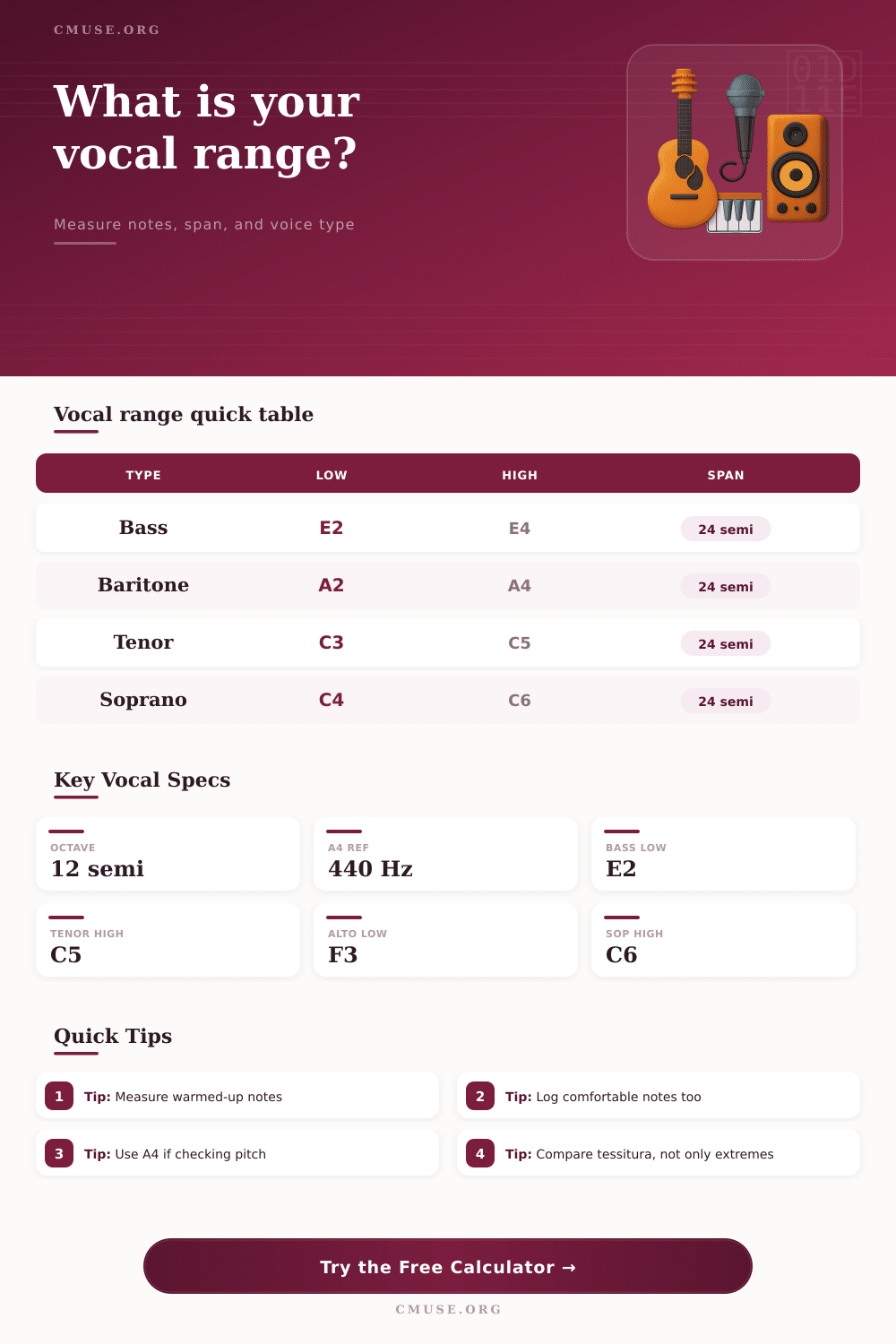
📋 Standard Voice Type Ranges
| Voice Type | Typical Low | Typical High | Span | Common Tessitura Center |
|---|
🎙 Singer Preset Comparison
| Preset | Entered Range | Semitones | Tessitura | Closest Type |
|---|
🔀 Song Fit and Transposition Table
| Check | Current Song Range | Fit Result | Useful Move | Why It Matters |
|---|
🎼 Pitch and Frequency Reference
| Note | MIDI | Frequency at A4 | Voice Context | Interval From C4 |
|---|
Knowing your vocal range is importance because knowing your vocal range can help you to avoid vocal strain. While many singer may feel that the highest and lowest notes that they can sing are the most important, the notes that they can comfortabley sing are actualy more important than those extreme vocal notes. These comfortable vocal notes are refer to as the tessitura, or the range in which an individual singer typically set their voice when they are performing.
It is important for singers to understand the difference between their extreme vocal ranges and their tessitura, since the tessitura range can help them determine the types of songs that they can sing, as well as inform their vocal warm-up and practice session. The extreme vocal notes are those highest and lowest vocal pitches that an individual singer can reach. However, these vocal notes is typically difficult for the singer to maintain for extended period.
Know Your Singing Range and Comfortable Notes
Instead, individual singers should focus in the vocal notes that they can continuously sing. Vocal range calculators use these type of repeatable notes to calculate the midpoint of the singer’s vocal range, which is the best indicator of their vocal range. Thus, vocal calculators can be used to determine an individual singer’s tessitura.
Many individual singers may focus upon their vocal range and their tessitura, but the center of an individual singer’s vocal range is more important than their vocal extreme. For instance, many baritone singer may be capable of hitting high vocal notes, but if a song exists within the vocal range of those singers beyond their tessitura, the singers will find it difficult to sing that song. These vocal range calculators allow for individual singers to separate their vocal range from their tessitura, allowing them to understand their vocal range more complete.
Singing teachers and directors recognize vocal categories that is. These vocal categories allow those singers to have a comparison grid to their vocal range and tessitura to determine what type of vocal range they have. By understanding where their vocal range and tessitura fall within the vocal categories, singers are able to utilize transposition.
Transposition is the movement of a singer’s vocal range within a piece of music to another note range, such as within their tessitura. Vocal range calculators also display the vocal ranges in units of Hertz. These units are helpful for those who wish to work alongside sound engineer for vocal productions, or who wish to compare their vocal range to other vocal ranges.
For the majority of singers, though, the Hertz measurements are not necessary to understand their vocal range. However, these units help to demonstrate the differences between vocal ranges of octave. Additionally, vocal range calculators also display the range of each singer’s vocal notes in relation to middle C. This vocal note is one of the most common vocal notes among vocal score, and thus, is useful for understanding how the singer’s range compares in sheet music.
Next, vocal range calculators also provide examples of singers with similar vocal ranges. However, individual singers dont need to have the same vocal range and tessitura as these well-known singers. For instance, Johnny Cash and Frank Sinatra are two singers who has vocal ranges and tessituras that is similar to those who sing within the lower vocal ranges.
However, the vocal range of Johnny Cash’s comfortable range versus that of Frank Sinatra’s comfortable range is different. Similarly, Adele and Beyoncé are two singers who have vocal ranges and tessituras that falls within the mezzo singer vocal range. However, the upper ranges of Adele and Beyoncé are different.
An individual singer can determine whether a singer has a good vocal fit with their vocal range by comparing their vocal range and tessitura to that which they wish to sing. Vocal range calculators can help to determine whether a singer can sing a song with their vocal range, as well as whether they will need to change the key of that song. Moreover, by knowing the gap between a singer and a song’s vocal range, the singer can determine whether they should of use transposition prior to beginning to learn the song.
Singers should warm up their vocal range prior to using these calculators to determine their vocal range. By warming up their vocal range prior to singing, singers will achieve more accurate measurement for vocal range. Furthermore, the type of vowel that a singer utilizes when determining their vocal range can have an impact on their vocal range.
For instance, using an open vowel will allow the singer to reach higher vocal notes than if they used a different, closed vowel. While one of the goals of singers to learn their vocal range is to ultimately expand their vocal range, another of the main goals is to understand the range of their vocal abilities. Thus, singers can use this knowledge to make informed decision about the songs that they wish to sing and their vocal health.
Furthermore, singers can always return to these vocal calculators to determine their vocal range and tessitura, especially if they find that their vocal range has changed over time.