Violin String Tension Calculator
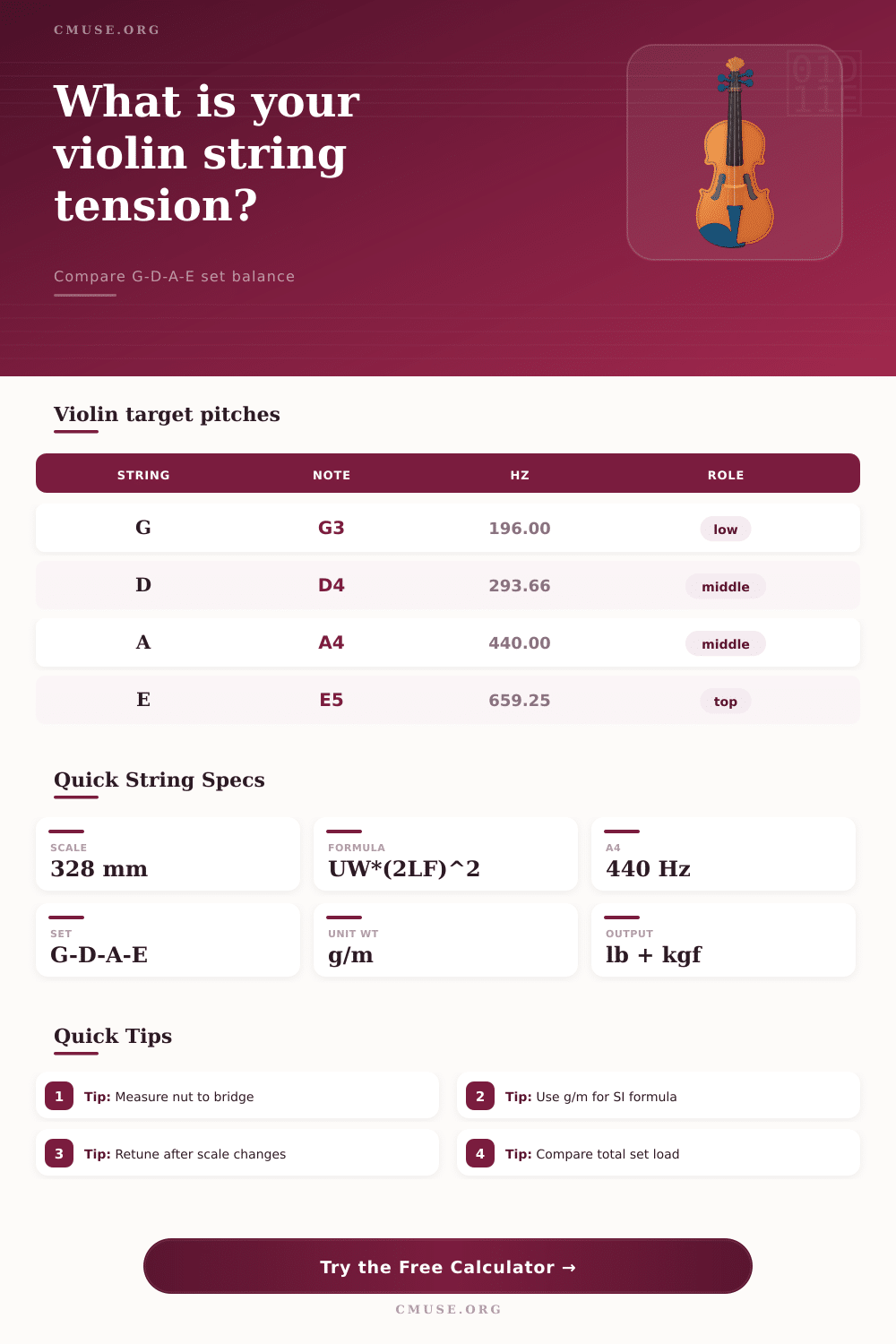
Calculate G3, D4, A4, and E5 string loads from scale length, target pitch, gauge, and unit weight using T = UW × (2LF)².
🎻 Named Violin Presets
⚙ Scale, Pitch, and Set Inputs
📏 Unit Weight and Gauge by String
G3 String
D4 String
A4 String
E5 String
| String | Target | Frequency | Unit Weight | Tension |
|---|
📊 Violin Spec Grid
🧮 Dynamic Set Comparison
Synthetic
Steel
Gut
Solo
🎯 Pitch Target Reference
| String | Target Note | Frequency at A4 440 | Semitone Offset from A4 |
|---|---|---|---|
| G string | G3 | 196.00 Hz | -14 semitones |
| D string | D4 | 293.66 Hz | -7 semitones |
| A string | A4 | 440.00 Hz | 0 semitones |
| E string | E5 | 659.25 Hz | +7 semitones |
⚖ Preset Unit Weight Table
| String Set | G g/m | D g/m | A g/m | E g/m |
|---|---|---|---|---|
| Synthetic medium core | 2.84 | 1.19 | 0.59 | 0.19 |
| Steel bright practice | 3.02 | 1.28 | 0.64 | 0.20 |
| Gut light historical | 2.48 | 1.05 | 0.52 | 0.17 |
| Solo higher tension | 3.05 | 1.30 | 0.65 | 0.21 |
| Fractional student set | 2.58 | 1.08 | 0.54 | 0.17 |
| Studio soft response | 2.62 | 1.10 | 0.55 | 0.18 |
📏 Scale Length Comparison
| Violin Size | Scale Length | Same String Effect | Use Case |
|---|---|---|---|
| 4/4 full | 328 mm / 12.91 in | Reference tension | Standard adult violin |
| 7/8 | 320 mm / 12.60 in | About 5% lower | Compact full-size feel |
| 3/4 | 305 mm / 12.01 in | About 14% lower | Student instrument |
| 1/2 | 285 mm / 11.22 in | About 24% lower | Smaller student setup |
🔍 Tension Range Guide
| Per-String Load | Set Feel | Typical Observation | Check |
|---|---|---|---|
| Under 8.5 lb | Light | Flexible response, less bow resistance | Watch pitch stability |
| 8.5-11.5 lb | Medium | Common modern violin feel | Balance across strings |
| 11.5-13.0 lb | Firm | More resistance and projection | Bridge and setup load |
| Over 13.0 lb | High | Special-purpose or solo bias | Confirm safe instrument setup |
String tension are the measurement of the force that is applied to the string of a violin. String tension affects how a violin feel to the player, as well as how the violin respond to the player. Players may notice that different set of strings create a different feeling on there violins, and this is due to the difference in the amount of tension that each of those sets of strings applies to the violins.
String tension can influence the speed at which a violin produce sound, as well as the pressure that the left hand of a violin player must apply. Players can use a violin string tension calculator to compare the string tension of different sets of strings. Scale length is one of the primary factor in the calculation of string tension for violins.
How Violin String Tension Affects Sound and Feel
Scale length is the distance between the nut and the bridge of the violin. The scale length of a standard 4/4 violin is 328 mm, but many violins has a different scale length than this standard measurement. The calculator will use the scale length as one of the factors to ensure that any comparison of string tensions is consistent.
Pitch is another factor in the calculation of violin string tension. The pitch of the strings correlates to the tension that is place upon the strings; the higher the pitch of the string that is tuned, the more tension that is placed upon that string. For instance, tuning the A string of a violin to 442 Hz instead of the standard 440 Hz will increase the tension that is placed upon all of the violin’s strings.
Unit weight is another factor that correlates to the tension that is placed upon the violin strings. Unit weight is a measurement of the weight of the violin string, measured in grams per meter. Unit weight is important in that strings with a heavier unit weight will have more tension place upon them at the same frequency as strings with a lighter unit weight.
For instance, strings with steel cores will feel firm to violin players than synthetic strings, even if the gauge of the strings is the same. The player can enter the unit weight of the string into the tension calculator to determine the effect that it have upon the total tension of the set of strings. Gauge is another factor in the calculation of violin string tension.
Gauge refers to the thickness of the violin strings. Thin strings may have a low unit weight, but because the gauge is low, there may be less tension place upon them than upon a string with a higher gauge and unit weight. Thus, both gauge and unit weight are factors that must be considered when determining string tension with a violin string tension calculator.
Many violin players desire a balance between the four strings of their violins. Balance in this context means that each of the four strings (G, D, A, and E strings) feels the same tension. Some violin players desire that the tension be even along each of the strings, while other violin players may desire that some of the strings have more tension than others.
A string tension calculator allow violin players to set a balance target for their violin strings. Violin players can utilize this target to test the tension of each string according to each violin player’s individual desires. Such a calculator will provide an output that demonstrates the total load of each string, the average tension that is placed upon each string, and the spread in tension between each string.
A spread in tension that is under fifteen percent is often considered comfortable to violin players, while spreads in tension that are more than fifteen percent may indicate that some violin strings are under more tension than others. In addition to the string tension calculator, there are other factors in the violin that may effect the tension that is placed upon its strings. These variables may include the bridge height, the soundpost of the violin, the age of the violin’s top, and more.
For instance, violins with a short scale length will measure less string tension, but violins with small bodies may require more tension to create high volumes of sound with their strings. Furthermore, violins that are more aged and have thinner tops may feel as if they are “choked” if there is too much tension to be placed upon their strings. Thus, while the string tension calculator is a helpful tool for violin players, reference tables exist for factors like scale length that may affect violin tension.
Violin players can measure the scale length of a violin, and that measurement can be stored in the violin’s case. The player can enter the scale length measurement into a violin string tension calculator whenever violin players wish to compare sets of strings. For instance, when purchasing a new set of strings, the violin player may wish to use the string tension calculator to review the tension of each string of the new set of strings.
If the calculator determines that the E string has high tension compared to the G string, the violin player will be aware that this set of strings will feel different from those that are already installed on the violin. Furthermore, if the total tension that is calculated for the set of strings is high, the violin player may choose to purchase a different set of strings that have a lower tension. Thus, by employing this string tension calculator, violin players can make purchase decisions based off mathematical calculations, rather than the marketing claim of the violin string manufacturer.