Vinyl Side Time Limit Calculator
Estimate safe vinyl side duration from record format, RPM, groove density, bass content, lacquer safety margin, track spacing, and the way tracks are allocated across sides.
Load a named release shape, then adjust the cut format, RPM, groove density reference, low-end profile, safety margin, spacing, and track list before sending a side plan to mastering.
Breakdown
| Side | Tracks placed | Music time | Spacing added | Side total | Headroom | Status |
|---|
Selected groove density reference
Base format time before modifiers
Total recommended disc capacity
Longest side pressure against limit
| Reference cut | Groove density | Best use | Side-time effect |
|---|---|---|---|
| Relaxed loud side | 180 LPI | 12 inch singles, punchy rock, club cuts | Shorter capacity with more groove room. |
| Conservative album | 210 LPI | Balanced LP sides with normal level | Useful middle ground for many releases. |
| Standard planning reference | 225 LPI | General album estimates before mastering review | Good first-pass target for side planning. |
| Tight album side | 255 LPI | Longer sides with controlled bass and level | Fits more time but needs cleaner program material. |
| Dense long side | 285 to 300 LPI | Archival, spoken, ambient, or quieter music | Can extend time while reducing cutting comfort. |
| Format | Speed | Conservative side | Standard side | Dense side |
|---|---|---|---|---|
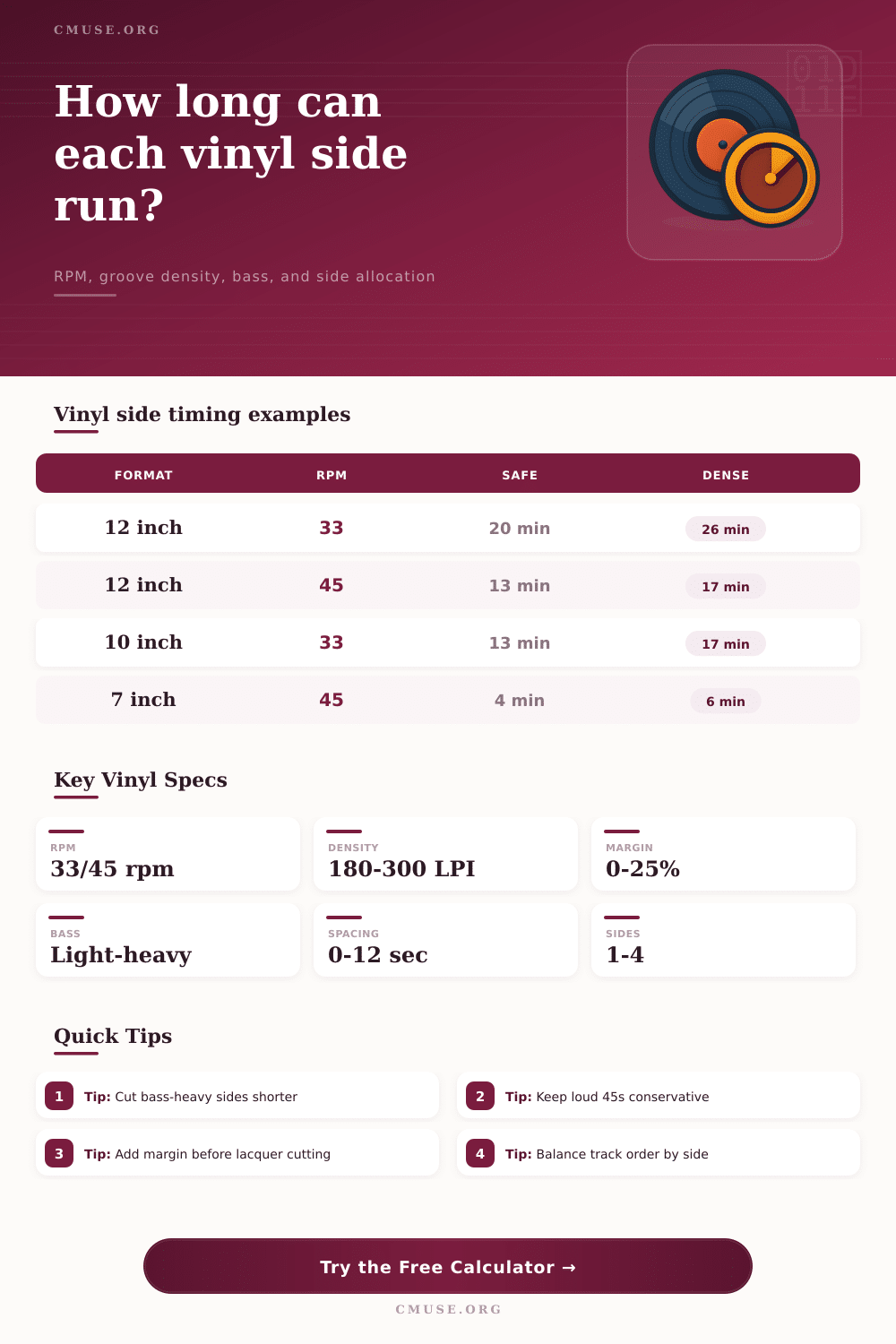
| 12 inch LP | 33 1/3 RPM | 18 to 20 min | 20 to 23 min | 24 to 28 min |
| 12 inch single | 45 RPM | 10 to 13 min | 13 to 15 min | 16 to 18 min |
| 10 inch record | 33 1/3 RPM | 11 to 13 min | 13 to 16 min | 16 to 18 min |
| 10 inch record | 45 RPM | 8 to 10 min | 10 to 12 min | 12 to 14 min |
| 7 inch single | 45 RPM | 3 to 4 min | 4 to 5 min | 5 to 6 min |
| Program profile | Low-end movement | Cutting level pressure | Planning recommendation |
|---|---|---|---|
| Acoustic or spoken | Light | Low to normal | Longer sides are more realistic when sibilance and inner-groove material are controlled. |
| Balanced indie or pop | Moderate | Normal album level | Use standard LPI and keep each side under the calculated limit. |
| Rock, funk, or dense drums | Punchy | Normal to hot | Leave extra margin for kick, bass guitar, and cymbal energy near the inner grooves. |
| Dance, hip-hop, synth bass | Heavy | Hot or club level | Shorter sides generally cut cleaner and louder with fewer compromises. |
| Preset | Format | Program shape | Density | Watch point |
|---|
A vinyl record have a physical limit to the amount of music that will physically fit on one side of that record. The physical limit to the amount of music that will fit on a side of a vinyl record is not based upon the total length of the music that is to be stored on that side of the record. Instead, the way in which the groove are cut into the lacquer, the amount of space that the low-end bass requires to be played from that record, and the amount of space that the cutting engineer requires to actually complete that cutting process creates the physical limit to that music.
Each of these variables can be entered into the calculator that is provided to determine these physical limits for vinyl records. The variables that must be entered into the calculator include the release format of the vinyl record, the RPM of the record, the groove density of the record, the bass profile of the records, the safety margin for the record, and the track spacing of the records. Each of these variables impact the amount of space that is made available for the music that is to be played from that vinyl record.
How Much Music Can Fit on a Vinyl Record
For instance, the amount of music that can fit upon a 12-inch vinyl record playing at 33 RPM will be different than the amount of music that can play from a 12-inch vinyl record that is playing at 45 RPM. Additionally, the amount of music that can be played from that same 12-inch record will change if that music contains heavy bass elements compared to music with light bass content. Each of these variables will influence the calculations that the calculator performs regarding the physical limits of the vinyl record prior to sending the music files to a mastering engineer for processing.
The results of the calculator will show the physical limits of each side of the vinyl record. If the calculated time for each side of the record is relatively far from the physical limits of those records, then the cutting engineer will have some room to adjust the level of the music or the inner groove radius of the records if the music plays differently upon the lathe than upon the monitor room records players. However, if the result of the calculation for the length of each side of the record is relatively close to the physical limits of those records, then the sequence, groove density, or low-end bass content of the records may need to be changed prior to cutting the lacquers of the records.
The bass content of the music will have a primary impact upon the amount of music that can play from each side of the vinyl record. Music with heavy bass content will take up more space within the vinyl record than music with less bass content. Because of this, the type of bass content that the music creates impacts the amount of time that each side of the record will play.
Thus, instead of entering the length of the vinyl record into the calculator, the user will need to enter the type of bass content into the calculator. The length of each side of the vinyl record may be either easy or difficult to fit onto the record according to the amount of bass content that exists within the bottom two octaves of the music. Another of the factors that will impact the length of music that can play from each side of a vinyl record is the loudness target that is established for that record.
Records with loudness targets, especially those created for clubs, will require the grooves to extend further into the vinyl record than music with lower loudness targets. The wider grooves will take up space within the record that could otherwise be used for music to play from that record. Many producers is unaware of this constraint until after the vinyl records are produced; however, by calculating these variables early in the production of the master vinyl records, producers can decide whether or not adjustments need to be made to the side of the record.
Track order is another factor that can impact vinyl records and which the calculator can assist in determining. The calculator can automatically allocate the tracks within the record, or the producer can manually enter the track order. By manually entering the tracks, the producer may be able to determine whether moving one or more tracks will resolve the problem of the length of one side of the record.
While the calculator does not calculate the best sequence for the vinyl record, it does indicate the limits of the vinyl records that will be created. The safety margin can be a variable that the producer must enter, but it should be entered as a specific number. The safety margin will be a percentage that is entered into the calculator prior to determining the limits of the vinyl records.
The cutting engineer will use the safety margin to make last minute adjustments to the records, to account for the inner groove of the records, and to account for any differences in the performance of the records upon different lathes. If the safety margin is set too low, the cutting engineer may not have time to make these last minute adjustments. By establishing a modest safety margin, the cutting engineer will have time and space to ensure that each side of the vinyl record will cut cleanly the first attempt at cutting the lacquers.
Many vinyl record producers make mistakes when they enter the calculation. A common mistake is to believe that the length of the side of the record is a fixed value. In fact, the length of each side of the record is a variable that changes with the content of the music that is to play from that record.
For instance, a 12-inch record that plays at 33 RPM may have a length of twenty-two minutes for each side of the record. However, if that record contains heavy bass content, the length of that record will be less than twenty-two minutes. Thus, while there may be an easy calculation to determine the length of the side of the record based off the total length of the music, the content of that music also impacts the length of the side of the record.
These same calculations will apply for any type of vinyl record. For instance, a 10-inch vinyl record will behave differently at 33 RPM than a 12-inch record at 33 RPM; similarly, a 7-inch single at 45 RPM will have a different length of each side of the record than a 12-inch record at 33 RPM. Each of these different vinyl records can be entered into the calculator so that the producer is able to make certain that they do not have to rely upon there memories of the different lengths of each type of record.
The goal of calculating each of these variables is not to determine the length of each side of the vinyl record to its maximum potential. Instead, the goal of calculating each of these variables is to determine at what point each side of the record becomes limited by that vinyl record; this will allow the producer to decide where each side of that record should be placed. Finally, the calculation of each of these variables is provided to ensure that the listener hears the best possible version of the music.
If any side of the vinyl record comes too close to the physical limit of that record, the music may experience distortion within the inner groove of the record or it may have reduced volume levels. The calculation of each of these variables will provide the producer with an idea of the physical limit of the vinyl records that will be cut from the lacquers. Once the producer is aware of the physical limit of each record, they can make decisions about the vinyl record sequence, its level, and the record format.