Vibrato Depth Cents Calculator
Convert one-way or peak-to-peak vibrato into cents, Hz pitch excursion, semitone fraction, and estimated string bend width for voice or instrument work.
Vibrato Depth Results
| Style | Typical One-Way Depth | Typical Rate | Use Case |
|---|---|---|---|
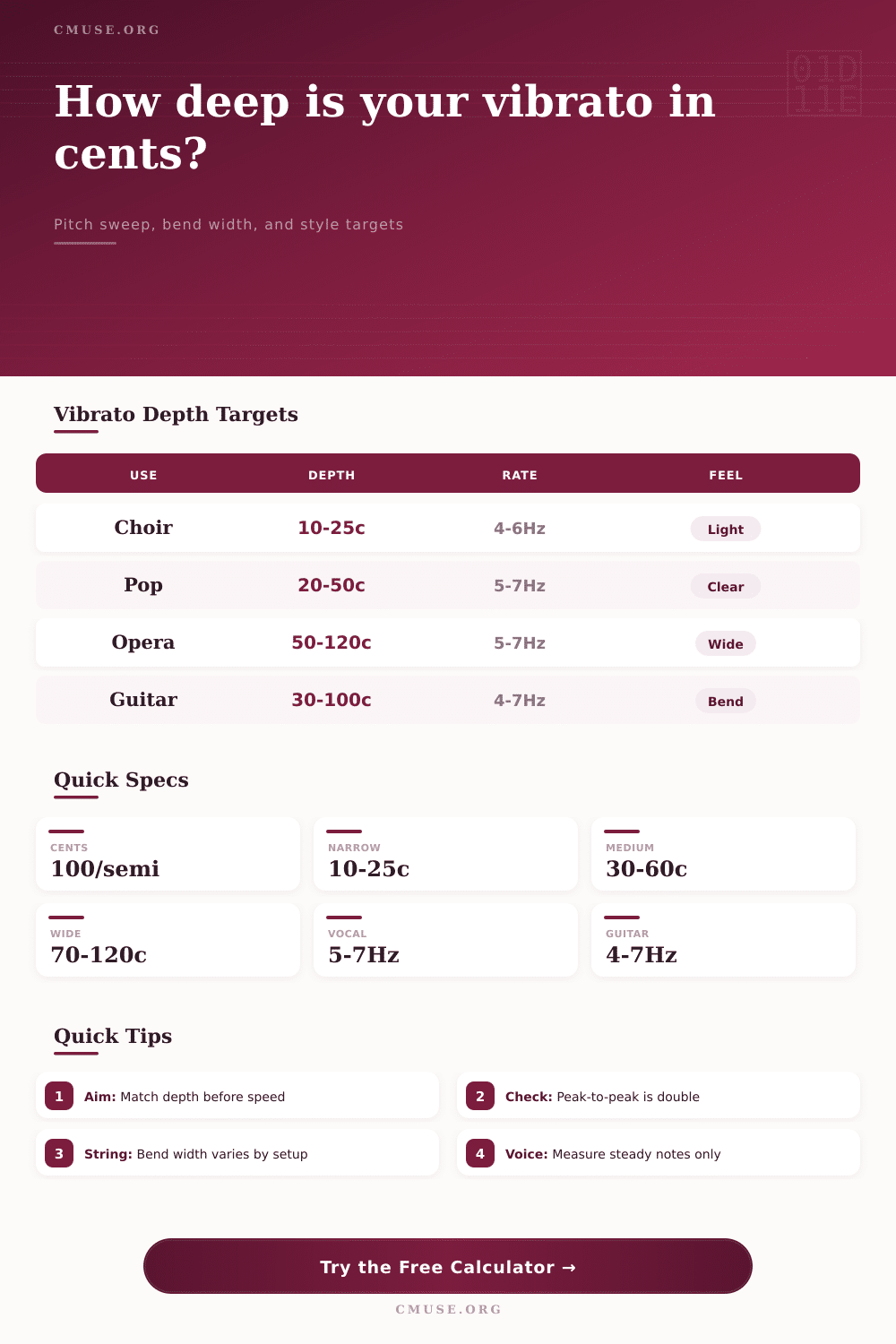
| Choir blend | 10 to 25 cents | 4.0 to 6.0 Hz | Light pitch motion that preserves ensemble tuning |
| Classical voice | 30 to 70 cents | 5.0 to 7.0 Hz | Centered singing with audible warmth and controlled width |
| Pop vocal | 20 to 50 cents | 5.0 to 7.5 Hz | Clear vibrato that stays close to the melody note |
| Opera / dramatic | 60 to 120 cents | 5.0 to 7.0 Hz | Wide expressive vibrato on sustained notes |
| Electric guitar | 30 to 100 cents | 4.0 to 7.0 Hz | Finger vibrato, bend vibrato, and sustained lead notes |
| Violin / viola | 15 to 70 cents | 4.5 to 8.0 Hz | Narrow to broad left-hand vibrato on stopped strings |
| Cello / bass | 20 to 80 cents | 3.5 to 6.5 Hz | Slower wide vibrato suited to lower registers |
| Synth LFO | 5 to 100 cents | 3.0 to 8.0 Hz | Programmed pitch modulation, chorus, or lead movement |
| Instrument Setup | Approx 50 Cents | Approx 100 Cents | Notes |
|---|---|---|---|
| 25.5 inch electric guitar, 12th fret | 0.21 in / 5.3 mm | 0.42 in / 10.7 mm | Medium response baseline used by this calculator |
| 24.75 inch electric guitar, 12th fret | 0.20 in / 5.1 mm | 0.41 in / 10.3 mm | Shorter scale usually feels slightly easier |
| Acoustic guitar, 12th fret | 0.25 in / 6.4 mm | 0.50 in / 12.7 mm | Stiffer strings may need more lateral travel |
| Bass guitar, 12th fret | 0.30 in / 7.6 mm | 0.60 in / 15.2 mm | Higher tension and larger strings widen the estimate |
| Violin finger vibrato | Finger roll | Finger roll | Width is measured as pitch result, not fretboard bend distance |
| Center Pitch | 25 Cents One-Way | 50 Cents One-Way | 100 Cents One-Way |
|---|---|---|---|
| A3, 220.00 Hz | 216.85 to 223.17 Hz | 213.74 to 226.45 Hz | 207.65 to 233.08 Hz |
| A4, 440.00 Hz | 433.70 to 446.35 Hz | 427.47 to 452.89 Hz | 415.30 to 466.16 Hz |
| C5, 523.25 Hz | 515.75 to 530.85 Hz | 508.34 to 538.62 Hz | 493.88 to 554.37 Hz |
| E5, 659.25 Hz | 649.80 to 668.84 Hz | 640.47 to 678.58 Hz | 622.25 to 698.46 Hz |
| A5, 880.00 Hz | 867.39 to 892.70 Hz | 854.95 to 905.79 Hz | 830.61 to 932.33 Hz |
| Depth | Semitone Fraction | Pitch Ratio From Center | Musical Reading |
|---|---|---|---|
| 10 cents | 0.10 semitone | 1.0058 up / 0.9942 down | Very narrow shimmer |
| 25 cents | 0.25 semitone | 1.0145 up / 0.9857 down | Subtle but measurable vibrato |
| 50 cents | 0.50 semitone | 1.0293 up / 0.9715 down | Moderate half-semitone edge |
| 75 cents | 0.75 semitone | 1.0443 up / 0.9576 down | Broad expressive motion |
| 100 cents | 1.00 semitone | 1.0595 up / 0.9439 down | One semitone to each side |
Instead of just sitting there as a static midi sample, vibrato breathes and swells a long note to give it life. It’s the difference between amateur and professional. The difference often comes down to two variables. These are the distance the pitch move away from the centre note and how quickly it does so.
We measure it because most players believe they knows what vibrato should be. However, it is not actualy intuitive. Vibrato involves both emotion and physics.
How to Use the Vibrato Calculator
So now you plug in your target depth into the calculator above with your base frequency and it does the math for you. No more wondering if your wide vibrato is expressive or just out of tune. Moving eighty cents versus twenty cents is all the difference in the world, and they tell very different stories. An eighty-cent vibrato is a statement that pushes toward neighboring notes and demands attention from room. The latter is a twenty-cent vibrato. It is a shimmer sitting right on top of the pitch, warming things up but not obscuring melody.
Knowing where you land helps you decide if your technique matches the genre you are playing in. One style is not like another. A narrow, tight vibrato is used in choral blending where voices need to meld together as chords instead of beating each other up. In opera, you are looking for width to project through hall without mics. For pop, it’s somewhere between (clear and present but not overpowering). On the page, there’s a neat little table that spells all of this out if you’re looking for a benchmark for certain styles. If you play an instrument, you may opt to set it to the classical vocal control preset, for example, or to a slow-bending electric guitar preset, depending on what you’re aiming for. From there it’ll show you in real terms what you’re chasing when you go to practice.
There’s another dimension for string players: the physical aspect of their instrument. It takes force to bend a string; pressing down on fingerboard alters its pitch, but only after the string has been moved in such a way as to change its shape relative to the fingerboard (i.e., geometrically). The calculator determines how far you need to move sideways to reach a specific number of cents, depending on which fret is pressed and overall scale length. That’s helpful since it provides a real clue. A step towards converting an abstract musical objective into a physical one.
At the twelfth fret, the tool may suggest that a fifty-cent pitch change takes about five millimeters of finger movement. You have a visualization point and can train yourself to move precisely that far. The process eliminates guesswork when building muscle memory.
One pitfall with measuring vibrato is that it tends to be measured as the Peak-to-Peak movement; that is the total distance from high to low. A musician typically thinks about it in one way: how far away from center of the note do I go? How far do I go from top to bottom? These are not the same thing at all. What if you have an analyzer reporting a swing of sixty cents and presume that is the size of your swing when it realy means you’re going up or down thirty cents from the note? The calculator lets you specify which measurement style you are using so it corrects for this discrepancy automatically. It may seem like a minor consideration, but it saves you half an octave of confusion over your playing habits.
The same holds true for Low-Frequency Oscillator modulation designed by synth programmers. A gentle five-cent ripple will make a dry lead organic, whereas cranking it up to one hundred cents makes a siren effect that may be cool for a solo but clashes in a dense mix. Depth and rate are another critical pair. Nervous sounds come from fast with narrow vibrato. Slow, wide vibrato can sound lush, but if it is overdone, it could of drift out of key. Both levers has to be balanced with each other to find that sweet spot where the pitch motion seems not accidental but an intended part of the sound.
Numbers are ultimately no more than a guide. They are a way to hone your touch and tune in your ear. Once you have a feel for the right width for your fretting hand or voice at forty-five cents, you don’t need to count anymore; you can simply feel. You always want that technical precision to become part of the music. You measure so you don’t have to think about measuring anymore. Then the note will breathe.