Vibrato Cents to Hertz Calculator
Convert vibrato width in cents into exact lower and upper frequencies, total Hz span, cycle timing, and curve sample points for a chosen note, reference pitch, and instrument profile.
🎯 Vibrato Presets
🎚 Pitch And Vibrato Inputs
Calculation Breakdown
One-Cycle Sample Points
| Point | Phase | Cents | Frequency | Offset |
|---|
🎻 Instrument Comparison Grid
Expressive bowed vibrato often sits near 5 to 7 cycles per second.
Voice vibrato varies by singer and registration, with rate often around 5 to 7 Hz.
Finger and whammy-bar vibrato can be subtle, bluesy, or intentionally wide.
Lower fundamentals need fewer Hz of travel for the same cents width.
Pitch vibrato is commonly narrower while breath pulse may dominate the sound.
LFO vibrato is exact, repeatable, and easy to sync to tempo subdivisions.
Small cent widths are audible because the note is low and exposed.
Many classical settings use limited pitch vibrato and careful rate control.
📊 Cents To Hz Reference Tables
| Centered Width | A3 220 Hz Span | A4 440 Hz Span | A5 880 Hz Span | Use Case |
|---|---|---|---|---|
| 5 cents | 1.271 Hz | 2.542 Hz | 5.084 Hz | Very narrow pitch shimmer |
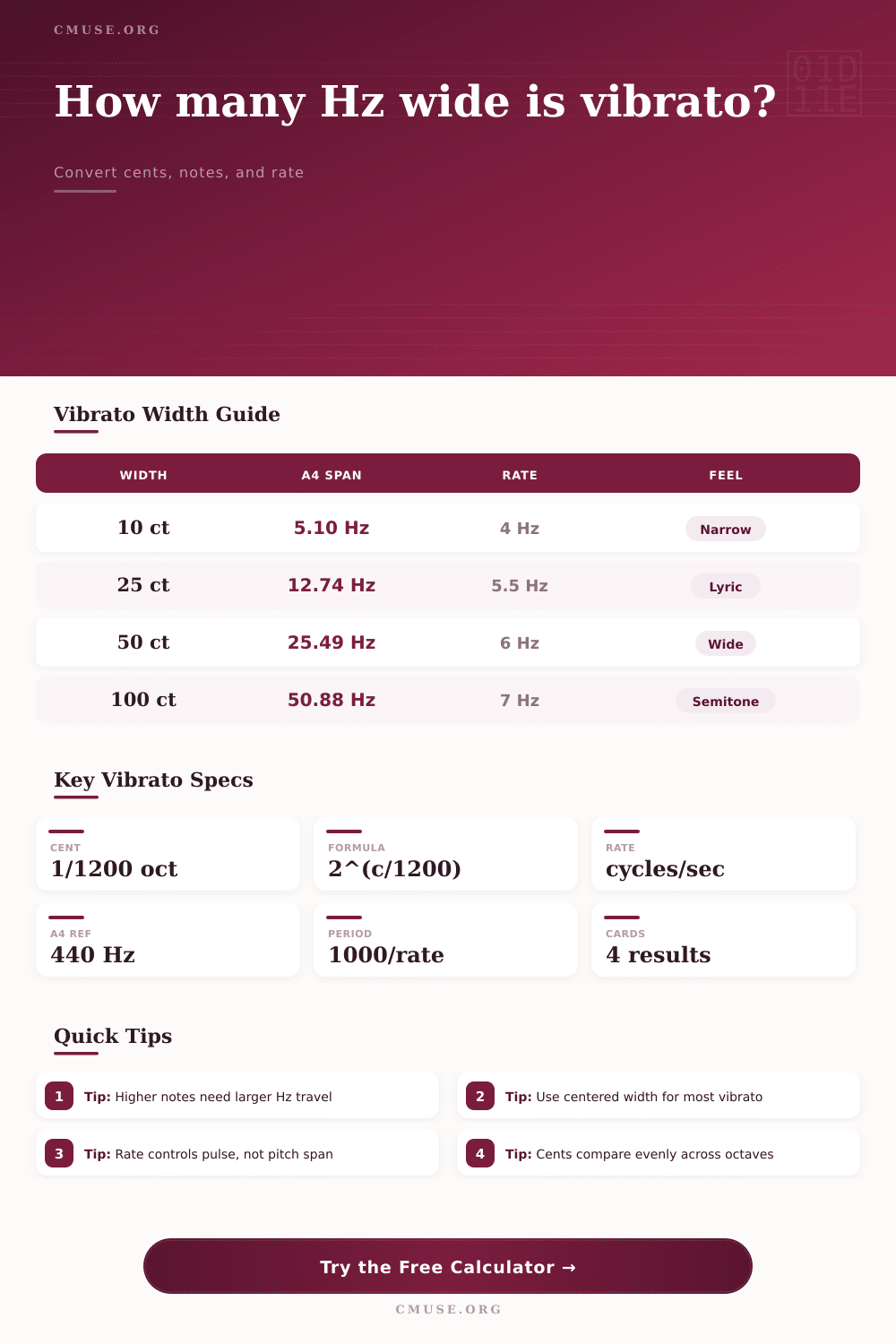
| 10 cents | 2.542 Hz | 5.084 Hz | 10.169 Hz | Subtle orchestral color |
| 25 cents | 6.352 Hz | 12.704 Hz | 25.408 Hz | Lyric string or vocal width |
| 50 cents | 12.706 Hz | 25.412 Hz | 50.824 Hz | Wide expressive vibrato |
| 100 cents | 25.435 Hz | 50.870 Hz | 101.740 Hz | Full semitone pitch motion |
| Rate | Period | Cycles Per 90 BPM Beat | Cycles Per 120 BPM Beat | Perceived Motion |
|---|---|---|---|---|
| 3.0 Hz | 333.3 ms | 2.00 | 1.50 | Slow and deliberate |
| 4.5 Hz | 222.2 ms | 3.00 | 2.25 | Gentle pulse |
| 5.8 Hz | 172.4 ms | 3.87 | 2.90 | Common lyrical motion |
| 7.0 Hz | 142.9 ms | 4.67 | 3.50 | Fast shimmer |
| 9.0 Hz | 111.1 ms | 6.00 | 4.50 | Intense LFO effect |
| Instrument | Typical Width | Typical Rate | Hz Span At A4 | Practical Note |
|---|---|---|---|---|
| Violin / viola | 20-45 cents | 5-7 Hz | 10.16-22.87 Hz | Hand motion changes width quickly |
| Classical voice | 15-60 cents | 5-7 Hz | 7.62-30.50 Hz | Measure stable sustained vowels |
| Electric guitar | 20-100 cents | 4-8 Hz | 10.16-50.87 Hz | String bending may be asymmetric |
| Flute | 5-25 cents | 4.5-7 Hz | 2.54-12.70 Hz | Breath vibrato can mix pitch and level |
| Synth lead | 10-80 cents | 3-9 Hz | 5.08-40.65 Hz | LFO depth maps directly to cents |
| Center Note | Center Hz | 25-Cent Low | 25-Cent High | Total Span |
|---|---|---|---|---|
| E2 | 82.407 Hz | 81.226 Hz | 83.606 Hz | 2.380 Hz |
| G3 | 195.998 Hz | 193.188 Hz | 198.849 Hz | 5.661 Hz |
| A4 | 440.000 Hz | 433.694 Hz | 446.398 Hz | 12.704 Hz |
| C5 | 523.251 Hz | 515.753 Hz | 530.858 Hz | 15.105 Hz |
| A5 | 880.000 Hz | 867.388 Hz | 892.796 Hz | 25.408 Hz |
💡 Practical Vibrato Tips
Think of vibrato as simply a wobbly quality we add to a held note. In truth, it’s much more mechanical than that. There are realy two different variables at play: rate and width. Rarely does one number fully describe it. Sure, someone may describe their vibrato as wide, but you don’t know whether it’s fast or slow. So can you determine if this person is trembling nervously, or singing a slow line? We actualy perceive pitch deviation and temporal frequency as two streams of information.
Once you enter your desired width and the center pitch into the calculator above, it crunches the numbers for you. No need to guess at conversions and coefficients. You don’t need to worry about musical cents when you are focused on Hertz, since Hertz describe how air actually moves. That’s the link between way you experience the sound and how it really occurs.
How to Use Vibrato Tools
What we’re talking about here is a logarithmic unit called the cent. Instead of an absolute distance, it’s a description of the ratio between two frequencies. Whether it’s a high note played on flute or a low note played on a cello, a ten-cent deviation sounds approximately similarer. When professionals talk about their vibrato width they tend to use the word ‘cents’. This gives them a common language no matter the register.
Hertz, however, is linear. Ten hertz of deviation from A4 is not the same kind of musical interval than ten hertz of deviation from E2. While the first barely changes, the second jump noticeably out of tune. On the page above there is a reference table that makes this perfectly clear. It illustrates how the same width in cents spreads out to create different spans in hertz depending on which part of the staff you are on. Being aware of this relationship lets you anticipate what your vibrato would sound like in each octave.
The other half of the equation that’s often not understood is rate. Rate is measured in cycles per second. This means how fast the pitch vibrate. Too slow a rate might cause a note to drift towards or out of tune. Too fast a rate could result in a metallic harshness to the note. For most singers and instrumentalist, the sweet spot for rate ranges from five to seven hertz. It is fast enough to blur the separate steps of the pitch together into a smooth shimmer, but slow enough to still be musically expressive.
Drop the rate below three hertz and your ear begins to track individual pitch change. It no longer sounds like vibrato. It sounds like you’re not managing to hold the note steady at all. You can toggle the rate using the tool. See how the rate causes cycle period to change. This helps you see the timing.
Each instrument has physical limitations. Its common vibrato characteristics are formed because of those limitations. The violinist rolls their finger up and down the string to change pitch. This movement naturaly lends itself to moderate widths and speeds. Similarly, the flute player typically uses breath pressure to create a vibrato which give a narrower frequency variation. These norms are reflected in the instrument presets within the calculator. By choosing an instrument preset, you aren’t merely receiving a figure. You are also getting something that reflects its historical playing style and it acoustics.
Be aware though that these are averages not rules. Jazz players frequently push widths well beyond classical norms, using wide, slow bends that would sound inappropriate in a string quartet. This isn’t just about dialing in a synthesiser LFO. It has a real-world use as well.
When your voice or keyboard recording is sounding muddy, see what vibrato rate you are using relative to the rest of the ensemble. If you find that your own vibrato is limited but your tuner indicates large hertz changes, then perhaps you have been singing in a higher octave than intended. By breaking down the upper and lower peaks the tool displays exactly where the limits of your pitch movement lie. It shows how much it stretches up or down in absolute terms. It quantifies something you would hear subjectively; making it a precise parameter to experiment with.
Try different rates and widths separately. See the impact on overall span (in hertz) when you make a small change in cents without altering the rate. It is a small detail, but it counts.
At its core, then, vibrato is a matter of control. It’s what separates a wobbly sounding note from an alive one. When we understand how the math of that movement work, then we have the power to shape it as desired. We no longer guess; now we design. Knowing exactly how many hertz we’re spanning gives us something to shoot for whether we’re dialing in a vocal exercise or bending a guitar string.
The numbers give us a map. Your ear gives us a destination. Plug the info in, calibrate the instrument, and then rely on your instinct to bring it to life. Not only is the point not accuracy, it’s expression. And this happens when we precisely manipulate those unseen cycles.