UPS Runtime Calculator
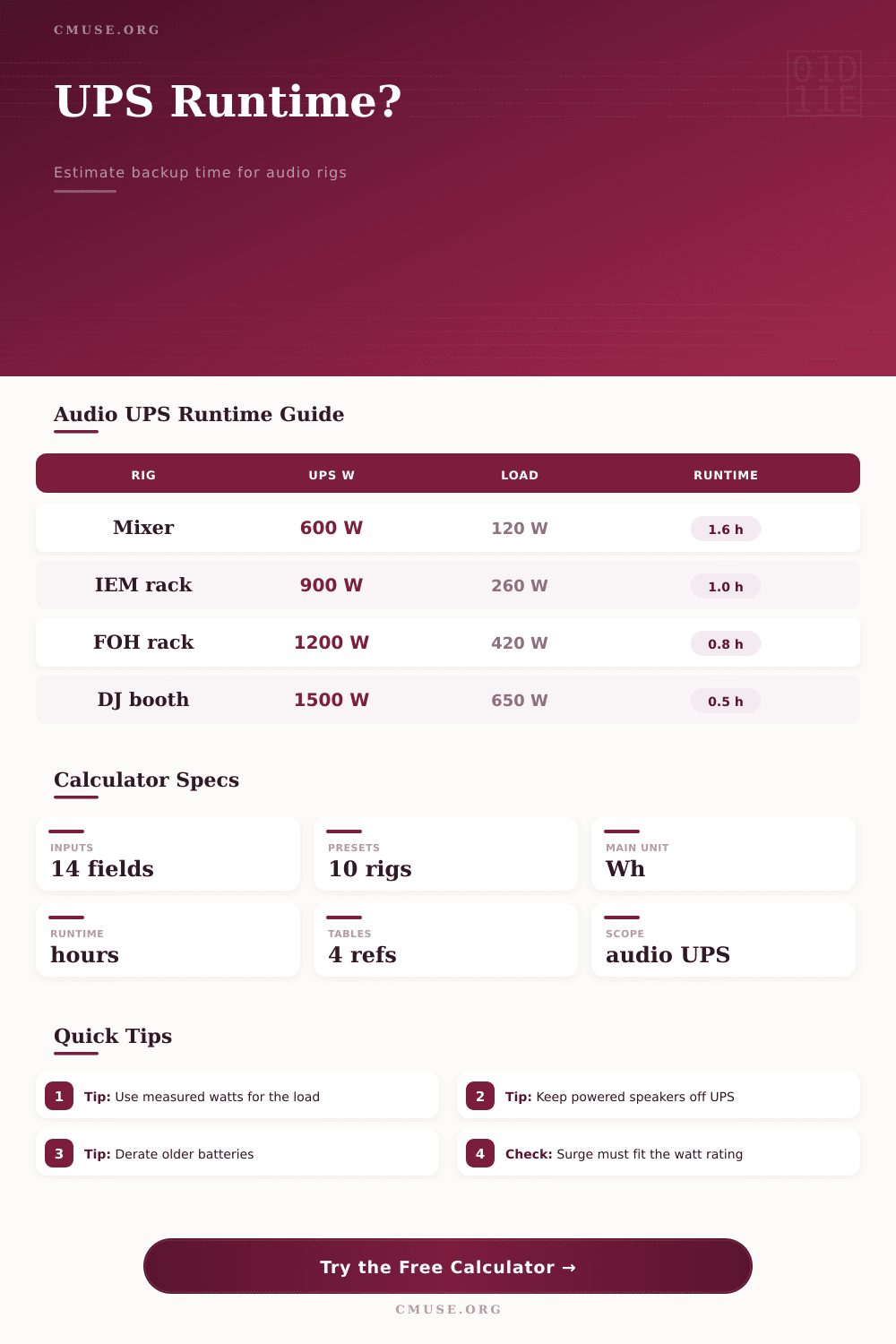
Estimate usable battery watt-hours, live audio load, backup runtime, inverter efficiency, and surge headroom for mixers, wireless racks, IEM systems, playback rigs, and control gear.
Choose a realistic audio rig, then edit the UPS label values or measured watt-meter readings. The calculator separates stored battery energy from usable AC energy, reserve margin, and surge headroom.
Formula Breakdown
1500 VA
Apparent power ceiling
900 W
Real power ceiling
216 Wh
Raw battery storage
1350 W
Short surge planning limit
Wh Formula
battery Wh = V x Ah x stringsThen multiply by health and high-rate derate before inverter losses.
Load Formula
adjusted W = measured W x duty %Use measured wall watts for digital mixers, RF racks, network switches, and computers.
Runtime Formula
runtime h = usable AC Wh / adjusted WUsable AC Wh includes health, derating, inverter efficiency, and reserve.
Headroom Formula
headroom = limit - loadThe stricter of UPS watts, VA corrected by power factor, and surge limit controls the result.
| Load Case | Adjusted Load | Runtime | Notes |
|---|
| Power Limit | Available | Used | Headroom |
|---|
| Audio Device | Typical Watts | UPS Priority | Runtime Note |
|---|---|---|---|
| Digital console or stagebox | 70 to 180 W | High | Keeps mute groups, scenes, and preamps alive during short outages. |
| Wireless mic or IEM rack | 120 to 350 W | High | Count antenna distro, network switch, chargers, and rack fans. |
| Playback laptop plus interface | 60 to 160 W | High | Use the charger input draw, not the computer battery rating. |
| Powered speaker or subwoofer | 250 to 1600 W | Low | Usually too large for small UPS runtime; protect control gear first. |
| UPS Type | Transfer Behavior | Typical Efficiency | Audio Use |
|---|---|---|---|
| Standby | Short transfer delay | 82% to 88% | Small mixers, network switches, and noncritical playback. |
| Line-interactive | AVR with brief transfer | 86% to 92% | FOH racks, RF racks, recording carts, and venue control. |
| Online double conversion | Always on inverter | 84% to 91% | Broadcast audio, critical stream rigs, and unstable venue power. |
| Lithium audio cart | Battery inverter platform | 88% to 95% | Field recording, mobile podcast, and remote production carts. |
| Load Power Factor | VA at 300 W | VA at 600 W | Planning Meaning |
|---|---|---|---|
| 0.70 | 429 VA | 857 VA | Older supplies can hit VA limits before watt limits. |
| 0.85 | 353 VA | 706 VA | Common mixed rack planning value when the meter is unknown. |
| 0.92 | 326 VA | 652 VA | Typical of many modern switch-mode audio supplies. |
| 0.99 | 303 VA | 606 VA | Power-factor-corrected supplies make better use of VA capacity. |
The digital mixer reboots and there’s a power outage during the gig… Cue panic! It wipes out all of your scene presets and network switch loses power. Suddenly, what should of been a carefully run gig becomes a scramble for those precious paper notes.
That’s where the UPS is supposed to come in: an insurance policy to prevent the chaos. But most folks purchase their UPSs based off VA ratings they don’t understand. Once you plug in your load and battery specs into the calculator above, it do the rest of the work and spares you having to guess if that shiny 1500VA unit will save your rig long enough to get through the song, or if it’ll croak just before the encore begins.
How to Choose the Right UPS for Live Sound
Real power (what your gear really burns) is confused with apparent power (voltage times amps), which is the biggest error in judgment made by live sound engineer. Audio interfaces and switching power supplies suffers from this lag (power factor) between voltage times amps and watts. It can cause you to believe you have all kinds of headroom based on label but the moment the console spikes, it trips the breaker. The reference table on the page will lay out just how quickly a lower power factor will eat into your available capacity different than what you’d expect.
Before you even pull the plug, you want to know whether your UPS is rated by its wattage or its VA rating. There’s one other layer of complexity we don’t often talk about until it’s too late: battery chemistry. Maybe your sealed lead-acid battery claims to be a nine-amp-hour battery. But that’s under the assumption that it will slowly and gently discharge over several hours.
Audio loads live in an entirely different world. They’re pulling power hard and fast, instantaneously. That high-rate discharge results in a large loss of usable capacity. The tool accounts for this by applying a derating factor. This acknowledges that you can’t pull every single joule out of your battery when you ask for them all at once.
This is why older batteries suffers much more from this sag; adjusting the health percentage isn’t pessimism. It’s realism.
A cardinal rule is to not run your powered speakers off the same circuit as your control gear. At start-up they pull huge amounts of current which will overload surge capacity and flatten a small UPS in minutes. Protect the brain of your operation. Ensure that the network switch, wireless rack, mixer and playback computer stays online. They use much less power than your amplifiers, but without them, there is no show at all. Thirty minutes of silence beats zero minutes of chaos.
Efficiency in battery chargers isn’t sexy. But here’s why it’s important: The inverter inside the UPS converts DC battery power back into AC for your gear. Doing this produces waste heat, which wastes money. If your inverter runs at eighty-eight percent efficiency, you are losing twelve cents on every dollar of stored energy. This results in lost time throughout a long day.
The best ones are called “online” double-conversion inverters. They operate all the time to produce cleaner power, but they run hot and use up battery life even when not charging something. This makes them different than less expensive “line-interactive” types. How stable is the electricity coming off the grid at your venue? A few bucks’ worth of added peace of mind is well-spent if it’s constantly flickering. Otherwise, spend your money on stretching your battery further.
It’s the reboots that are difficult because of surge headroom. A device does not wake up gracefully when power comes back from a blackout. It wants inrush current so it can fill its internal capacitor bank. The inrush can be more than the UPS’ continuous rating. This causes it to shut down, restart, and begin the process all over again.
Your maximum startup watts should be less than the surge capacity for the unit. Otherwise, you’ve got yourself a paper tiger. It looks good on spec sheet but crumbles under pressure in the real world.
Backup power planning is not so much an issue of having stuff as it is knowing what to have and when it’s no longer worth it. Infinite energy does not fit into size-for-the-door rack case. Figure out your real-world load on a meter instead of relying on stickers. Even though moddern equipment runs efficiently and coolly, racks of old equipment will surprise you. The calculator lets you see those tradeoffs in concrete minutes. It takes some abstraction away from electrical engineering and makes it concrete.
To conclude. Knowing how long you have before your buffer dies will ultimately provide confidence. How much buffer do you need? You need enough to shut down the mains, save your work, pack up, and avoid panic. How else can you tell if you’re going pro or going publicly bonkers?
A lot of people don’t like math. However, the math doesn’t lie…provided that you give it honest information. Respect your UPS. It’s finite and it needs respect. Your preparedness will be the most noticeable thing in the room when the grid goes away.