Two Note Beat Frequency Calculator
Choose two note names, octaves, cents offsets, and harmonic partials to calculate beat frequency, beat period, pitch distance, and tuning-system comparisons.
🎯 Two Note Presets
🎼 Note And Tuning Inputs
Formula Breakdown
📌 Current Two Note Cards
🎛 Tuning Comparison Grid
📊 Beat And Acoustics Tables
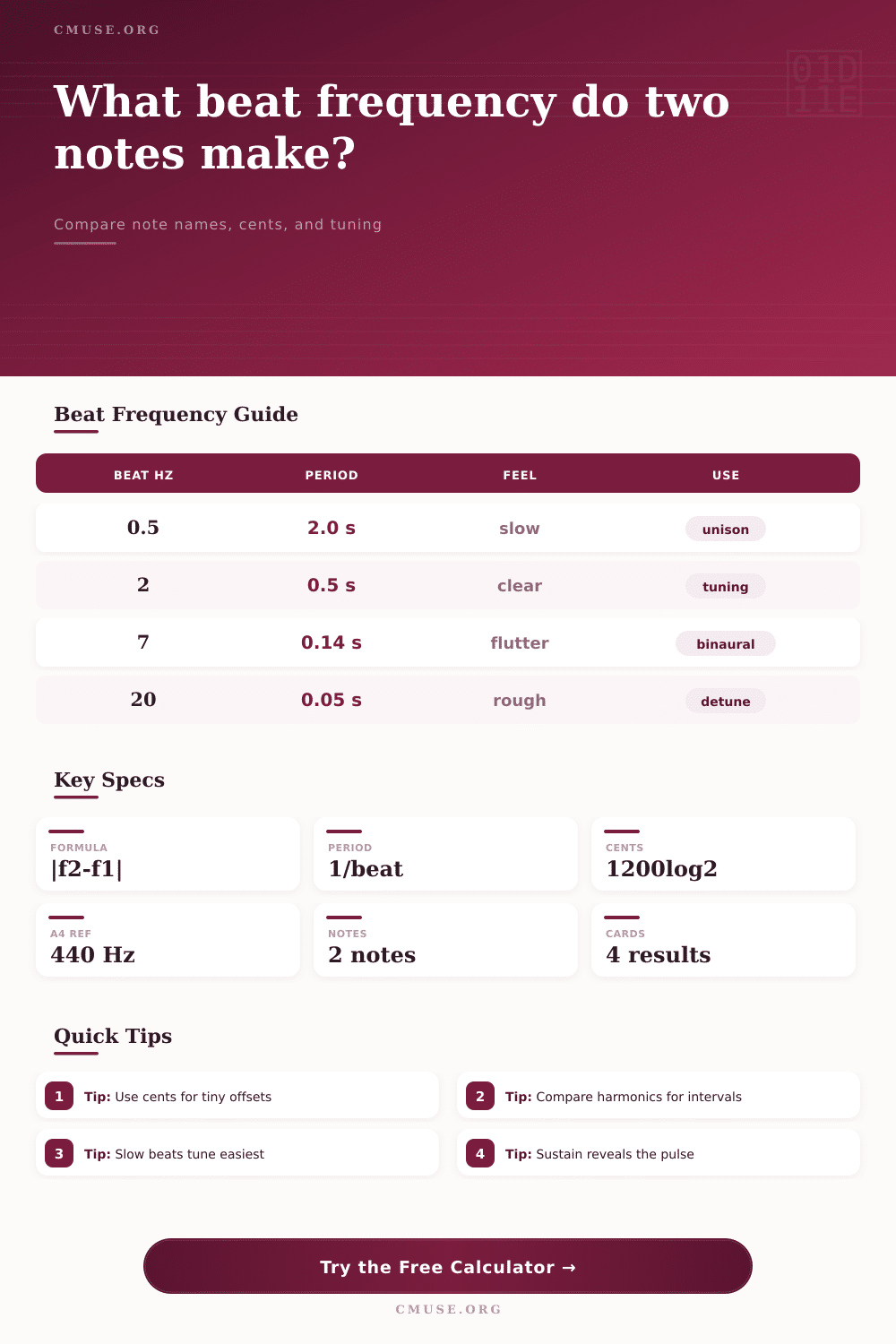
| Beat Rate | Beat Period | Listening Feel | Practical Use |
|---|---|---|---|
| 0 Hz | No cycle | No beating at this comparison | Unison or a matched harmonic partial. |
| 0.1-1 Hz | 10-1 s | Very slow swell | Fine piano, string, reed, and vocal tuning. |
| 1-3 Hz | 1-0.333 s | Clear countable pulse | Easy to hear and count against a drone. |
| 3-10 Hz | 0.333-0.100 s | Fast flutter | Common for deliberate detune or binaural checks. |
| 10-40 Hz | 0.100-0.025 s | Roughness zone | Often heard as thickness, chorus, or tension. |
| Above 40 Hz | Under 0.025 s | Less countable | The gap is usually perceived as pitch spacing. |
| Two Note Example | Note One | Note Two | Expected Beat |
|---|---|---|---|
| A4 reference lift | A4 at 440 Hz | A4 at +7.85 cents | About 2.00 Hz, one pulse every 0.5 s. |
| Piano unison | C4 | C4 +3.31 cents | About 0.50 Hz, one pulse every 2 s. |
| Guitar A string | A2 | A2 +11 cents | About 0.70 Hz, slow enough to count. |
| Sub bass detune | A1 | A1 +31.19 cents | About 1.00 Hz, a strong low pulse. |
| Binaural pair | G3 | G3 +71 cents | About 7 Hz near a headphone beat reference. |
| Interval | Compare Partials | Beatless Ratio | Calculation Use |
|---|---|---|---|
| Unison | 1st vs 1st | 1:1 | Direct frequency match. |
| Octave | 2nd lower vs 1st upper | 2:1 | The doubled lower note should align. |
| Perfect fifth | 3rd lower vs 2nd upper | 3:2 | Pure fifths make these partials match. |
| Perfect fourth | 4th lower vs 3rd upper | 4:3 | Pure fourths align these nearby partials. |
| Major third | 5th lower vs 4th upper | 5:4 | Just thirds tune by slowing this partial beat. |
| Minor third | 6th lower vs 5th upper | 6:5 | Useful for slow beating in triads. |
| Acoustic Metric | Formula | What It Means | Where It Helps |
|---|---|---|---|
| Beat frequency | |f2 - f1| | Number of loudness pulses per second. | Unison tuning and oscillator detune. |
| Beat period | 1 / beat Hz | Seconds from one loud pulse to the next. | Counting slow beats by ear. |
| Half-cycle dip | 1 / (2 x beat) | Approximate time from loud pulse to cancellation dip. | Understanding phase motion. |
| Cents spread | 1200 log2(f2/f1) | Pitch gap measured as hundredths of a semitone. | Tuners, intonation, and temperament checks. |
| Wavelength | speed / frequency | Physical length of one sound cycle. | Room, speaker, and acoustic comparisons. |
| Current Comparison | Frequency One | Frequency Two | Beat Result | Interpretation |
|---|
💡 Two Note Beat Tips
Take two players who is playing the exact same note. If they’re hitting the correct key then why does it sound so wrong?
The answer’s not a mystery; it’s an audible warble of unpleasing thickness, created by a physical phenomenon known as ‘beating‘, which occurs when two sound waves combine at different frequencies. In this area your brain doesn’t hear two separate pitch. Rather, it hears one tone whose volume increase and decreases rhythmically. This pulsing of the volume is what we call the beat frequency.
What Are Beats?
How fast it pulsates will give away exactly how far apart those notes actualy are. Interestingly, the math here is very straightforward, though it’s something most player relying on electronic tuners miss. You simply subtract the two pitches and there is your beat frequency. For example if you’ve got one note tuned at 440 and another at 442, you have a beat rate of 2Hz. This implies that the volume increase and decreases twice a second.
The calculator above can do the math for you, but the trick is in what you then make of that number. Ideally you want your beat to be slow, perhaps with a pulse once every couple of seconds. Then you have enough time to listen for which way the pitch is drifting and correct it as needed. When the beat is fast, the pulses blur together and becomes difficult to follow, sounding instead like a constant, rough shimmer.
Acoustics never operates in isolation: once we’ve pitched to the intended note, most of us leave it there… But often it’s the ‘invisible’ harmonics, or the overtones, that bring depth to a violin or richness to a piano. Whenever you tune a note into another interval, whether this be a third or even more commonly a fifth. You’re not simply bringing the fundamental tones into alignment. Instead, you’re considering how higher overtones of each sound relate to one another.
In a complex chord, it’s here that the actual beating occurs. What happens if the second partial of one note clash with the third partial of the other? The interval will feel tense. By slowing that beat down, what’s heard is a sensation of stability and purity.
When you listen for this pulse, context is key. You may be able to notice a very slow beat of only 0.5 Hz if it is heard in a drone sound that has sustained in a quiet space. However, those slower swells is lost in the mix of a loud ensemble. So instead, many players will then aim for a slightly higher beat rate, perhaps at 7Hz, where we perceive a gentle flutter rather than a slow swell. This flutter is more easly perceived over other noises in the background.
On the page there is a table of reference points explaining these practical cutoffs and how your perception of the same physical interaction vary between playing something tuned in unison on a piano or testing a synth patch.
The other consideration is how fast the beat sounds compared to the tempo. At 120 BPM a 2 Hz beat lines up on the quarter note and can be misleading. Depending off how your ear hears it, you may think you’re hearing rhythmic phrasing instead of an out-of-tune note. An even division of the musical meter in beats per second can obscure out-of-tune notes because they’ll sound like something you intend to hear.
You can use the calculator to see how the beat rate compares to your selected tempo and know when not to get caught in one of these rhythmic coincidences by accident.
The next wrinkle is tuning systems. The system used on pianos today is called equal temperament. It deliberately compresses or extends various intervals. For example, even if a piano is perfectly tuned, there will still be some beating because a perfect fifth is never quite a perfect fifth. If you tune using just intonation then these beats dissapears on some chords but then you cannot play in other keys.
What sounds best to your ear for the music you create? That’s the gap the calculator fills by telling you the cents spread, which is how many hundredths of a semitone each interval is away. That bridges the gap between pure frequency and something we can hear.
The bottom line is that beat is never a bad thing. Beat is feedback. It’s the voice of physics communicating to you where the energy is flowing. If you can train your ear to hear this pulse, you would of stop fighting the instrument and begin to cooperate with it. Then the warble guides you directly to the heart of the note.