Twelve Tone Row Calculator
Enter a 12-pitch aggregate, build the full twelve-tone matrix, transpose P I R RI forms, inspect interval content, and compare row segments for serial composition planning.
Preset use: Load a complete aggregate row, then adjust notation, transposition, row form, rotation, and segment size to inspect matrix behavior.
Calculation Breakdown
| Form | 1 | 2 | 3 | 4 | 5 | 6 | 7 | 8 | 9 | 10 | 11 | 12 |
|---|
| Operation | Formula | Order Direction | Serial Use |
|---|---|---|---|
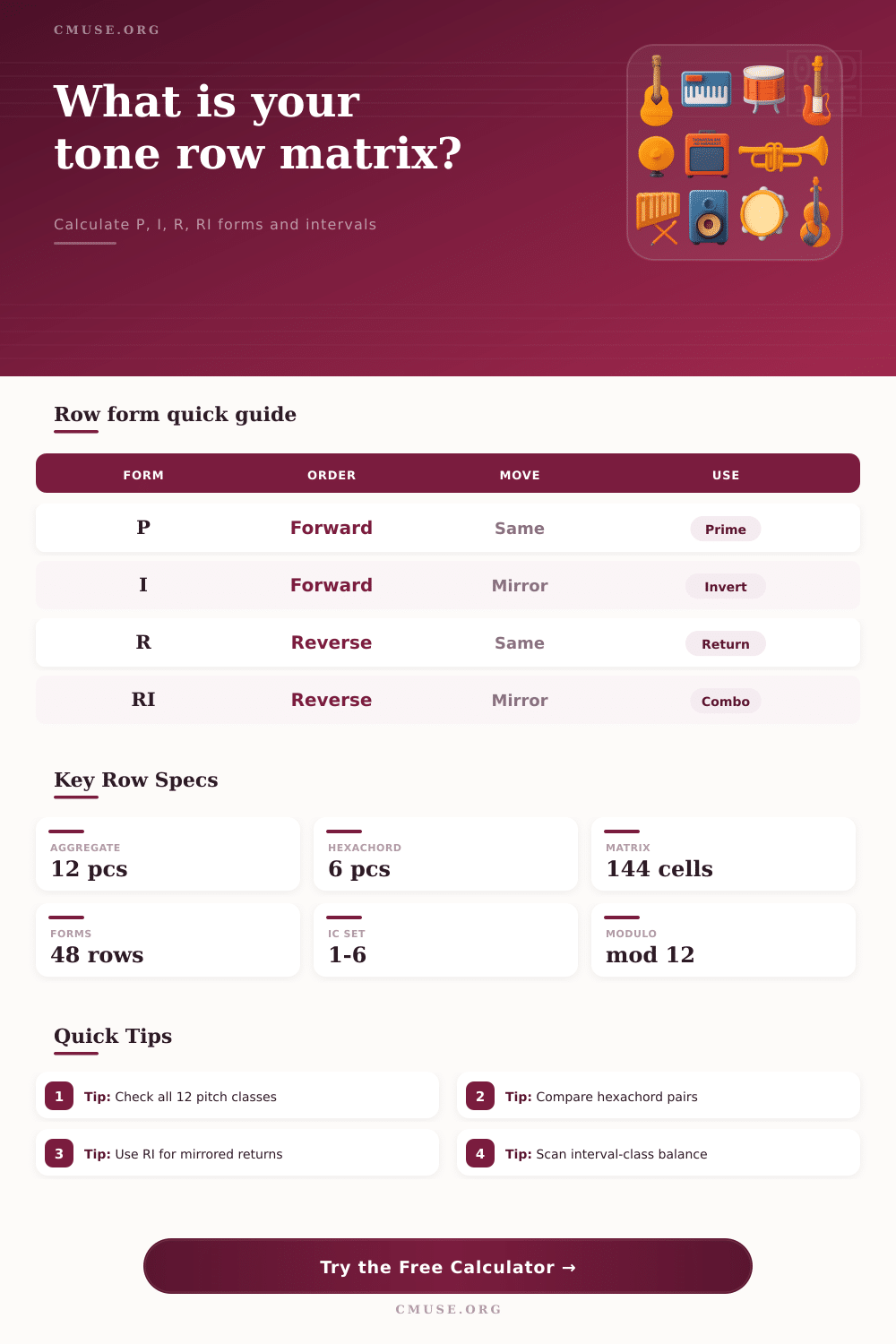
| P Prime | Original intervals transposed to n | Forward | Main source row or melodic statement |
| I Inversion | Intervals reflected around n | Forward | Mirror contour while preserving aggregate content |
| R Retrograde | Prime form read from last pitch to first | Backward | Return gesture, palindrome planning, phrase closure |
| RI Retrograde inversion | Inversion form read from last pitch to first | Backward mirror | Combines reversed order with mirrored interval direction |
| Interval Class | Semitone Sizes | Common Sound | Calculator Count |
|---|---|---|---|
| IC1 | 1 or 11 | Minor second or major seventh tension | 0 |
| IC2 | 2 or 10 | Whole tone or minor seventh span | 0 |
| IC3 | 3 or 9 | Minor third or major sixth color | 0 |
| IC4 | 4 or 8 | Major third or minor sixth color | 0 |
| IC5 | 5 or 7 | Fourth or fifth openness | 0 |
| IC6 | 6 | Tritone axis and symmetry point | 0 |
| Segment | Pitch Classes | Prime Normalization | Complement Note |
|---|---|---|---|
| Hexachord A | 0 1 4 2 9 3 | 0 1 4 2 9 3 | Compared with remaining six pitch classes |
| Design Type | What To Watch | Strength | Calculation Clue |
|---|---|---|---|
| All-interval row | Eleven ordered adjacent intervals should all differ | Maximum melodic interval variety | Interval signature uses every 1 to 11 move once |
| Hexachordal row | First six and last six pitch classes form contrasting sets | Clear phrase halves and aggregate control | Segment table shows 6+6 complementary blocks |
| Symmetric row | Inversion or retrograde may share ordered content | Strong axial identity and compact transformations | Matrix rows reveal repeated contours after transposition |
| Chromatic row | Adjacent IC1 count can dominate the profile | Dense linear pull and close voice leading | Interval-class table shows high IC1 or IC2 counts |
| Wide-leap row | Large ordered intervals need registral planning | Angular identity and dramatic contour | MIDI span grows when ascending registration is applied |
| Check | Target | Why It Matters | Where It Appears |
|---|---|---|---|
| Aggregate completeness | 12 unique pitch classes | Confirms the row is a valid twelve-tone source | Aggregate status card |
| Transposition family | P0 through P11 | Shows the row at every pitch-class level | Generated matrix rows |
| Inversion family | I0 through I11 | Shows mirrored forms around each pitch class | Generated matrix first column |
| Adjacent intervals | 11 ordered intervals | Describes melodic motion before the row closes | Interval profile card and breakdown |
| Segment grouping | 3, 4, or 6 pitch-class cells | Supports motif, tetrachord, and hexachord planning | Segment and complement table |
Twelve-tone composition require careful planning. Twelve-tone composition requires a composer to transform abstract idea into concreted ideas regarding tone row construction and tonal modifications. A tone row contains each of the twelve pitch class once.
Each of these tone rows can be reflected in different way to create different sounding rows while maintaining the requirement of each of the pitch classes to be represent in the piece of music. The calculator included in this article can help composers envision these different reflections of the same tone row. The prime form of the tone row is the original tone row that a composer construct for their composition.
Using the Tone Row Calculator
The inverted tone row reflects the interval between each of the tones in the tone row around a particular starting tone. The retrograde form of a tone row reads the tone row in reverse. The retrograde inverted tone row combine these two modifications to the tone row.
These four tone row contain forty-eight different lines of musical pitches. Many composers, however, utilize only a few of these lines to develop there composition. The matrix that a composer construct from the initial tone row can help to make it easier to envision these inverted tone rows.
The size of the segments of the tone row help to determine the structure of the composition that is developed from the tone row. If a composer divide the tone row into two hexachords, or rows of six different pitches, the remainder of the composition can utilize those two separate section of the tone row. The two hexachords may contain contrasting pitches to allow them to be developed separately within the same composition.
The size of the segments of a tone row can also be divided into tetrachords, or four note rows, or trichords, or three note rows. Using different segment size for the tone row helps to develop different sections within the composition. The composer can adjust the segment size for the tone row with the tool provided for composer.
Each of the adjacent notes of a tone row contain intervals that belongs to one of six interval classes. If there are many intervals of class one within a tone row, the tonal material will be chromatic. The distribution of the different interval class can be used to determine how a tone row will sound within a composition.
The calculator included in this article will calculate these interval classes for a tone row, saving the composer the effort of counting the intervals of each class within the tone row. The tone row can be rotated to begin at a different pitch within the tone row. While the intervals between each of the tones will be the same, rotating the tone row shift its starting point.
The rotation field within the calculator will indicate at which point the rotated tone row will begin, as well as indicate the relationship between the rotated tone row and the original, unrotated tone row. Often, composers find that the most interesting tone rows are not those with exotic interval patterns, but those whose transformations continue to be heard as musicaly interesting if the tone row is sung in different registers or played on different musical instrument. When sung in different registers, a tone row may lose it’s identity.
If played on different musical instruments, a tone row may lose its identity. These factor can be considered through listening to the tone row and its transformations generate by the calculator. The same considerations apply to the relationship of the two hexachords within the tone row.
Each of the two complementary hexachords may contain similar intervals, or they may contain no shared intervals. The calculator will generate the complementary relationship between the two hexachords, but the composer must use their own ears to determine if such a relationship within the tone row is interesting for their composition. Once establish, the matrix construct from the initial tone row becomes a reference tool for the composer.
It is no longer necessary to recompute the transformations of the tone row. The composer can instead focus on other aspect of the composition once the tone row is established.