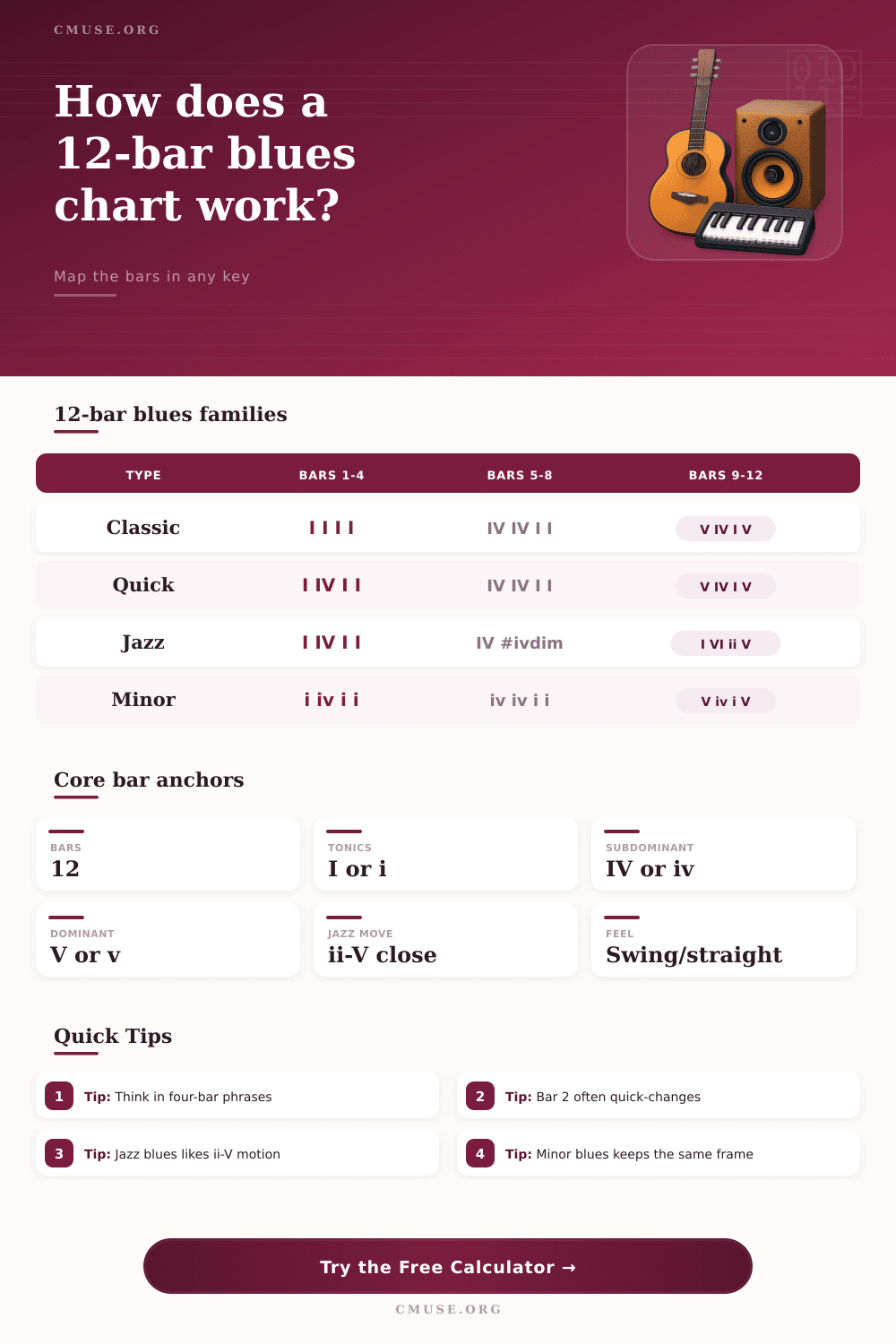
Twelve Bar Blues Chord Progression Chart
Build a bar-by-bar blues map in any key, then compare classic, quick-change, jazz, and minor variants without losing the form.
This chart is set up as a practical reference for players and arrangers. Pick a key, choose a family, and see the full 12-bar progression with clean chord names, Roman numerals, and an ending shape that matches the groove.
Every preset updates the key, family, color, feel, and ending so the chart stays musically coherent.
📊Progression family snapshot
📖Chord function reference
| Degree | Common chord | Function | Usual role |
|---|---|---|---|
| I / i | Tonics | Home base | Start and settle |
| IV / iv | Subdominant | Response | Pushes away from home |
| V / v | Dominant | Tension | Leads back to tonic |
| ii / ii7 | Predominant | Setup | Prepares a V chord |
🎹Common turnaround shapes
| Ending | Bars 11-12 | Best use | Feel |
|---|---|---|---|
| Hold | I | I | Open vamp or fade | Loose and roomy |
| Tag | I | V | Simple stop or repeat | Direct and clean |
| Turnaround | V | IV | Classic band cue | More movement |
| Jazz | I VI / ii V | Strong resolve | Most active |
Count the tune as three four-bar phrases so the form stays easy to hear and easy to chart.
If the bar 2 quick change sounds too busy, swap back to tonic and keep the ending strong instead.
The twelve-bar blues consist of twelve measures of music with a specific pattern to the chords that musicians play. The twelve-bar blues structure consist of three phrases each of four measure in length. The twelve-bar blues structure is used in many type of music, and many different musicians play the twelve-bar blues.
The twelve-bar blues chord pattern start with the tonic chord for four measures. The tonic chord is also referred to as an I chord. Following four measures is the subdominant chord for two measure.
How the Twelve-Bar Blues Works
The subdominant chord is also referred to as the IV chord; playing this chord create a change in the harmony of the song. The third phrase return to the tonic or I chord for two measures for stability within the song. Following these two measures, the song enter the ninth measure and plays the dominant chord for one measure.
The dominant chord is also referred to as a V chord; this chord creates a sense of tension for the song listener. The song can either play the IV chord for the tenth measure or stay on the V chord for that measure. Finally, for the eleventh and twelfth measures, the song resolve to the I chord once more to complete the twelve-bar blues cycle.
There are different variation of the twelve-bar blues structure. One common variation is the quick-change twelve-bar blues structure in which the song move to the IV chord in the second measure instead of remaining on the I chord. The quick change add more energy to the song.
Another common variation is a minor blues structure in which each of the major chords used in the twelve-bar blues are replaced by their associated minor chords. Thus, the I chord becomes the minor i chord and the IV chord becomes the minor iv chord. However, each chord structure is still played in the twelve-bar blues format for twelve measure.
Musicians play the twelve-bar blues using different rhythm. For instance, a shuffle involve a specific swing in the eighth notes for each measure, while a straight twelve-bar blues use even eighth notes within each measure. Additionally, musicians may use different chord voicing for the twelve-bar blues.
For instance, instead of using a major chord for the I chord, a musician may use a thirteenth chord for that chord; this will alter the sound of the twelve-bar blues cycle. The chords of the twelve-bar blues can be expressed using Roman numeral, regardless of the key of the song. For instance, if the song is in the key of C, the I chord will be C, the IV chord will be F, and the V chord will be G. For the key of G, the I chord will be G, the IV chord will be C, and the V chord will be D. Thus, each chord still has the same relationship to each other within the twelve-bar blues cycle.
Pay attention to the ninth measure of the twelve-bar blues; during this measure, musicians play the V chord. This chord creates tension in the song; thus, it must be resolve by the end of the song. Beginners who are new to playing twelve-bar blues often make mistake in the last two measures of the song, known as the turnaround.
The turnaround ensure that the song can continue into the next cycle of the twelve-bar blues. If the song is to be over, simply hold the I chord after the twelfth measure. Finally, practice playing the four-bar phrase within the twelve-bar blues to ensure that you maintain the structure of the song when playing it.