TWA Noise Calculator
Estimate 8-hour time-weighted average exposure, daily dose, allowed time, and protected noise level for music and audio work.
🎧 Quick Presets
📈 Exposure Inputs
📌 Noise Rule Spec Grid
| Standard | Criterion | Exchange Rate | TWA Dose Formula |
|---|---|---|---|
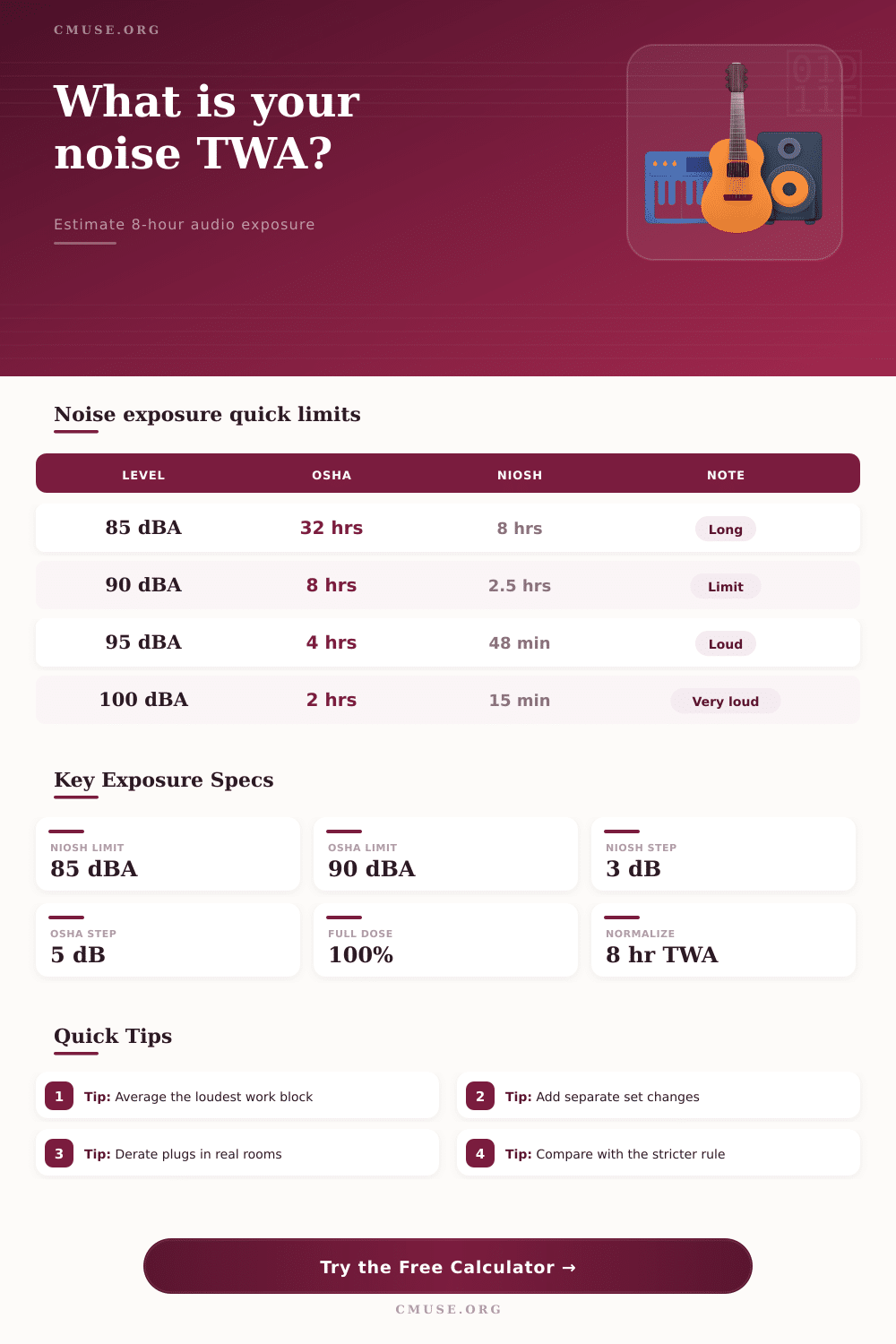
| NIOSH / ACGIH | 85 dBA for 8 hr | 3 dB | 85 + 9.97 log10(dose/100) |
| OSHA PEL | 90 dBA for 8 hr | 5 dB | 90 + 16.61 log10(dose/100) |
| Custom | User entered | User entered | Criterion + exchange/log10(2) scale |
| Protected Estimate | Same rule | Same rule | Recalculates dose after attenuation |
| Level | OSHA Allowed Time | NIOSH Allowed Time | Exposure Note |
|---|---|---|---|
| 85 dBA | 32 hours | 8 hours | NIOSH daily criterion |
| 90 dBA | 8 hours | 2 hours 31 minutes | OSHA daily criterion |
| 95 dBA | 4 hours | 48 minutes | Common loud rehearsal |
| 100 dBA | 2 hours | 15 minutes | Typical club monitor risk |
| 105 dBA | 1 hour | 5 minutes | Very short safe window |
| Music Scenario | Typical dBA | Duration | NIOSH Dose |
|---|---|---|---|
| Studio editing room | 70-75 dBA | 6 hours | Below 10% |
| Orchestra pit rehearsal | 86-90 dBA | 3 hours | 38-95% |
| Drum practice room | 96-100 dBA | 1 hour | 317-800% |
| DJ booth monitor | 98-103 dBA | 1.5 hours | 756%+ |
| Total Dose | TWA Meaning | Result Color | Calculation Use |
|---|---|---|---|
| Under 50% | Below half daily dose | Low concern | Track cumulative work |
| 50-100% | Approaching daily limit | Watch exposure | Reduce later loud blocks |
| 100-200% | Daily limit exceeded | High exposure | Shorten duration or lower level |
| Over 200% | Multiple daily doses | Severe exposure | Recheck levels immediately |
Sound exposure accumulate in the body over time, and sound exposure can lead to damage even if the listener feel no discomfort from the sound that is present. For example, it is possible for a drummer to feel fine after a rehearsal period yet have experience sound exposure that has reached beyond the accepted safety standards for sound exposure. Such high levels of sound exposure can occur in a vocal booth, an orchestra pit, or within a club monitor position.
The risk from sound exposure are determined by the volume of the sound exposure and the length of time that the exposure exist. Furthermore, which mathematical rule is used to calculate the amount of sound exposure to which a person is expose determine the risk. There is two main standards for calculating sound exposure.
How to Use the Sound Exposure Calculator to Protect Your Hearing
One standard use a 3 dB (decibel) exchange rate, where every 3 decibel of sound exposure represent a doubling of the energy of the sound. The other standard use a 5 dB exchange rate, which is more forgiving of sound exposures that has high levels of sound for short period of time. Each of these sound calculation standards lead to different measurements of the amount of sound exposure to which a person is exposed.
Thus, the calculator allow for the individual to switch between these two sound calculation standards to reflect the model that they would like to use to calculate there sound exposure. In order to use the calculator, an individual must enter specific data points into the calculator. These data points includes the sound level measurement (which should represent the average sound level of the loudest continuous block of sound during a period), the length of time that that block of sound lasted, the sound level measurement of any separate sound exposure segment (such as a sound check), the performance of any hearing protection that is used during that time period (which should be lower than the hearing protection rating that are printed on the packaging of that protection), and those entered value will lead to the calculation of a time-weighted average sound level over an 8-hour period.
In addition to calculating the time-weighted average sound level, the calculator also calculate the percentage of the daily sound exposure limit that the individual has reached, as well as how many minute that the individual can stay at that sound level before reaching the daily sound exposure limit. These outputs of the calculator can help an individual to make decision regarding their sound exposure. For instance, if the calculator calculates the percentage of the daily sound exposure limit to be 120%, that percentage indicate that the individual has reached beyond their daily allowance for sound exposure.
In such a case, the individual should either shorten the next loud segment of sound exposure, or incorporate the use of hearing protection. Additionally, the sound exposure calculator output the amount of time that the individual would spend in a protected environment with earplug or in-ear monitor, as well as the length of time that the individual can remain at their measured sound level before reaching the daily sound exposure limit. These outputs indicate the sound exposure risk for that individual, as well as the benefit of the incorporation of hearing protection.
Despite the fact that the sound exposure calculator allow individuals to calculate their risk from sound exposure, many real-world environment and schedule are more difficult to reflect in the parameter of the calculator. For instance, a brass sectional within a small rehearsal room may create more sound exposure than the same brass sectional within a large concert hall, as the large concert hall reflect more sound absorption. Additionally, sound exposure occur during period outside of the performance itself, such as during load-in and load-out of the performance location.
Finally, sound exposure can result from the use of headphone within a control room. All of these risk are difficult to measure with a sound meter. Thus, an individual should divide sound exposure into separate segment within a day, and each of those segment should be calculated with the calculator in order to provide an accurate estimate of the total sound exposure that an individual create during there workday.
The reference table that are provided within the calculator illustrate the length of time that an individual can remain at a certain sound level before reaching their daily limit. These reference table do not need to be memorized, but can aid the individual in understanding the steepness of the curve depicted within the calculator. For instance, a 5 decibel increase to the sound level of a performance may not seem like much to the listener, but it may cause the allowed time for that sound level to drop by half if the sound is exchange at the 5 decibel rate.
Thus, the steepness of the curve indicate that even small change in sound level or duration will have a large impact upon total sound exposure. It is possible for individual to make mistake when using the sound exposure calculator. One mistake is to consider the final calculated time-weighted average as some type of permanent label regarding the sound exposure of that individual.
For example, an individual may have a low calculated time-weighted average based off the sound exposure from one rehearsal, but experience high sound exposure during the production of that bands music. Thus, calculating time-weighted average over time will reveal the total amount of sound exposure of that individual. Furthermore, individuals often make the mistake of assuming that they feel fine after sound exposure indicate that they have experienced sound exposure at high level.
Sound exposure can cause temporary threshold shift, which is a masking of the damage cause by sound exposure. Such damage may not become apparent until the following day, or possibly the following week. Although the sound exposure calculator is not a means of replacing professional calculation of sound exposure and health, it do remove some of the mathematical difficulty regarding calculating sound exposure.
Thus, this calculator allow for sound exposure risk to become an easier habit for an individual to incorporate into there performance schedule. Maintaining such a habit regarding the use of the sound exposure calculator is important for each of those individual who contribute to the sound exposure of there environment.