Turnaround Bar Calculator
Plan progression length, turnaround bars, repeat handling, tempo, meter, phrase alignment, seconds, beat counts, and exact cue bar numbers for charts, rehearsals, and DAW markers.
Calculation Breakdown
| Cue | Repeat | Cue Bar | Turnaround Starts | Turnaround Ends | Time at Cue |
|---|---|---|---|---|---|
| Calculate to generate cue bars. | |||||
| Planning Item | Formula | What It Tells You | Typical Use |
|---|---|---|---|
| Cycle length | progression + turnaround | Bars before a repeat resets | 12-bar, 16-bar, 32-bar forms |
| Played turnarounds | repeat rule | How many turns are actually heard | Last-time tags and endings |
| Bar duration | 60 / BPM x numerator x 4 / denominator | Seconds per measure | DAW marker and film cue timing |
| Cue bar | turn start - lead bars | Where to call the next change | Band charts and rehearsals |
| Alignment remainder | total bars mod phrase grid | Whether the form lands squarely | 4, 8, 12, or 16 bar phrase checks |
| Form Type | Progression Bars | Turnaround Bars | Cycle Length | Phrase Check |
|---|---|---|---|---|
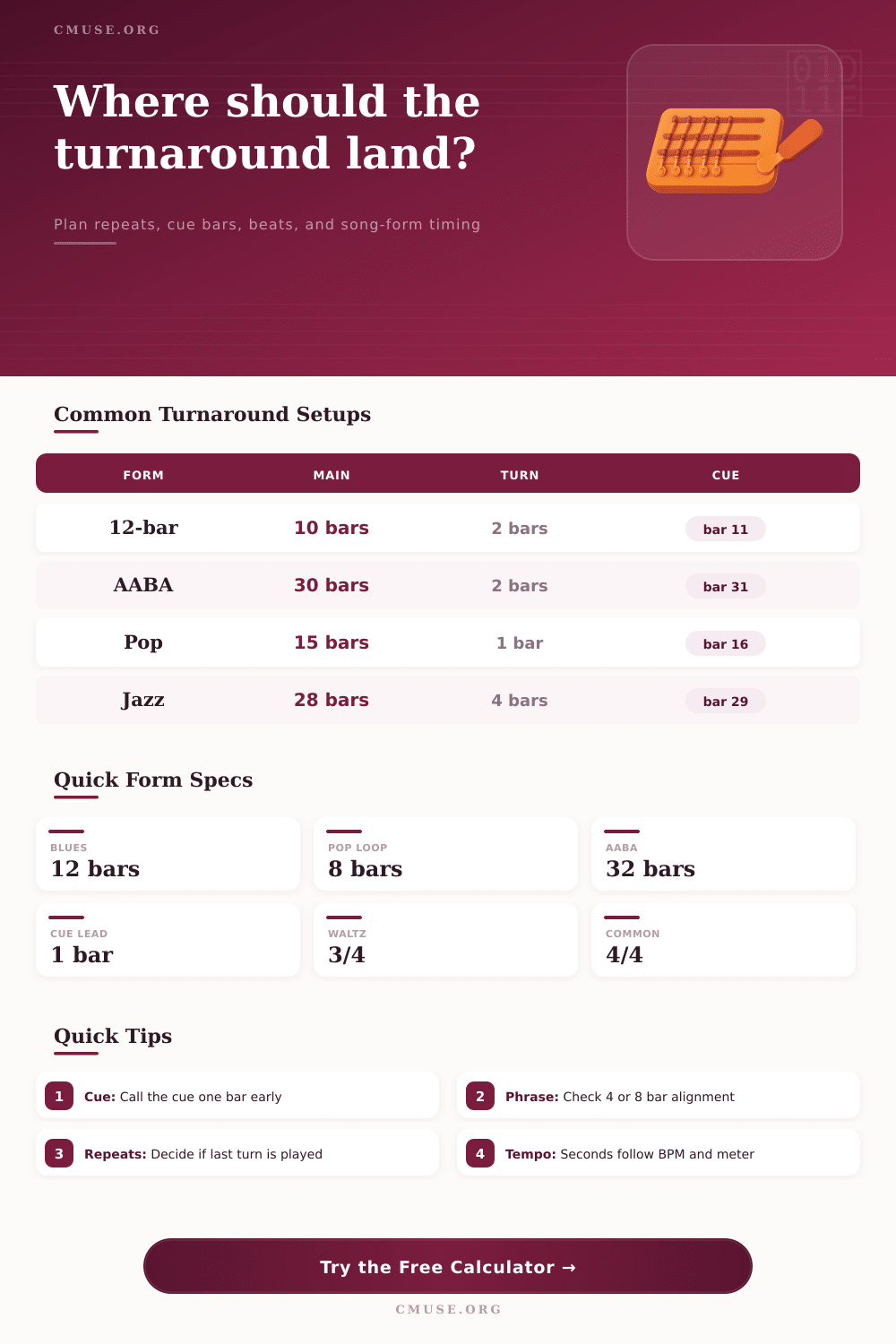
| 12-bar blues | 10 | 2 | 12 bars | Aligns to 12-bar chorus |
| 8-bar pop loop | 7 | 1 | 8 bars | Aligns to 4 and 8 bars |
| 16-bar verse | 14 | 2 | 16 bars | Aligns to 4, 8, and 16 bars |
| 32-bar AABA | 30 | 2 | 32 bars | Aligns to 8 and 16 bars |
| Montuno cycle | 28 | 4 | 32 bars | Long phrase resolution |
| Meter | 90 BPM | 120 BPM | 140 BPM | Counting Note |
|---|---|---|---|---|
| 4/4 | 2.667 sec/bar | 2.000 sec/bar | 1.714 sec/bar | 4 quarter notes |
| 3/4 | 2.000 sec/bar | 1.500 sec/bar | 1.286 sec/bar | 3 quarter notes |
| 6/8 | 2.000 sec/bar | 1.500 sec/bar | 1.286 sec/bar | 6 eighth notes |
| 5/4 | 3.333 sec/bar | 2.500 sec/bar | 2.143 sec/bar | 5 quarter notes |
| 7/8 | 2.333 sec/bar | 1.750 sec/bar | 1.500 sec/bar | 7 eighth notes |
| Rule | Turnarounds Played | Best For | Last Repeat Behavior |
|---|---|---|---|
| Every repeat | same as repeats | Blues choruses, vamps, looped sections | Final turnaround is included |
| Skip final | repeats minus one | Ending that replaces the last turnaround | Progression goes directly to ending |
| Last only | one | Simple verses with one setup into next section | Only the final pass turns around |
| No turnaround after first pass | zero | Straight-through forms or spoken-count charts | Repeats use progression bars only |
| Preset | Meter | Tempo | Repeats | Main + Turn | Reason To Use |
|---|---|---|---|---|---|
| 12-Bar Blues 4 Choruses | 4/4 | 120 BPM | 4 | 10 + 2 | Classic solo or comping roadmap |
| Jazz AABA 2 Choruses | 4/4 | 132 BPM | 2 | 30 + 2 | 32-bar chorus marker plan |
| Pop 8-Bar Loop Vamp | 4/4 | 96 BPM | 6 | 7 + 1 | Loop ending and live cue checks |
| Waltz 8-Bar Phrase | 3/4 | 84 BPM | 3 | 6 + 2 | Three-count arrangement timing |
| Odd Meter 7/8 Cue | 7/8 | 140 BPM | 5 | 7 + 1 | Bar count stays clear in odd meter |
Phrase Grid
Four-bar alignment is the fastest way to spot an extra or missing turnaround in most pop, rock, and country charts.
Section Grid
Eight-bar checking is useful when the turnaround is part of a verse, bridge, vamp, or solo chorus.
Blues Grid
Twelve-bar checking keeps solos, pickups, shout cues, and ending tags aligned to blues chorus math.
DAW Markers
The seconds output helps place markers, click-count instructions, or cue sheets against a fixed tempo session.
Despite repeated rehearsals of the changes, panic can set in as soon as you reach the downbeat. You may be familiar with melody, and even remember where to place the turnaround for the last chorus in bar so-and-so; it’s not that your mind has gone blank… unless you have a clear grasp of the structure. Typicaly this comes back to the fact that you hadn’t worked out the timings prior to arriving at piano.
The way it relates to music is that turnarounds provides the hinge between the end of one section of a song and the start of another. This applies equally to AABA standard through to a twelve-bar blues. Whilst most players counts the bars rather than thinking in terms of phrases this serves well when piece is performed once. However, when repeated several times during a performance or if the tempo alter, things become hard mentally.
Why Planning Helps You Play Better
What’s required here is to take what we hear in our heads (musical intuition) and apply it to specific points. This page calculator do just that by turning your choices for repeats and progression length into precise cue points.
The arrangement becomes more complex with repeats, depending on how you handle them. Do you play the turnaround each time through, or omit it on the last chorus? That decision change the number of bars right away. Every marker in a digital audio workstation or live playback chart move. The rhythm section is waiting for a loop; other players are anticipating a stop. It’s a common problem for band. Eliminate that ambiguity by planning those details.
The other aspect of communicating with the band is the meter and tempo. At sixty beats per minute in a four-four ballad, you have roughly two seconds to communicate with each bar. You have time to provide visual cues. If it’s a fast tempo like a seven-eight track that’s running at one hundred forty beats per minute, then there is very little time to convey your intentions. With a fast tempo, you must make lead calls a full bar ahead. Otherwise, musicians won’t have any time to respond. You can see from the timing tables below on this page just how rapidly music travels based off the speed and the meter.
A second frequent cause for error is phrasing. Typicaly Western music use bars in groups of two, four, eight, or twelve. An odd number of turnaround bars mean your arrangement sits outside that grid. Nobody could of be able to tell but the song feels lopsided. You don’t notice if the form lands on beat one or hangs in half-measures until you check total bar count on a phrase grid. That structural element make all the difference to the professional sound of the track.
There are some good presets included that cover usual things like jazz montunos and pop loops that provide a basis to tweak instead of starting at zero. You might adjust your cue lead time, pick up bars, end tag etc., to match what is on your chart. The flexibility let you model odd structures where the number of bars adds up wrong when rehearsing.
Freedom is vital for great musicianship, yet it must have a solid framework too. It means being able to know when the turnaround comes so you don’t need to count anymore and just feel the music. You can then rely on the structure and be free to express yourself and interact with other player. The performance is what shines when the math happens in the background.