Tuplet Ratio Calculator
Work out the exact duration of any tuplet – triplets, quintuplets, septuplets and beyond. Get per-note milliseconds, full group length, MIDI ticks and the effective note rate for any ratio, base note value and tempo
Full Calculation Breakdown
| Tuplet Name | Ratio (N:M) | Meaning | Commonly Used In |
|---|---|---|---|
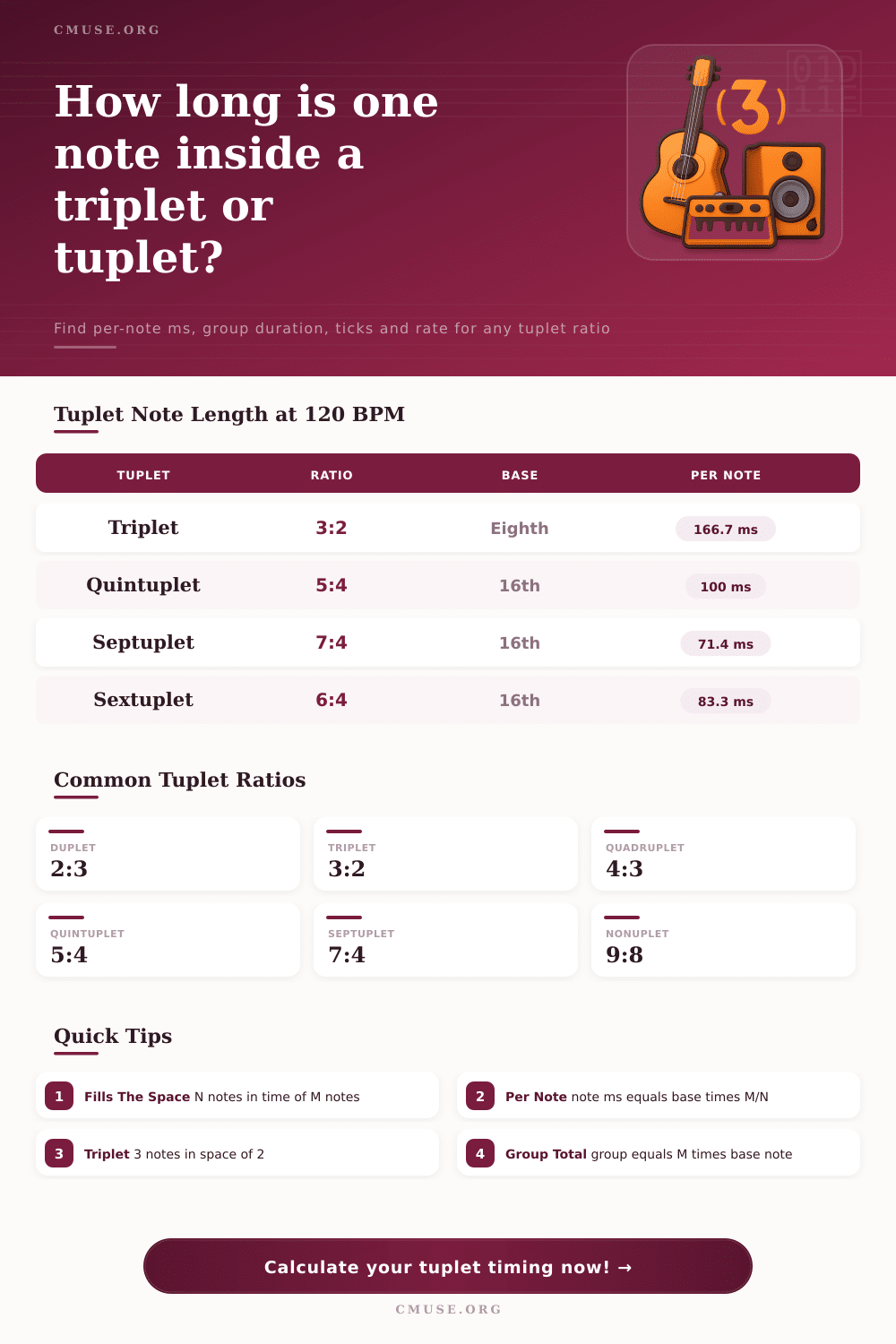
| Duplet | 2:3 | 2 in space of 3 | Compound meters (6/8, 9/8) |
| Triplet | 3:2 | 3 in space of 2 | Swing, shuffle, fills |
| Quadruplet | 4:3 | 4 in space of 3 | Compound meters |
| Quintuplet | 5:4 | 5 in space of 4 | Prog, fusion, fills |
| Sextuplet | 6:4 | 6 in space of 4 | Fast runs, double kick |
| Septuplet | 7:4 | 7 in space of 4 | Prog metal, modern jazz |
| Nonuplet | 9:8 | 9 in space of 8 | Dense ornamental runs |
| BPM | Quarter | Eighth | Sixteenth |
|---|---|---|---|
| 80 | 750 ms | 375 ms | 187.5 ms |
| 90 | 666.7 ms | 333.3 ms | 166.7 ms |
| 100 | 600 ms | 300 ms | 150 ms |
| 120 | 500 ms | 250 ms | 125 ms |
| 140 | 428.6 ms | 214.3 ms | 107.1 ms |
| 160 | 375 ms | 187.5 ms | 93.75 ms |
| Tuplet | Ratio | Per Note (ms) | Group Total (ms) |
|---|---|---|---|
| Triplet | 3:2 | 166.7 ms | 500 ms |
| Quintuplet | 5:4 | 200 ms | 1000 ms |
| Sextuplet | 6:4 | 166.7 ms | 1000 ms |
| Septuplet | 7:4 | 142.9 ms | 1000 ms |
| Nonuplet | 9:8 | 222.2 ms | 2000 ms |
| Tuplet | Notes (N) | In Space Of (M) | Duration Factor M/N |
|---|---|---|---|
| Triplet | 3 | 2 | 0.6667 |
| Quintuplet | 5 | 4 | 0.8000 |
| Sextuplet | 6 | 4 | 0.6667 |
| Septuplet | 7 | 4 | 0.5714 |
| Nonuplet | 9 | 8 | 0.8889 |
By now most musicians has heard of and felt what a triplet is, and they will know what I mean by a bouncy, swung subdivision that splits even eighth notes in half. Yet ask them to describe, with millisecond accuracy, the exact millisecond difference between a quintuplet and a septuplet at one hundred twenty beats per minute, and they will frequent freeze up. This isn’t because it’s not musical; its because it’s precise.
Your ears dictate the feel when playing a complex fill on a live instrument, or programming drums into a digital audio workstation, yet the grid dictates reality. Enter the number of beats per minute, the base note value, and the tuplet ratio to get hard time values using the tool above. This translates from an abstract idea of rhythm to actual time. Your brain thinks about rhythm in terms of duration, not simply relative spacing between notes. This translation are essential.
How to Calculate Tuplet Time Accurately
The calculator also gives you the number of midi ticks (if that’s what you’re dealing with), the total time of the tuplet, and the actual duration of each note in milliseconds. The rest of the settings is based off the tempo, base note value, and ratio you enter. So you’ll notice that a sixteenth note triplet sounds different than a triplet on a whole note, even though they are played in time. You’ll be able to switch through different subdivisions here to make sure you’re measuring the correct slice of time.
It’s also a small detail that trips people up as sometimes people wants an eighth note as their base note value instead of a quarter note. In this case, you’ll be out by a factor of two which is enough to break all the math. For producers, this PPQN setting is key too. Older standards was ninety-six ticks per quarter note, but newer DAWs typically has nine hundred sixty or above ticks per quarter note. This prevents subtle drift errors when you copy timing information from one piece of software to another with different resolutions. Those errors can kill a nice tight groove.
Time compression techniques is what tuplets are really all about. They simply pack more notes than there should of been into the same amount of time. By creating an element that disrupts your internal metronome, a quintuplet places five notes instead of four into available space. That disruption is the whole point of fusion jazz or progressive metal, and it provide forward motion and tension to drive energy along. But if you’re too rigid about it then it can become enemy of groove as opposed to precision.
The calculator’s output give you perfect mathematical equality between each note in the tuplet. This means that in theory, all five notes of a quintuplet is equal in length. In practice, this can sound robotic. Great musicians will often add micro-timing variations so the pattern breathes, as well as accenting certain beats within the tuplet. You have to add the flesh and blood. It doesn’t tell you which ones to punch forward or pull back for stylistic effect; it only tells where the notes land on the grid.
For rapid sanity checking I’d refer to reference tables found on the page. These show how time is split up with a standard triplet compared to more unusual ones like nonuplets. You can see how small those subdivisions are at higher tempos when they’re placed next to each other. At one hundred and sixtieth BPM a septuplet travels along quick enough that even very small imperfections stands out as glaring errors. Knowing your millisecond targets makes it easy to configure your recording software’s quantization settings correctly.
Playing tuplets is a question of combining your timing skills with a grasp of mathematics. Use the ruler (the calculator above) to measure yourself against, but how do you choose to sit in the middle of the line, or dance around it to create an effect? With the confidence that comes from knowing precisely how long each note lasts, you can break the rule with intent and precision instead of guesswork as to where the beat lands. You will know exactly how long to give each note.