Tuplet Duration Calculator
Convert tuplets into exact milliseconds, beats, measure share, and playback density from tempo, written note value, ratio, dots, repeats, and time signature.
Load a common notation problem, then adjust the ratio and tempo. The calculator treats a tuplet as a chosen number of written notes compressed or expanded into the time of another number of the same written note value.
Duration Breakdown
Tempo Conversion
The BPM value is first converted into milliseconds for the selected beat unit, then into quarter-note units for comparison across meters.
quarter ms = 60000 / BPM * beat unit
Tuplet Compression
A tuplet group lasts as long as the reference count of normal written notes, then that span is divided equally by the played notes.
each note = normal note ms * in-time count / tuplet notes
Measure Occupancy
The total notated span is compared with the selected time signature, so dense runs can be checked before copying them into a bar.
bars = phrase quarter units / meter quarter units
Practice Density
Notes per second and accent spacing show how fast the gesture feels, even when two tuplets occupy the same notated duration.
notes per second = total played notes / total seconds
| Tuplet Type | Typical Ratio | Speed Versus Normal Notes | Common Count Shape | Best Musical Use |
|---|---|---|---|---|
| Triplet | 3 in the time of 2 | 1.50 times the normal note rate | 1-trip-let | Swing subdivisions, fills, compound-to-simple crossing |
| Sextuplet | 6 in the time of 4 | 1.50 times the normal note rate | 1-2-3-4-5-6 | Drum rudiments, guitar runs, keyboard flourishes |
| Quintuplet | 5 in the time of 4 | 1.25 times the normal note rate | 2+3 or 3+2 | Modern phrasing, progressive fills, classical ornaments |
| Septuplet | 7 in the time of 4 | 1.75 times the normal note rate | 2+2+3 | Compressed runs and dramatic cadential figures |
| Duplet | 2 in the time of 3 | 0.67 times the normal note rate | long two | Simple-feel notes inside 6/8, 9/8, or 12/8 |
| Written Figure | Normal Duration | Triplet 3:2 Each | Quintuplet 5:4 Each | Septuplet 7:4 Each |
|---|---|---|---|---|
| Quarter notes | 500 ms | 333.33 ms | 400 ms | 285.71 ms |
| Eighth notes | 250 ms | 166.67 ms | 200 ms | 142.86 ms |
| 16th notes | 125 ms | 83.33 ms | 100 ms | 71.43 ms |
| Dotted eighth notes | 375 ms | 250 ms | 300 ms | 214.29 ms |
| 32nd notes | 62.5 ms | 41.67 ms | 50 ms | 35.71 ms |
| Figure | Meter | Notated Span | Bar Share | Reading Check |
|---|---|---|---|---|
| Quarter-note triplet group | 4/4 | 2 quarter-note beats | 50% of a bar | Fits across beats 1 and 2 or beats 3 and 4 |
| Eighth-note triplet group | 4/4 | 1 quarter-note beat | 25% of a bar | One beat of triplet subdivision |
| Five 16ths in time of four | 4/4 | 1 quarter-note beat | 25% of a bar | Use 2+3 or 3+2 accents for clarity |
| Duplet eighths in compound time | 6/8 | 3 eighth-note beats | 50% of a bar | Creates simple two across dotted-quarter pulse |
| Seven 16ths in time of four | 7/8 | 2 eighth-note beats | 28.57% of a bar | Dense fill inside two eighth-note slots |
| Practice Target | What To Watch | Useful Range | Tuplet Risk | Adjustment |
|---|---|---|---|---|
| Below 4 notes per second | Subdivision steadiness | Slow study | Dragging between notes | Count aloud or tap the normal pulse |
| 4 to 8 notes per second | Accent placement | Moderate tempo | Uneven grouping | Mark a 2+3, 3+2, or 2+2+3 shape |
| 8 to 12 notes per second | Hand coordination | Fast passage | Rushing the final notes | Loop one group before adding repeats |
| Above 12 notes per second | Gesture economy | Virtuosic burst | Blurring rhythm into texture | Use slow tempo scale and raise BPM gradually |
Conventions Notation has assumptions behind it. We assume that we all know a half note is twice as long as a quarter note. We assume that every bar in 4/4 time contain four beats.
But what happens when a composer notates a quintuplet or a triplet? It goes against the binary math we all rely on. Now you’re staring at a group of notes contained within brackets; you don’t know how long they last. The calculator does the maths for you, but pressing a button doesn’t help you understand why those numbers matter.
How Tuplets Change Musical Timing
Confusion regarding tuplets most commonly arises from blurring the difference between note as it appears on paper versus its true duration. Triplet does not alter what ink hits the page. It alters when it happen. Playing eighth-note triplets at 120 beats per minute means that your brain understands there is three evenly spaced notes where there would normally be two eights.
The conversion to milliseconds allows for easier understanding, since musicians seldom calculate in thousandths of a second except when they has to sync to a DAW or click track. Having that specific millisecond value makes clear how far apart you are supposed to be physically, whether with your feet or fingers.
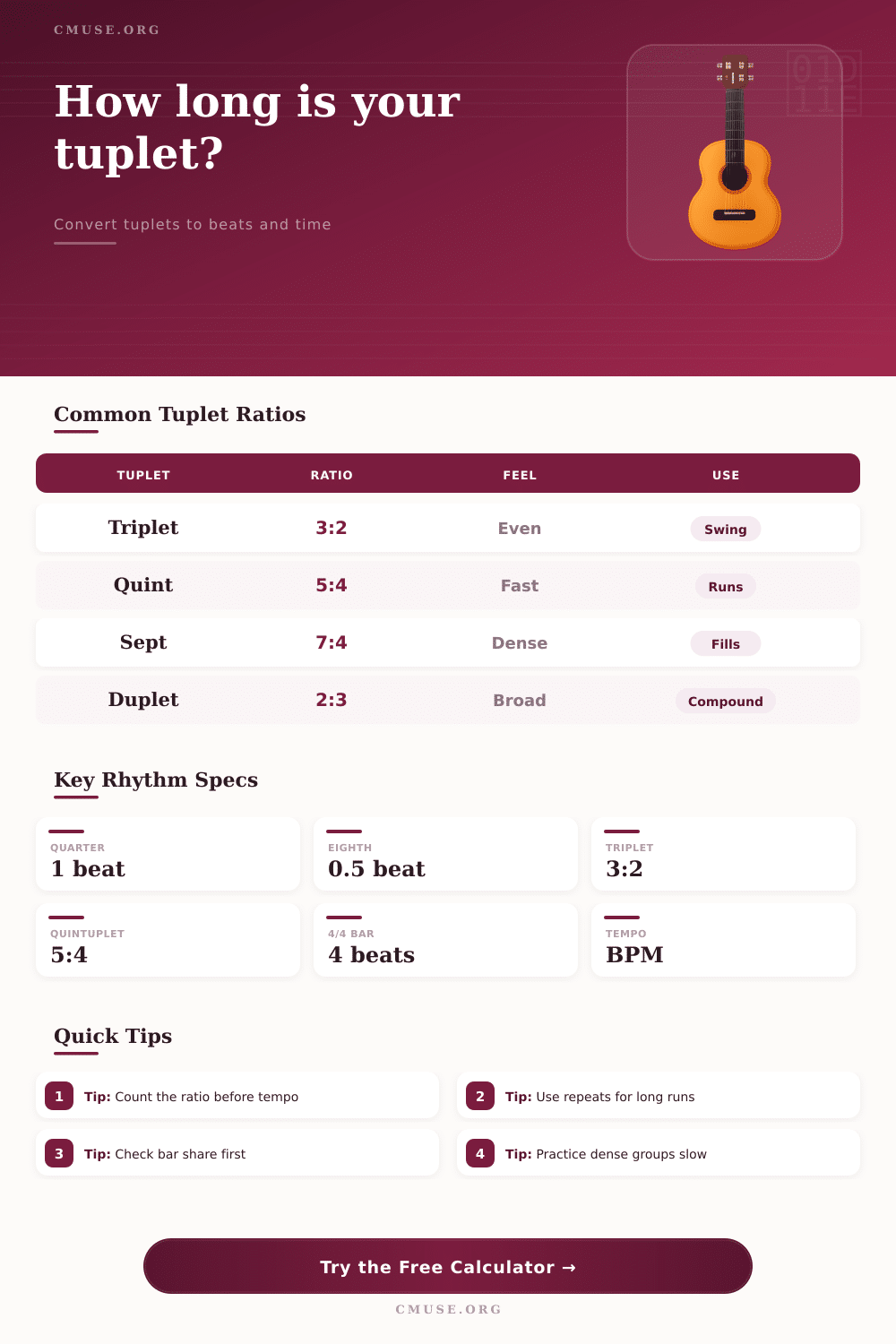
Sometimes the problem isn’t even the ratio. While triplets are familiar to most (the 3:2 ones at least), septuplets and quintuplets don’t fall neatly onto a standard pulse; therefore they sounds chaotic. Look at table of references on the page for an example. Here we have the ratio of 5:4, which squeezes five notes into the four spaces normaly occupied by them.
In other words, it’s what turns classical cadenzas into a hair’s breadth of speed or makes progressive metal sound like it’s ripping through the strings. There’s no sorcery here. Just math with makeup on. Plug in the number of notes, enter the note value and the system will convert that airy ratio into concrete measures of time.
Is your run of septuplets going to fit snugly within the measure? Or will it spill over into the next bar? If so, that’s something worth considering when rehearsing.
Then there’s the feeling side to it as well; the human factor. Performance change while notation stays the same. What sounds like a straight triplet does not necessarily read straight on paper. Pushed rhythms, swung phrasing, laid-back feel all change the way we perceive time, yet stay within the confines of what is written.
The calculator accounts for these nuances by recognizing that a metronome may suggest one thing, while a jazz pianist’s triplet will hold slightly longer. Here, theory meets the practice. You can enter into the calculator the ideal millisecond figure but unless you can play it quickly enough, it means nothing.
These figures are commonly linked to practice strategies too. If you know that a group of tuplets lasts 500 milliseconds, you can plan your repetitive exercise to match. You won’t necessarily play any faster but try to be accurate in this predetermined time slot.
The reference grids on the page let you see visually where various tuplets sits compared to regular notes. This helps you avoid the frequent error of speeding up through a complex passage, only to discover at the end of the phrase that you should of covered two bars rather than one.
In conclusion, tuplets are all about mastering the control of time against its natural flow. Adding an odd number to an even structure create tension. And that’s what these tools aim to take out of the equation: guesswork. Counting and doing division in your head isn’t necessary. You simply need to know where to arrive.
Once the numbers match up with your inner pulse, the music stop being mathematical and begins to sound groovy. That is what it’s all about.