Practice Hours to Learn Trombone Calculator
Estimate focused trombone study time from slide positions, embouchure, breath, intonation, lip slurs, clefs, and articulation needs.
🎺Trombone learner presets
♫Practice profile
Your trombone learning estimate
📊Trombone/spec grid
The estimate treats trombone learning as coordinated control of air, face, slide, pitch, reading, and style rather than a single generic practice total.
📘Reference tables
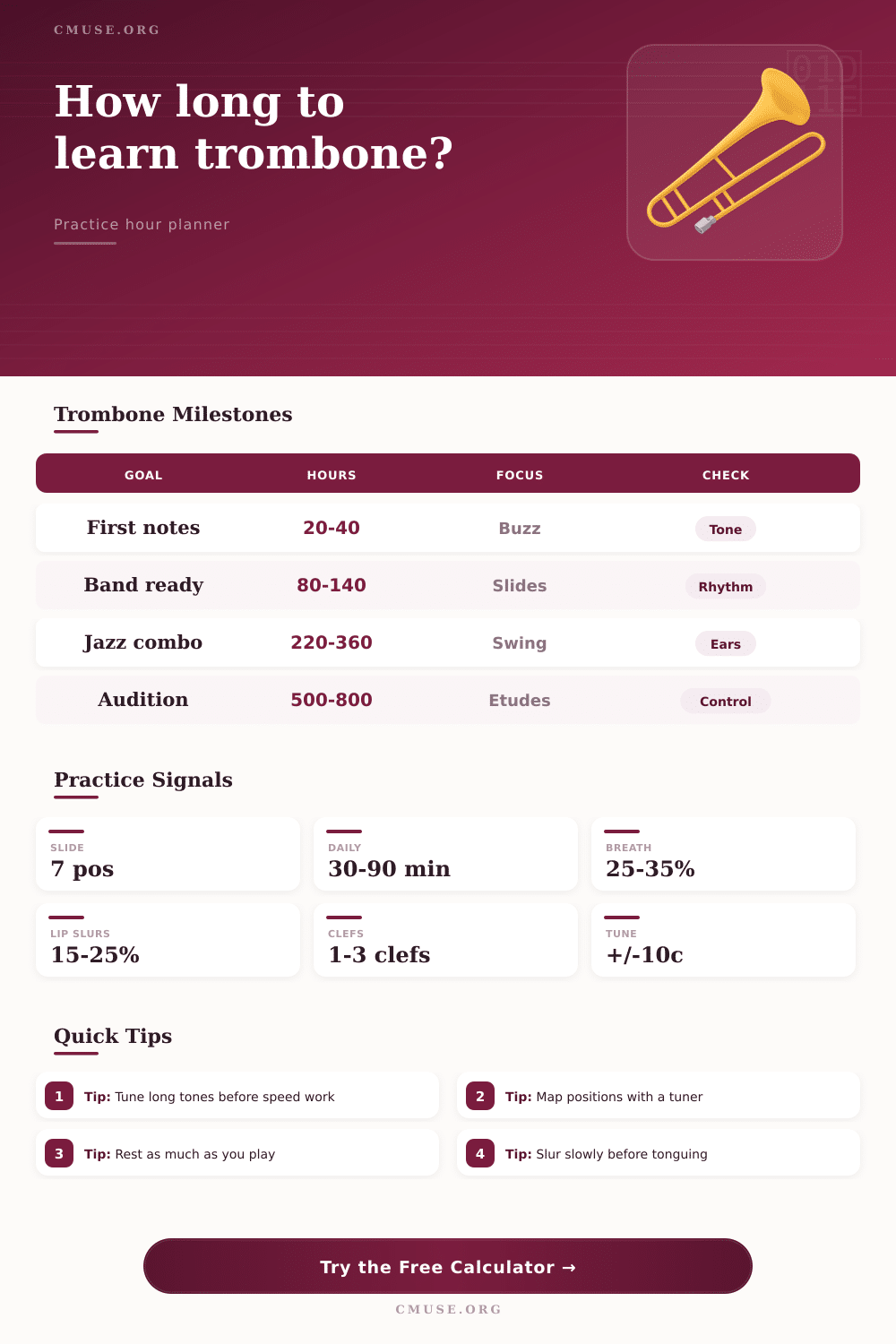
| Milestone | Typical focused hours | Trombone focus | Ready check |
|---|---|---|---|
| First controlled notes | 20 to 40 | Buzz, posture, easy Bb/F | Starts notes without pinching |
| First band pieces | 80 to 140 | Positions 1 to 6, quarter notes | Finds notes without writing every slide number |
| Intermediate fluency | 220 to 360 | Slurs, scales, dynamics, tuning | Adjusts slide by ear inside ensemble chords |
| Jazz or classical ensemble | 360 to 600 | Style, range, clefs, articulation | Changes articulation without losing pitch center |
| Audition-ready amateur | 600 to 900 | Etudes, excerpts, consistency | Repeats clean takes under pressure |
| Slide area | Learning demand | Practice cue | Common drift |
|---|---|---|---|
| 1st and 2nd positions | Low | Anchor tone and hand shape | Sharp 2nd if the slide is short |
| 3rd and 4th positions | Medium | Match bell landmarks, then tune by ear | Flat 4th when the wrist collapses |
| 5th and 6th positions | High | Slow glissando checks with drone | Late arrivals in faster passages |
| 7th position | Very high | Use reach drills and relaxed shoulder | Short reach, sharp low E and B |
| Trigger alternates | Medium-high | Compare open and valve position color | Heavy valve attacks or dull response |
| Reading/articulation goal | Extra hour factor | Most useful drill | Performance signal |
|---|---|---|---|
| Bass clef only | Base | Rhythm plus slide-number removal | Reads line and space notes directly |
| Tenor clef | +10% to +18% | Short daily clef translation etudes | No mental bass-clef detour |
| Alto clef or treble transposition | +14% to +24% | One-octave scales in the target clef | Correct first attempt at tempo |
| Classical articulation | +8% to +14% | Tenuto, staccato, accent ladder | Same pitch center on each tongue |
| Jazz articulation | +12% to +22% | Swing eighths, doodle tongue, falls | Style changes without rushed slide motion |
| Practice block | Beginner share | Intermediate share | Advanced share |
|---|---|---|---|
| Long tones and breath | 30% | 22% | 18% |
| Slide position and intonation | 25% | 22% | 18% |
| Lip slurs and flexibility | 18% | 22% | 20% |
| Music, clefs, and rhythm | 17% | 22% | 24% |
| Style, articulation, and excerpts | 10% | 12% | 20% |
💡Practice calibration tips
When most folks think about learning the trombone they imagine waving their arm around and then the notes magically end up in the correct spots. In truth, it’s a lot more effort. Controlling muscles in your face, supporting your breath and being aware of what note you’re playing. You must coordinate rate of airflow with pressure from your lips as you move through seven different hand posture without ever glancing down at your hands.
When you realize how complicated this instrument is, an hour seems like too little time to be any use by itself. But it is still the safest bet when considering where to put your hours. After that, the rest is math. Once you determine which skill are missing you plug them into the calculator. It transforms vague goals into a practical plan of attack complete with a week-by-week calendar. This calendar takes into consideration embouchure fatigue and intonation drift.
How Many Hours Do You Need to Practice?
Knowing which input applies help you understand where your roadblock lies. Accuracy with slide placement isn’t a black-and-white trait. It’s a continuum ranging from guesswork at distance to recognizing alternative placements for each pitch. The lower your self-assessment there, the more hours the calculator suggest. If you rate yourself low there, you’ll spend extra time adjusting to reach a note by ear instead of simply placing it in a specific location.
Embouchure consistency mirrors this too. Being able to produce continuous long tones indicates a solid setup of your facial muscles. They don’t pinch. Your sound stays in tune and your range intact. Without this, you will wrestle for pitch center every lesson. This doubles the learning time for basic melody line.
Another factor in how long it takes to get to where you want to go is breath support. Many beginning students find themselves unable to complete a single phrase because their breath fails them. This means stopping and restarting repeatedly. To help with this, we consider your breath control score versus what you want to achieve. For example, if you’re wanting to improvise like a jazz musician but have a weak breath stream, then the computer will account for starting from scratch on some core exercises. It knows that having a physical control baseline is necessary to meeting the demands of whatever style you are after. You can’t expect to rush through complicated articulation or swing rhythm unless you have that underlying base.
Another element here is choice of clefs. Most commonly, it is the bass clef. Adding alto or tenor clefs brings with it the problem of transposition, which slows down the rate at which you can read initially.
To break these milestones down into achievable sections there are reference tables on the page. Between eighty and one hundred forty focused hours is enough for many players to be able to play basic band parts. It correlates with developing basic position familiarity and some grasp of rhythm. Two-hundred plus hours gets you closer towards being intermediate fluent. By this stage, within an ensemble context, you’ll be playing by ear and adjusting your pitch. The figures above give you an expectation range.
No, you’re not going to learn the low end over the weekend. If you log your focused minutes, it becomes clear just how far you’ve come. A concentrated hour is worth more then two distracted. In most cases, the bottleneck will be your weakest link. Does it direct you towards embouchure? Practice in smaller tone blocks, adding rest between each, to stop facial tension from sabotaging your development. Is it directing you toward slide accuracy? Slowly check out how accurately you can glide on a drone.
Remember, the instrument is a system with all the elements connected. Air creates the sound, lips shape it, and the slide places it. When one element fall behind, the others suffer. Trombone playing is more a series of feedback loops than a matter of raw strength. Every time you play, you should of be able to hear the sound, feel the note vibrate through your body and react in kind.
That is where the calculator helps. It becomes your road map for this process. Time becomes focused on style, reading, and technique. Knowing why you spend an hour gives you something to focus on. You’re not spending time on autopilot. It eliminates the fear of never being good enough. Instead, it makes progress feel doable day by day.
But keep in mind, the numbers don’t become rules. They’re only guidelines. What realy matters is if your slides are smooth, your pitch is true and your tone is clean. If so, you’re doing it correctly regardless of how much time the screen says you need.