Tritone Substitution Calculator
Map any target chord to its dominant, swap in the bII7 substitute, and see shell voicings, guide-tone motion, and half-step bass resolution instantly.
🎵 Presets
⚙ Calculator Inputs
Breakdown
📊 Reference Tables
| Key | Target | V7 | bII7 | Resolve |
|---|---|---|---|---|
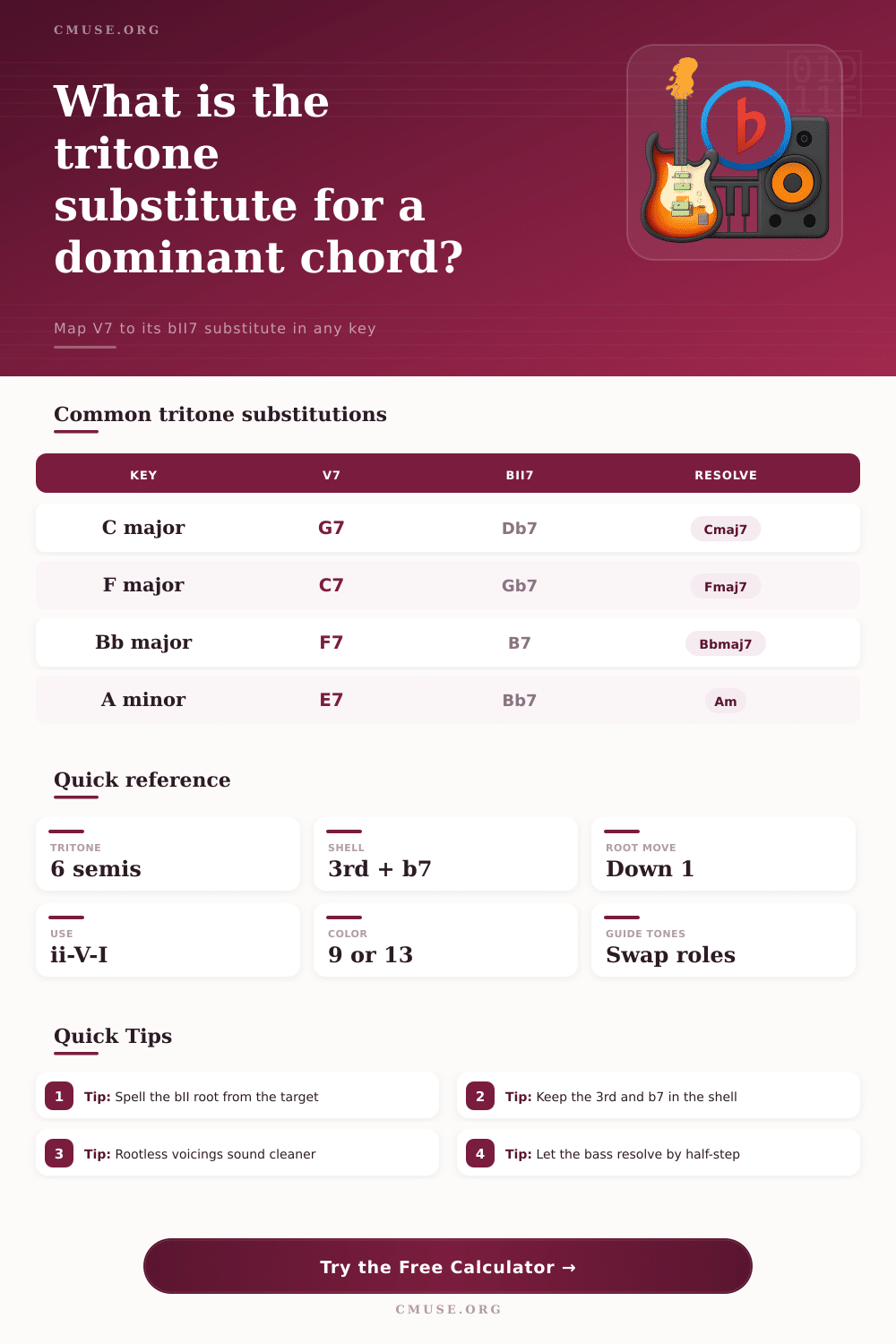
| C major | Cmaj7 | G7 | Db7 | Cmaj7 |
| F major | Fmaj7 | C7 | Gb7 | Fmaj7 |
| Bb major | Bbmaj7 | F7 | B7 | Bbmaj7 |
| A minor | Am | E7 | Bb7 | Am |
| Original | Sub | 3rd / b7 | Motion |
|---|---|---|---|
| G7 | Db7 | B / F | Swap roles |
| C7 | Gb7 | E / Bb | Same tritone |
| F7 | B7 | A / Eb | Half-step bass |
| D7 | Ab7 | F# / C | Down semitone |
| Voicing | Tones | Sound | Best use |
|---|---|---|---|
| Shell | R-3-b7 | Lean | Comping |
| Close | R-3-5-b7 | Dense | Block chords |
| Rootless | 3-b7-9-13 | Open | Piano or guitar |
| Guide | 3-b7 | Clear | Fast cadence work |
💡 Theory Notes
This tritone substitution calculator maps any target chord to its dominant and bII7 substitute, showing voicings, guide tones, and resolution paths for faster jazz harmony decisions in practice.
Tritone substitution is a method of replacing one dominant seventh chord with another in jazz harmony. In a ii-V-I progression in C major, for example, there are Dm7, G7, and Cmaj7 chords. The G7 chord are the dominant seventh chord, and it resolves to the Cmaj7 chord.
You can replace the G7 chord with a Db7 chord, which is located a half-step above an Cmaj7 chord. The reason that tritone substitution work is because dominant seventh chords contains a tritone. A tritone consists of three whole step.
How Tritone Substitution Works
The tritone can be created by the interval between the major third and the flat seventh of a dominant seventh chord. In the chord G7, the major third is B and the flat seventh is F. The notes B and F creates a tritone. In the chord Db7, the major third is F and the flat seventh is Cb.
The note Cb is the same pitch as B. Therefore, the Db7 chord contain the same notes as the G7 chord. The guide tones for these chords are the major third and the flat seventh. Because the guide tones is the same for these two chords, the tension of the chord progression is also the same.
Trite substitution also alters the movement of the bass line. In the ii-V-I progression, the root of the dominant seventh chord resolve from G to C. This movement is a perfect fifth. With tritone substitution, the root of the substitute chord resolve from Db to C. This movement is a half-step.
Bass player may prefer this type of resolution because half-step movement in the bass are considered smooth. The half-step resolution between the roots of the substitute chord and the tonic chord create a smooth transition into the tonic chord for the listener. Tritone substitution can be used in many context in jazz music.
However, tritone substitutions should not be used too often in a chord progression. Jazz listener may become fatigued if there are many tritone substitutions in a row due to the half-step movement between the roots of the substitute and tonic chords. Use tritone substitutions in contexts in which you would like to add some variety to the harmonic texture.
For example, tritone substitutions can be used in a turnaround progression for jazz improvisation. There are different way to play these chords. A shell voicing contain only the root, the third, and the seventh of the chord.
Rootless voicings do not include the root of the chord. These voicings can be useful for bass players to play the root of the chord. Altered voicings include different note in the chord, such as the flat ninth, the sharp ninth, the sharp eleventh, or the flat thirteenth of the chord.
These voicings add tension to the chord, which then resolve when playing the tonic chord. When playing jazz chord progression, the key of the music should be considered. In flats keys, for example, Gb might be used in place of F to avoid using many sharps in the chord.
The key of the chord determine the types of chords that can be used in a chord progression. The key also ensure that the chords will sound correct when played in sequence. In addition to the chords, the octave in which the notes are played should also be considered.
Piano player may use shell voicings in the lower register of the piano keys. For guitar player, rootless voicings might be preferred in the middle register. To practice tritone substitution, play the ii-V-I progression and the same progression using tritone substitution for the dominant seventh chord.
Play Dm7, G7, and Cmaj7, and then play Dm7, Db7, and Cmaj7. Focus on the guide tones when playing these chords. The guide tones are the most important part of tritone substitution.
A firm understanding of the guide tones will provide an understanding of why tritone substitution work.