Triplet Delay Time Calculator
Convert BPM into tempo-synced triplet delay times, adjusted echo milliseconds, stereo spread values, repeat-tail length, and straight or dotted rhythm comparisons.
🎯 Triplet Delay Presets
⚙ Delay Timing Inputs
Calculation breakdown
📏 Triplet Delay Spec Cards
Each triplet value is two thirds of the same straight note.
Common for vocals, guitars, keys, and rhythmic throws.
Leaves space while still leaning against the groove.
Keeps left and right delays near the triplet center time.
🎚 Triplet Note Formula Table
| Triplet value | Beat length | Formula from BPM | Time at 120 BPM |
|---|---|---|---|
| 1/2-note triplet | 1.333 beats | (60000 / BPM) x 2 x 2 / 3 | 666.7 ms |
| 1/4-note triplet | 0.667 beat | (60000 / BPM) x 1 x 2 / 3 | 333.3 ms |
| 1/8-note triplet | 0.333 beat | (60000 / BPM) x 0.5 x 2 / 3 | 166.7 ms |
| 1/16-note triplet | 0.167 beat | (60000 / BPM) x 0.25 x 2 / 3 | 83.3 ms |
| 1/32-note triplet | 0.083 beat | (60000 / BPM) x 0.125 x 2 / 3 | 41.7 ms |
| 1/64-note triplet | 0.042 beat | (60000 / BPM) x 0.0625 x 2 / 3 | 20.8 ms |
⏱ BPM Triplet Delay Table
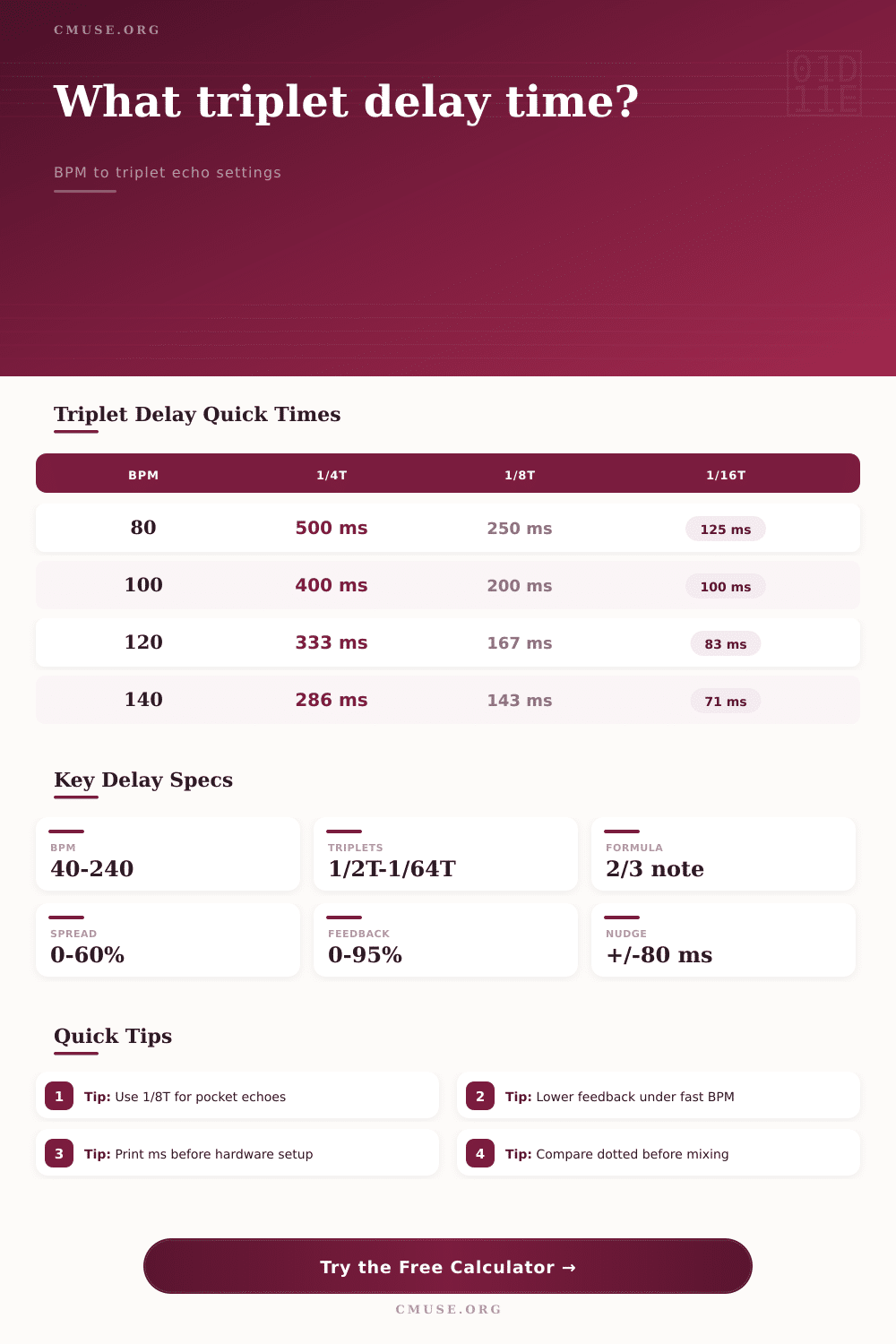
| BPM | 1/2T delay | 1/4T delay | 1/8T delay | 1/16T delay |
|---|---|---|---|---|
| 60 BPM | 1333.3 ms | 666.7 ms | 333.3 ms | 166.7 ms |
| 80 BPM | 1000.0 ms | 500.0 ms | 250.0 ms | 125.0 ms |
| 100 BPM | 800.0 ms | 400.0 ms | 200.0 ms | 100.0 ms |
| 120 BPM | 666.7 ms | 333.3 ms | 166.7 ms | 83.3 ms |
| 140 BPM | 571.4 ms | 285.7 ms | 142.9 ms | 71.4 ms |
| 160 BPM | 500.0 ms | 250.0 ms | 125.0 ms | 62.5 ms |
| 180 BPM | 444.4 ms | 222.2 ms | 111.1 ms | 55.6 ms |
🔀 Rhythmic Delay Comparison Grid
| Reference note | Straight value | Triplet value | Dotted value | Mix use |
|---|---|---|---|---|
| 1/4 note | 1.000 beat | 0.667 beat | 1.500 beats | Triplet sits ahead of dotted echoes and avoids long masking. |
| 1/8 note | 0.500 beat | 0.333 beat | 0.750 beat | Useful for vocal pockets and guitar delays between drum hits. |
| 1/16 note | 0.250 beat | 0.167 beat | 0.375 beat | Fast repeats that add motion without becoming a slap echo. |
| 1/32 note | 0.125 beat | 0.083 beat | 0.188 beat | Short modulation and rhythmic thickening at high tempos. |
🎶 Triplet Delay Use Table
| Source | Common triplet | Feedback range | Practical setting note |
|---|---|---|---|
| Lead vocal throw | 1/4T or 1/8T | 18-45% | Automate sends on phrase endings so the triplet answers the lyric. |
| Clean electric guitar | 1/8T | 20-40% | Keep the wet level low when the part already has sixteenth motion. |
| Dub snare or chord | 1/4T or 1/2T | 45-75% | Longer tails work best when the arrangement leaves space. |
| Synth arpeggio | 1/16T | 12-35% | Short triplets can add bounce without moving MIDI notes. |
| Drum fill throw | 1/8T or 1/16T | 10-30% | Print or freeze the delay when edits need sample-accurate timing. |
| Ambient send | 1/2T | 35-60% | Use the pre-delay field when the reverb begins after the echo. |
📊 Repeat Tail And Stereo Table
| Delay setup | Tail length estimate | Final repeat level | Stereo spread use |
|---|---|---|---|
| Subtle vocal pocket | 2-4 repeats | Feedback 20-35% | 0-12% spread keeps the echo near center. |
| Wide guitar rhythm | 3-5 repeats | Feedback 25-45% | 12-25% spread creates width without losing the triplet. |
| Ping-pong synth | 4-8 repeats | Feedback 35-60% | 25-45% spread makes left and right answers obvious. |
| Dub feedback throw | 6-12 repeats | Feedback 55-80% | Use narrower spread if the low-mid echo gets unstable. |
| Short slap triplet | 1-2 repeats | Feedback 0-20% | Small spread can thicken mono parts without sounding late. |
When the echo arrives at the wrong millisecond, vocal line can feel like something is off. It is not an issue of pitch, but a barely noticeable rhythmic mismatch, the kind that makes you sound like an amateur. And it’s usually because of the difference between straight note values and triplet subdivisions. Straight means you’ve got your foot on the eighth-note pulse of grid, while a triplet rushes forward to give you human bounce.
Get this and you’ll never fight your delay again; you’ll learn to include it in the sound. That’s what the calculator above does for you. It calculates exact millisecond targets based off your project’s tempo, sparing you a guess about when to make the echo land.
Why Timing Matters in Music Delays
In terms of math, a triplet note is two thirds the length of straight equivalent. So where a quarter note might be 500ms long, a straight eight would be half this at two hundred and fifty. The triplet eights comes down to about one hundred and sixty seven. It’s not much of a difference alone but as you repeat it it alters the groove. Producers tend to go with straight divisions because its visually easier to place on the music software grid. Triplets need another kind of mental map where flow is more important than fixed position. It may sound like a little thing but it makes all the difference to how emotionaly satisfying the music is at end of the day.
Adjusting the inputs mean choosing the way the sound behaves in space. Pre-delay is key to maintaining quality of the dry source. A delay without any pre-delay masks attack of guitar or voice with an immediate echo. Introducing a couple milliseconds of pre-delay allow the initial transient to punch through and then the repeats begin to weave around it.
How long do you want the tails to last? That’s where feedback comes into play. Be careful with high values because too much feedback on a fast triplet rhythm can blur into a cluttered wall of sound that masks main instrument. Aim for clarity by choosing modest feedback levels that allow the rhythm to breathe.
Another dimension is stereo spread. To widen an image by small amount (with no change in position) you offset left and right channel a little. Adding a rhythmic element to this can create a ping-pong sound. This can improve feel of the rhythm and also widen the image. Shorter triplet values work well for this because the sound becomes more rhythmic, emphasizing individual beats instead of creating a distraction that sweeps from side to side.
On the page is a reference table indicating absolute time values in relation to tempo. A triplet eighth note sounds expansive at lower tempos and quite rapid when at one hundred forty beats per minute. This require paying attention to note value, as well as matching the spread and feedback settings to the song speed.
Often, these math equations has hardware limitations. For example, some older analog pedals have delays that works on coarser increments or even just whole numbers. A single millisecond difference rounded up to nearest whole number could of been enough to offset the sync at higher tempos. Fortunately, digital plugins gets it precise, but understanding how many samples there is will come into play when you’re printing and automating your effects. When bouncing down to audio, having the precis length of the tail will avoid any unwanted cutting or clipping. It’s all about honoring the technical limitations to achieve the artistic intent.
In conclusion then, a triplet delay add a rhythmic element to fill in the gaps between straight beats while retaining original feel of the song’s tempo. Whether it’s creating a dubby atmosphere with long, trailing echoes, or gently underpinning a lead vocal with an understated throw, the principle is the same. You’re sculpting time by determining when the echo finishes and the silence starts. And getting that split second correct transforms a mundane effect into a feature of your mix. It is a rhythmic pulse that gets people nodding along, even though they might not be able to tell you what actualy it is about the timing that just sounds right.