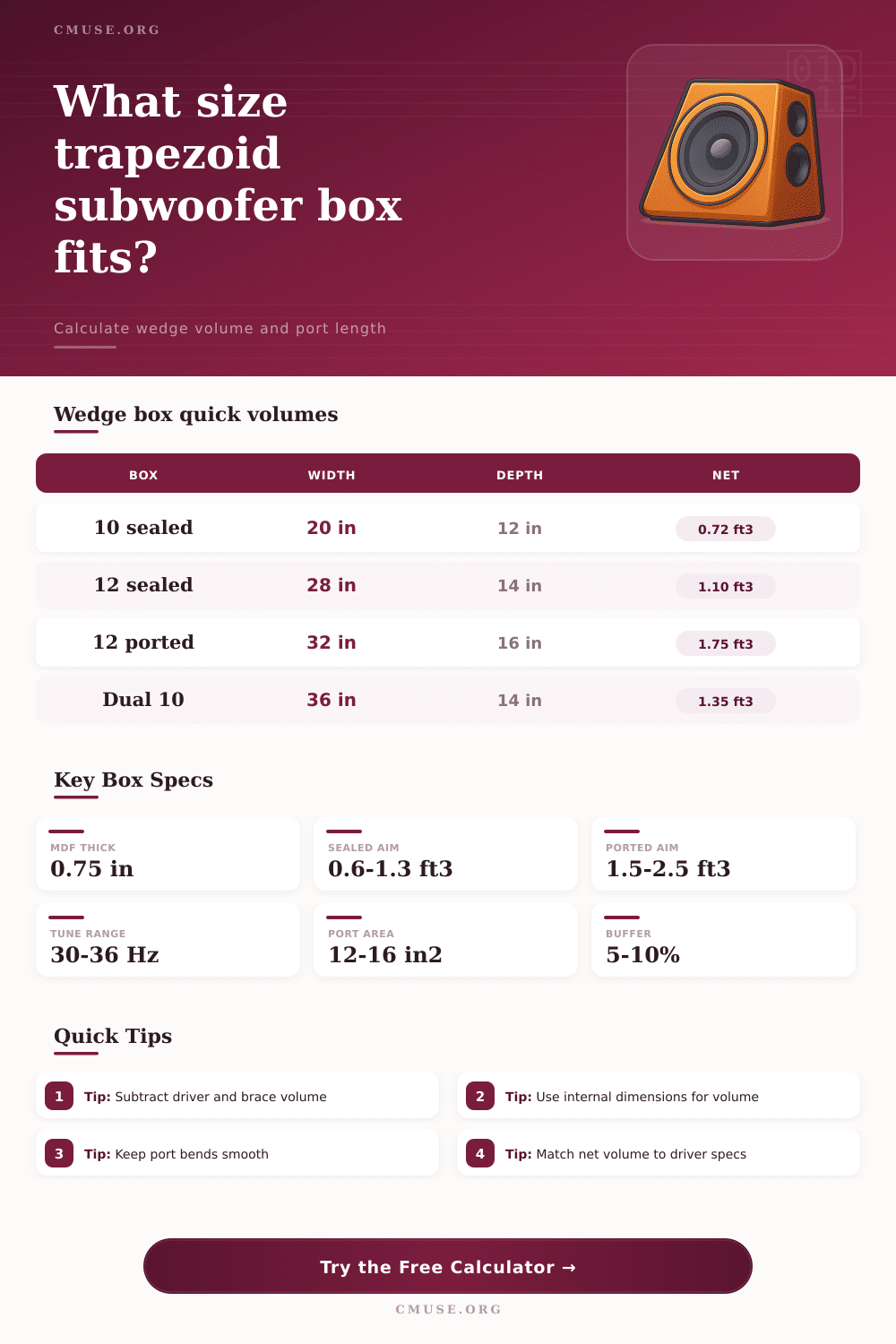
Trapezoid Subwoofer Box Calculator
Size a wedge-style subwoofer enclosure by external fit, material thickness, driver displacement, bracing, port volume, and target net air space.
🔊 Wedge Box Presets
🎚 Box Dimensions and Driver Data
Calculation Breakdown
📊 Current Box Spec Grid
📐 Subwoofer Volume Reference
| Driver and Alignment | Common Net Volume | Liter Equivalent | Typical Tuning | Notes |
|---|---|---|---|---|
| 8 inch sealed | 0.30 to 0.55 ft³ | 8.5 to 15.6 L | Sealed | Compact nearfield, truck, or practice-room builds. |
| 10 inch sealed | 0.55 to 0.90 ft³ | 15.6 to 25.5 L | Sealed | Tight transient response when matched to driver Qts. |
| 12 inch sealed | 0.85 to 1.35 ft³ | 24.1 to 38.2 L | Sealed | Common daily driver volume for many car subs. |
| 12 inch ported | 1.50 to 2.25 ft³ | 42.5 to 63.7 L | 30 to 36 Hz | Needs port and brace displacement subtracted from gross volume. |
| 15 inch ported | 2.75 to 4.00 ft³ | 77.9 to 113.3 L | 28 to 34 Hz | Watch port length and rear-seat cargo clearance. |
🔧 Trapezoid Build Comparison Grid
| Design Choice | Best Use | Main Formula Impact | Fit Check | Build Note |
|---|---|---|---|---|
| Sealed wedge | Small cabins and accurate bass | Net = gross minus driver and braces | Depth and baffle angle | Simpler cuts and no port resonance target. |
| Slot ported wedge | Louder low-bass output | Port volume and length reduce net air space | Folded port path | Keep port height large enough to reduce turbulence. |
| Round ported wedge | Replaceable aero ports | Area = pi x radius squared x count | Tube straight length | Flares change end correction and effective length. |
| Shared dual chamber | Dual driver boxes | Driver displacement is multiplied by count | Internal bracing span | Add a divider if the driver maker recommends separate chambers. |
🎵 Common Trapezoid Project Sizes
| Project | External Size W x D x H | Approx Net | Driver Match | Secondary Check |
|---|---|---|---|---|
| Compact 10 sealed hatch | 22 x 12 x 13/9 in | 0.70 ft³ | Single 10 sealed | Driver depth clearance |
| Behind-seat truck wedge | 28 x 13 x 15/8 in | 0.95 ft³ | Single shallow 12 | Seat-back angle |
| SUV daily ported 12 | 32 x 16 x 14/10 in | 1.70 ft³ | Single 12 ported | 33 Hz port path |
| Dual 10 slanted hatch | 36 x 14 x 15/11 in | 1.35 ft³ | Two 10 sealed | Baffle width |
| Large 15 cargo wedge | 38 x 20 x 18/13 in | 3.10 ft³ | Single 15 ported | Long folded slot |
📏 Port Area and Tuning Guide
| Net Volume | Mild Port Area | Loud Port Area | Tuning Range | Length Warning |
|---|---|---|---|---|
| 0.75 ft³ / 21 L | 7 to 10 in² | 10 to 13 in² | 34 to 40 Hz | Small ports can chuff at high excursion. |
| 1.25 ft³ / 35 L | 12 to 16 in² | 16 to 22 in² | 32 to 38 Hz | Check if the port fits without blocking the driver. |
| 1.75 ft³ / 50 L | 17 to 23 in² | 23 to 32 in² | 30 to 36 Hz | Wider slots often need folded paths. |
| 3.00 ft³ / 85 L | 30 to 42 in² | 42 to 55 in² | 28 to 34 Hz | Large low-tuned ports become physically long. |
A wedge subwoofer enclosure are a trapezoid-shaped enclosure that is built for specific area in the car. Many cars has areas of dead space due to the angle of the seats or the rear deck. A wedge subwoofer enclosure allow for the use of this dead space in the car, as the wedge subwoofer enclosure mirror the angle of the area in the car in which it is to be used.
Without wedge subwoofer enclosures, many car owners would either be forced to use a large box for the subwoofer that would take up too much of the trunk of the car, or to use a generic box that does not allow for the subwoofer’s driver to perform in the way that it should perform. The calculation of the volume of a wedge subwoofer enclosure can be challenging due to the difference in height between the front and rear of the enclosure. The standard formula for calculating the volume of an area (length times width times height) cannot be used for wedge subwoofer enclosures due to the fact that the height of the enclosure are not the same on each end of the enclosure.
How to Measure and Build a Wedge Subwoofer Box
Instead, you must use the average height of the enclosure in the calculation. Even more often, though, individuals calculate the volume of the wedge subwoofer enclosure with the external dimensions of the enclosure. However, you must subtract the thickness of the wood of the enclosure from each side of the enclosure to provide an accurate calculation of the volume of the internal area of the wedge subwoofer enclosure.
If the thickness of the wood is not subtract from the external dimensions of the enclosure, the calculated internal volume will be less than the actual internal volume of the wedge subwoofer enclosure. In addition to calculating the internal volume of the wedge subwoofer enclosure, another factor to consider is the displacement of components within the enclosure. Displacement is a measurement of how much of the internal area of the wedge subwoofer enclosure is take up by components other than the subwoofer driver.
The subwoofer driver has a magnet and a basket that take up space within the wedge subwoofer enclosure. Additionally, bracing the enclosure to prevent the walls of the wedge subwoofer enclosure from flexing take up some of the internal space of the enclosure. Each of these components take up some of the internal space of the wedge subwoofer enclosure, meaning that the gross internal volume of the wedge subwoofer enclosure is greater than the net internal volume that can be used by the subwoofer driver.
You must subtract the displacement of the subwoofer driver and bracing from the gross internal volume to find the net internal volume of the wedge subwoofer enclosure. If this step in the calculation is skipped, the net internal volume of the wedge subwoofer enclosure will be lower than the volume that is represented by the manufacturer’s recommendations for that model of subwoofer. Because the net internal volume of the wedge subwoofer enclosure will be lower than the manufacturer’s specifications, the resonant frequency of the enclosure will change.
Additionally, the way in which the subwoofer driver will produce sound will also change as a result of altering the resonant frequency of the subwoofer. Another factor to consider with the construction of a wedge subwoofer enclosure is the length of the port of the enclosure. The length of the port can impact the way in which the sound of the wedge subwoofer enclosure is produced.
Ports are used in ported wedge subwoofer enclosures to allow for certain frequencies to be boosted. The port of the wedge subwoofer enclosure take up some of the internal volume of the enclosure, and that internal volume could otherwise be used for air within the enclosure. If a longer port is added to the wedge subwoofer enclosure to allow for lower frequencies to be produced by the subwoofer, the length of the port will reduce the net internal volume of the wedge subwoofer enclosure.
The reduction of the net internal volume may require a change in the length of the port. Additionally, another consideration is the size of the port that will be constructed. Large ports take up more of the internal volume of the wedge subwoofer enclosure than small ports.
However, using small ports may result in chuffing of the subwoofer, which is a whistling sound that is created by the movement of the air within the wedge subwoofer enclosure. In cases in which the depth of the wedge subwoofer enclosure is not deep enough to allow for the placement of the port of the enclosure in a straight path, the use of a folded port may be used. A folded port is a port that turns a corner within the wedge subwoofer enclosure to allow the port to be longer than the depth of the wedge subwoofer enclosure.
Ensuring that the length of the folded port is correct is essential for the wedge subwoofer enclosure to be tuned to the correct frequency. Additionally, the materials that are used to build the wedge subwoofer enclosure can impact the sound of the wedge subwoofer enclosure. Medium Density Fiberboard, or MDF, is a common material for wedge subwoofer enclosures because this type of wood is very dense and does not resonate within the enclosure.
Plywood is another material that is sometimes used to build wedge subwoofer enclosures. Plywood is, however, less dense than MDF and may require bracing within the enclosure to prevent the walls of the enclosure from flexing. Bracing within a wedge subwoofer enclosure prevents the walls of the wedge subwoofer enclosure from flexing against the pressure of the air within the enclosure.
Flexing walls waste the energy of the vibrations of the subwoofer driver. To avoid flexing of the walls of the wedge subwoofer enclosure, you must add bracing. However, because the bracing take up some of the internal volume of the wedge subwoofer enclosure, the addition of bracing to the enclosure will reduce the net internal volume of the wedge subwoofer enclosure.
Another way of saying this is that the net internal volume of the wedge subwoofer enclosure will be less than the gross internal volume of the enclosure after the addition of bracing. The reason for adding bracing to the wedge subwoofer enclosure is to ensure that the walls do not flex. However, the reduction in the net internal volume of the enclosure must be accounted for.
Thus, the goal of constructing a wedge subwoofer enclosure is to find a balance between the slant of the vehicle, the thickness of the wood, the displacement of the components within the enclosure, and the net internal volume of the enclosure in relation to the specifications of the subwoofer driver. Thus, by taking each of these factors into consideration, it is possible to build a wedge subwoofer enclosure that will achieve the target net internal volume for the subwoofer driver.