Transpose Note Up Semitones Calculator
Choose a written note, octave, and number of semitones to raise it, then see the target pitch, octave crossing, MIDI number, frequency, interval name, cents, and enharmonic spelling.
Calculation Breakdown
The target octave rises by one for every complete 12 semitone cycle.
Cents give the tuning distance between the original and transposed pitch.
A move up 12 semitones doubles frequency in equal temperament.
The default 440 Hz reference can be changed for period or ensemble tuning.
| Semitones Up | Common Interval | From C With Sharps | From C With Flats | Cents |
|---|---|---|---|---|
| 0 | Perfect unison | C | C | 0 |
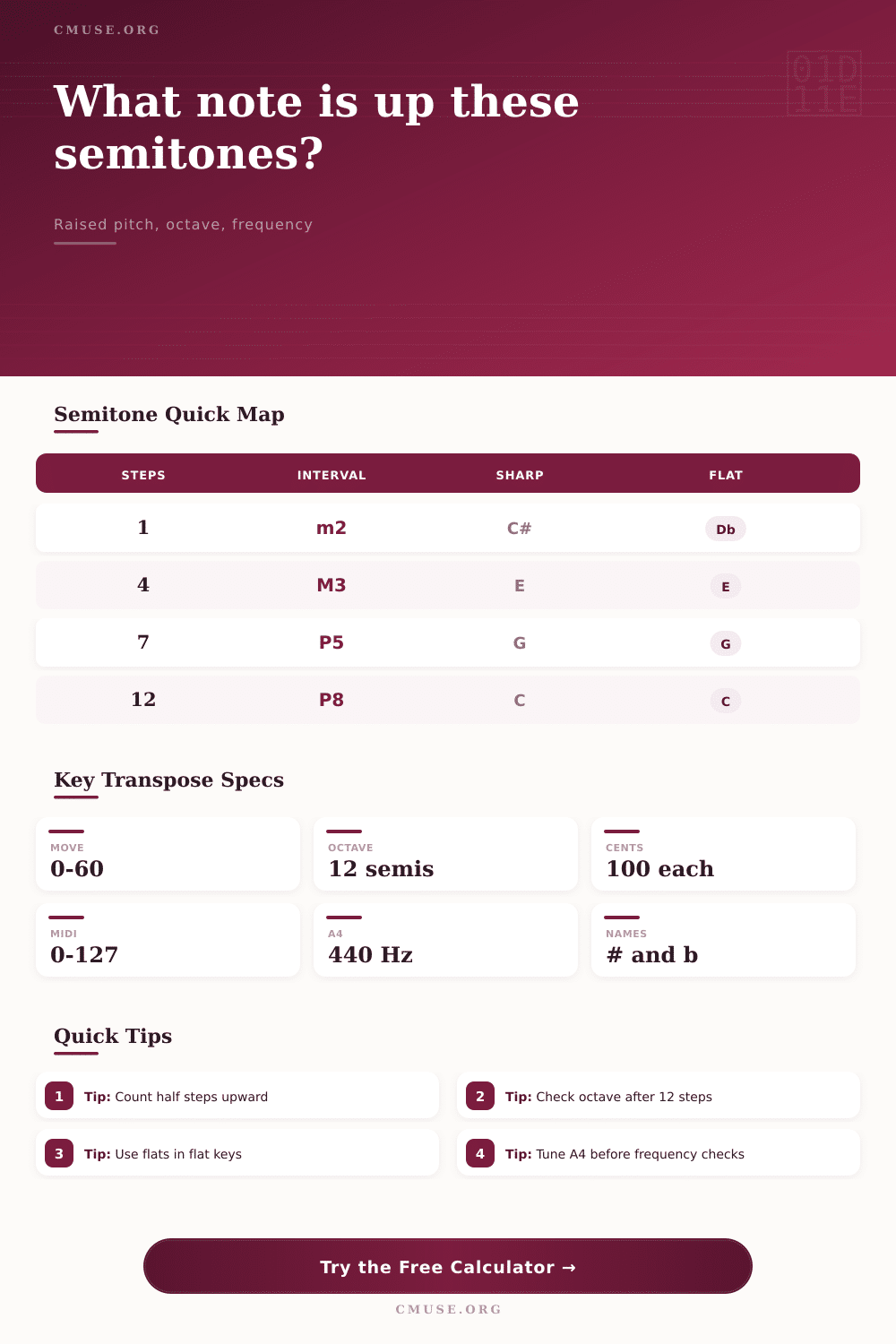
| 1 | Minor 2nd | C# | Db | 100 |
| 2 | Major 2nd | D | D | 200 |
| 3 | Minor 3rd | D# | Eb | 300 |
| 4 | Major 3rd | E | E | 400 |
| 5 | Perfect 4th | F | F | 500 |
| 6 | Tritone | F# | Gb | 600 |
| 7 | Perfect 5th | G | G | 700 |
| 8 | Minor 6th | G# | Ab | 800 |
| 9 | Major 6th | A | A | 900 |
| 10 | Minor 7th | A# | Bb | 1000 |
| 11 | Major 7th | B | B | 1100 |
| 12 | Perfect octave | C | C | 1200 |
| Use Case | Semitones Up | Example Start | Example Result | Reading |
|---|---|---|---|---|
| Half step modulation | 1 | E4 | F4 | Raises key color by one chromatic step. |
| Whole step modulation | 2 | F3 | G3 | Common in vocal and pop chart lifts. |
| Minor third sequence | 3 | A3 | C4 | Moves through diminished symmetry. |
| Perfect fourth move | 5 | D4 | G4 | Useful for circle motion and guitar shapes. |
| Perfect fifth move | 7 | Bb2 | F3 | Common for brass, bass, and power chord checks. |
| Octave displacement | 12 | C4 | C5 | Same pitch class, next octave. |
| Part Situation | Typical Up Move | Written Note | Upward Result | Check |
|---|---|---|---|---|
| Raise a melody one octave | 12 semitones | G3 | G4 | Same staff name, higher register. |
| Transpose C part for Bb instrument | 2 semitones | C4 | D4 | Written part sounds one whole step lower. |
| Transpose C part for Eb alto sax | 9 semitones | C4 | A4 | Written part sounds a major sixth lower. |
| Lift bass line above range | 12 or 24 | E1 | E2 or E3 | Preserves pitch class while clearing range. |
| Shift riff for capo style move | 1 to 7 | A3 | Bb3 to E4 | Use preferred spelling for the target key. |
| Start | Semitones Up | Target | MIDI Change | Frequency Ratio |
|---|---|---|---|---|
| C4 | 0 | C4 | 60 to 60 | 1.000 |
| C4 | 7 | G4 | 60 to 67 | 1.498 |
| C4 | 12 | C5 | 60 to 72 | 2.000 |
| B3 | 1 | C4 | 59 to 60 | 1.059 |
| F#4 | 6 | C5 | 66 to 72 | 1.414 |
| D4 | 24 | D6 | 62 to 86 | 4.000 |
C / B#
Pitch class 0. Natural spelling is usually C; B# appears in sharp-key leading-tone contexts.
C# / Db
Pitch class 1. Choose C# in sharp keys and Db in flat keys.
D
Pitch class 2. D is the shared natural name for this chromatic slot.
D# / Eb
Pitch class 3. D# often resolves upward; Eb often belongs to flat-key spelling.
E / Fb
Pitch class 4. E is common, while Fb can preserve interval spelling.
F / E#
Pitch class 5. F is common, while E# appears in some sharp-key notation.
F# / Gb
Pitch class 6. This is the tritone slot from C.
G
Pitch class 7. A clean perfect fifth above C.
G# / Ab
Pitch class 8. Use the spelling that matches the key signature or chord symbol.
A
Pitch class 9. A4 is the default tuning reference for frequency output.
A# / Bb
Pitch class 10. Bb is common in wind charts; A# is common in sharp keys.
B / Cb
Pitch class 11. B is common, while Cb can preserve flat-key notation.
Ever hear songbird tell you that their range doesn’t include that high note? Panic! Time to transpose the song, but how do you figure out the distance?
Once you know interval, is the new note a C sharp or a D flat? With this calculator doing the number crunching for you, you don’t have to count half steps as everyone wait on the band.
How to Change Musical Notes Easily
Rather than a math process, transposition are more of a map-making exercise: move your pitch class from its current position across a grid of 12 semitones. How you notate it is contextual. That note is named because of a social contract. It is called ‘semitone’ of distance. When I move up a note from C by one semitone, I gets something with two forms. These two pitches sounds the same in equal temperament but have different names on the page. In this case, they mean C sharp or D flat depending on which you write.
Getting the name correct assists others in reading harmony. This option can be helped by the spelling preference input. In other words if you work in a key where most of the notes has flats, then D flat would make more sense. Or perhaps you’re working in a sharp key, so C sharp is likely correct. You can change this and let tool know what spelling you prefer. That way it outputs whatever makes sense for how you notate.
After all, notation is a form of language. It is a language, not just a label for frequency. Not to mention a means of avoiding any double sharps or triple flats on your charts.
It can account for octave shifts too. One octave equals twelve semitones. When you go past that point the octave number change. Thirteen semitones will become a minor ninth. That means you have added an octave plus a minor second. It’s a simple interval but it becomes a compound interval. You can see both of them on the output. This way it makes sense structurally. Does the player remains in the same register? Are they jumping up an octave?
MIDI numbers and frequency precision are also added. For example, it based the calculations on A4 = 440Hz. From that you can calculate note’s frequency in hertz. This is helpful if you are an audio engineer. This is also helpful for synthesizer players who work on a Hz scale.
The MIDI number give us a linear count from zero to 127. There is no confusion over accidentals. In MIDI, G4 is 67 and C4 is 60. It is pure mathematics. There is no confusion over note names here.
It’s fiddly with instruments that are in Eb such as an Eb saxophone or Bb clarinet. For example, a written C on a Bb instrument will sound a whole step down. To get back to concert pitch it require you to transpose up by two semitones. If you do this the wrong way round then you ruin the song. Using this tool you can enter the starting note followed by amount you want to change and it will give you target note. No more guesswork when transposing an instrument. It is often one of the trickiest elements of mixing an ensemble arrangement.
The relationship of notes stay the same in transposition. What changes is where they sits absolutely. It could be to suit an instrument’s range. It might be for the comfort of the singer. The structure underneath, however, does not alter. The relationships between notes doesn’t change. It only alters where those notes sit on the ladder. Regardless of which key it is in, a semitone will still be a semitone.
That understanding makes what was formerly calculation become second nature. No longer do you have to count out on your fingers, but instead begin to hear distance. That mental leap could of transform the calculation into a simple musical move.