Transmission Line Length Calculator
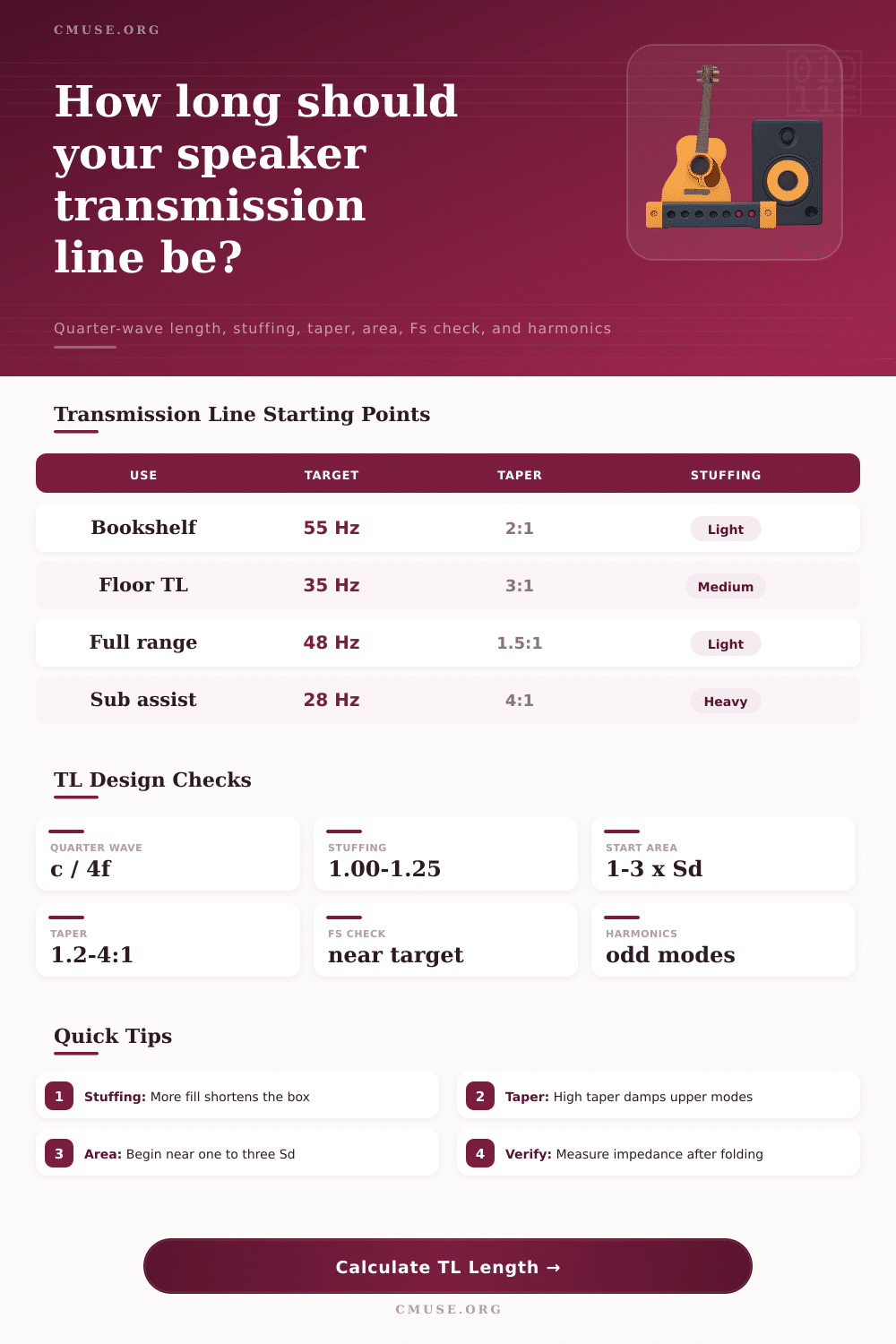
Estimate physical and effective acoustic length for a quarter-wave speaker transmission line, then check stuffing, taper, line area, driver Fs alignment, and harmonic spacing.
Speaker TL presets
Folded TL sketch
Inputs
Calculation breakdown
Reference specs
TL design grid
| Scenario | Physical length | Start area | Mouth area | Comment |
|---|
Quarter-wave harmonics
| Mode | Frequency | Wavelength | Design note |
|---|
Area and taper comparison
| Variant | Start area | Mouth area | Average area | Expected behavior |
|---|
Preset reference table
| Preset | Target | Driver | Taper | Stuffing |
|---|
With a transmission line speaker you get something special called quiet. It is quiet, detailed, and clean. No loose booms or slams from the bass. It is just naturaly speed moving through the room.
To achieve this you have to deal with physics in a different way than typical cabinets. You are making a tube where energy is absorbed over a long distance. That distance are the single most important variable. That’s the quarter-wave principle, which is how the math work. Temperature affects the rate at which sound moves. What you want is line to be exactly one-quarter of the targeted wavelength. If it’s shorter, there’s no bass extension. If it’s longer, there’s phase cancellation resulting in muddiness.
How Transmission Line Speakers Work
The calculator (above) take care of all that geometry for you. It translates your desired tuning frequency into physical length. That eliminates need to work out the sound speed yourself. Now you can concentrate on constructing the box, not crunching numbers.
There’s more than just raw length involved because air in a cabinet isn’t the same as free air. To make the line damped, it needs to be stuffed with something such as wool or fiberfill. That slows the rate at which sound travel down the line. What might of been an eight-foot physical line becomes an acoustic line that acts as if it were ten feet. And that’s where the stuffing factor come into play. Without that correction, your speaker tunes up higher then desired. The bass roll-off sound abrupt.
For this, you input a coefficient indicating how tightly the fill was packed. The tool then adjust the dimensions based off that. It makes the abstract world of acoustics measurable in board feet.
Then there is the cross sectional area that you must choose. Many first timers goes too small in diameter of the line. There is too much friction. Not enough sound come out; it just warms up the driver. Typically they begin at a place around size of piston from the driver. Then it will gradually decrease in diameter until reaching your mouth. The change in diameter tame harsher resonances in the mid-bass frequencies. A steeper taper provide better dampening. But the less efficient it is, there is no free lunch here. More is not always better. There is more of it but it is smoother.
Still, there are limitations to what’s feasible given the driver. You’ll want to tune a driver around its free-air resonance frequency. So if it has a thirty-eight Hertz free air res and you want it to be tuned to say fifty Hertz, well then you’re not going to get much out of it below that. So the tool let you know that you have a mismatch so you can choose to adjust the driver or live within the constraints of the available bandwidth. Better to find that out before you cut some plywood.
The line folding bring additional variables into play. Sharp corners disrupt airflow, causing reflections that blur the transient response. If you can have smooth arcs better yet but more complex constructions. Then there is the bend deviation and flare at the mouth, which is the end correction. It is a little change, sometimes only several percent. But it can swing perception of tuning enough to make a difference in critical listening situations.
Building a transmission line involve making compromises. There’s no such thing as small footprint, instant transient response and extreme bass extension…all in one package. It doesn’t matter if it’s a tower speaker or a bookshelf monitor; the process is the same. Define the objective, plot the route and pack the box carefully. Measure the outcome. Follow the numbers…but let your ears decide. Respecting each foot of the folded path earn you the first silence.