Total Neck Tension Calculator
Estimate the combined pull of a full string set, compare it with a reference setup, and see how scale length, tuning and construction change neck load.
Calculation Breakdown
The meter compares this setup with a broad 70 to 300 lb instrument tension range.
| String | Gauge | Reference Pitch | Base Pull | Adjusted Pull |
|---|
| Instrument Setup | Typical Scale | Common Set | Total Pull | Use Case |
|---|---|---|---|---|
| Extra light electric guitar | 24.75 to 25.5 in | 8-38 or 9-42 | 75 to 90 lb / 334 to 400 N | Low effort bending |
| Regular electric guitar | 24.75 to 25.5 in | 10-46 | 95 to 110 lb / 423 to 489 N | General standard feel |
| Heavy electric guitar | 25.5 in | 11-49 or 12-54 | 115 to 145 lb / 512 to 645 N | Firm rhythm feel |
| Steel-string acoustic | 24.9 to 25.5 in | 12-53 or 13-56 | 150 to 190 lb / 667 to 845 N | Full acoustic top drive |
| Electric bass | 30 to 35 in | 40-100 to 50-110 | 150 to 220 lb / 667 to 979 N | Long-scale low strings |
| 12-string acoustic | 24.9 to 25.5 in | 10-47 or 12-53 | 220 to 280 lb / 979 to 1246 N | Paired courses |
| Change | Tension Multiplier | Approx Effect | Example |
|---|---|---|---|
| 24.75 in vs 25.5 in scale | 0.942 | About 5.8% less pull | Same set on shorter scale |
| 25.5 in vs 24.75 in scale | 1.061 | About 6.1% more pull | Same set on longer scale |
| Half step down | 0.891 | About 10.9% less pull | E standard to Eb |
| Whole step down | 0.794 | About 20.6% less pull | E standard to D standard |
| Half step up | 1.122 | About 12.2% more pull | E standard to F |
| A4 442 vs 440 Hz | 1.009 | About 0.9% more pull | Orchestral pitch reference |
| Construction | Multiplier Used | Typical Feel | Best Match |
|---|---|---|---|
| Nickel wound electric | 1.000 | Reference electric pull | Most electric sets |
| Stainless wound electric | 1.018 | Slightly firmer estimate | Bright stainless sets |
| Pure nickel electric | 0.985 | Slightly softer estimate | Vintage-style electric sets |
| Phosphor bronze acoustic | 1.035 | Firm acoustic estimate | Modern acoustic bronze |
| 80/20 bronze acoustic | 1.015 | Near acoustic reference | Bright bronze acoustic |
| Flatwound electric | 1.060 | Higher mass estimate | Jazz guitar or bass flats |
| Preset | Strings | Scale | Reference Total | Neck Load Note |
|---|---|---|---|---|
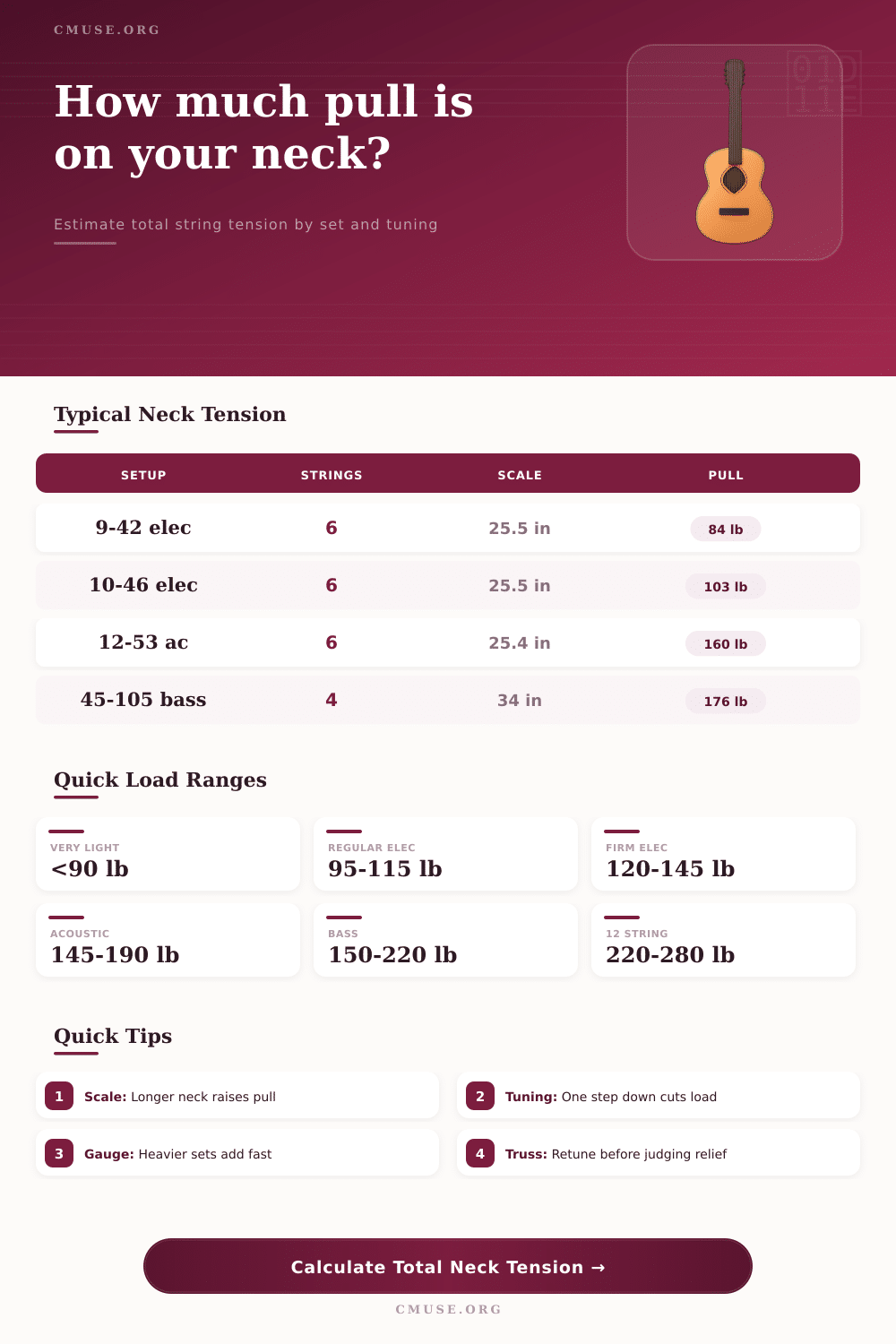
| Electric 9-42 | 6 | 25.5 in / 648 mm | About 84 lb / 374 N | Very light electric pull |
| Electric 10-46 | 6 | 25.5 in / 648 mm | About 103 lb / 458 N | Common reference setup |
| Electric 11-49 | 6 | 25.5 in / 648 mm | About 121 lb / 538 N | Firm electric feel |
| Acoustic 12-53 | 6 | 25.4 in / 645 mm | About 160 lb / 712 N | Light acoustic top load |
| Baritone 13-62 | 6 | 27 in / 686 mm | About 143 lb / 636 N | Long-scale low tuning |
| Bass 45-105 | 4 | 34 in / 864 mm | About 176 lb / 783 N | High total but fewer strings |
| 12-string 10-47 | 12 | 25.4 in / 645 mm | About 245 lb / 1090 N | High paired-course load |
Electric Guitar String Gauge Calculator After tightening down your low E string, you notice it’s no longer singing true. It is rarely due to the string but more likely because all six string are pulling together as one against the neck wood. Most players switch to heavier strings for better low end definition without thinking about total load. They then wonder why action has suddenly gotten stiff or even worse, why neck has bowed backwards. This calculator does the math by plugging in your tuning choice, gauge and scale length so that you’re not left guessing at just how much force you’re putting into bending your guitar.
There is tension. The balance of tension in a guitar’s neck are a fine line between what’s comfortable and what is physically possible. Each string pulls with an exact amount of tension depending on the pitch it is tuned to as well as diameter and mass of each one. Add these tensions together and you have a figure representing the total pull the truss rod has to overcomes.
Why Guitar String Tension Matters
For instance, a 10-46 electric string on a 25.5-inch scale yields approximately 103 pounds of pull. That’s more than a hundred pounds of tension your neck is battling when tuning up. Swap out for a lighter gauge set like a 9-42 and you’ll notice far less tension. This allows you to bend easier, but you might sacrifice some clarity or sustain down low. It’s a give-and-take that can be quantified.
The scale length is an interesting factor. Players often think that tension comes solely down to the gauges of strings. Not so. Because there’s less vibrating string on short scales they feel easier to fret due to tension being lower at a given pitch. For example, going from a 24.75-inch scale to a 25.5-inch scale means the tension have increased significantly although you’ve retained the same set as before. So the calculator takes into consideration your chosen scale and changes its tension estimate to match what it would of been like on your particular instrument versus some kind of industry average.
The tension of an acoustic guitar is in a class by itself. High tension are necessary for a steel string acoustic to effectively drive the top plate. A 12-53 set creates more than 160 pounds of pull, easily. That’s also why neck profile on an acoustic is thicker, and the truss rod heavier. You’ll notice that many acoustic owners will try to play their instrument with light gauge strings to get that ‘electric feel’ but inevitably end up with less definition and volume. The top just doesn’t move enough energy to work properly.
Knowing that helps you appreciate what makes acoustics seem stiffer under your fingers. It’s not a bad setup. It’s physics asking for its due for good sound production.
As important are tuning changes. Going down a half step for example cuts about ten percent off the overall tension. Sounds insignificant but over time it will be enough to cause the neck to straighten out too much, creating fret buzz in the mid-positions. If you play regularly but tune down often then you must pay extra attention to your truss rod adjustments compared than someone who remains at standard pitch. These ranges are broken down into reference tables on the page so you’ll see where your specific setup falls within the spectrum of common instruments. Knowing whether you’re working in the heavy, regular, or light tension zone is helpful when you decide to make any hardware tweaks.
At the end of the day, that knowledge of your overall neck tension changes your thinking around set up and maintenance. It’s not a vague “feeling” of loose or tight anymore but solid information on where the load exists. There’s no more guesswork as to what caused an action change; it’s now understood which factor changed the result.
You might use dropped tunings for crushing riffs or lighter strings for a vintage tone. Whatever your style, acknowledging the overall pull on the neck will keep your guitar playing true, stable, and playable. Always the same goal…keep the wood happy…the music can flow without friction.