Tonicization Duration Calculator
Estimate how strongly a temporary tonic is heard from applied chords, phrase span, cadence type, harmonic rhythm, and key strength.
🎼 Real Tonicization Presets
📝 Tonicization Inputs
Tonicization Result
📊 Current Spec Grid
📘 Duration Class Reference
| Class | Typical Span | Phrase Share | Hearing Cue |
|---|---|---|---|
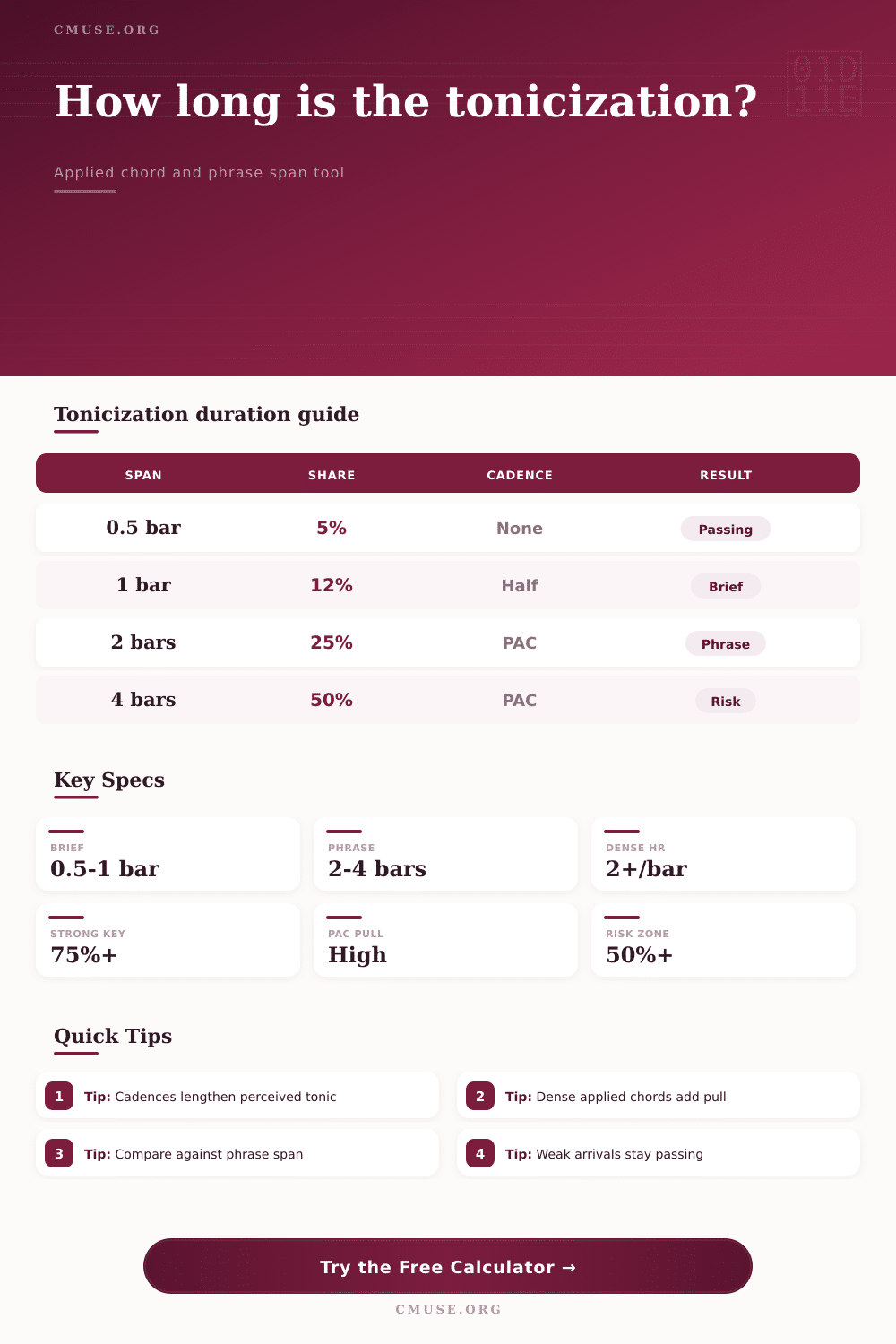
| Passing color | 0.25-0.75 bar | Under 10% | One applied dominant or chromatic predominant with no local close. |
| Brief tonicization | 0.75-1.75 bars | 10-25% | Short applied motion that points away, then returns quickly. |
| Phrase tonicization | 1.75-4 bars | 25-50% | Several applied chords, clearer arrival, and local phrase weight. |
| Modulation risk | 4+ bars | Over 50% | Cadential confirmation can make the temporary tonic sound structural. |
🎯 Cadence And Key Strength Weights
| Factor | Low Pull | Moderate Pull | High Pull |
|---|---|---|---|
| Cadence type | No cadence: 0.72 | Half / plagal: 0.88-0.98 | Authentic / PAC: 1.12-1.26 |
| Key strength | Color: 0.76 | Local key: 1.00 | Arrival center: 1.38 |
| Chromatic clarity | Below 45% | 45-74% | 75% and higher |
| Preparation | Direct shift | Pivot or sequence | Prepared cadence field |
⏱ Harmonic Rhythm Reading Table
| Chords Per Bar | Applied Chords | Density Reading | Analysis Note |
|---|---|---|---|
| 0.5-1.0 | 1-2 | Light | Slow rhythm makes each applied chord more audible. |
| 1.0-2.0 | 2-4 | Clear | Common in Classical phrases and jazz turnarounds. |
| 2.0-4.0 | 4-8 | Dense | Sequences can imply a target before it is cadenced. |
| 4.0+ | 8+ | Rapid | Use cadence and bass arrival to avoid over-reading. |
📋 Common Tonicization Scenarios
| Scenario | Likely Target | Usual Span | Typical Reading |
|---|---|---|---|
| Secondary dominant in a period | V or ii | 0.5-1.5 bars | Brief tonicization unless cadenced locally. |
| Applied ii-V in jazz | Next chord root | 1-2 bars | Clear local pull with fast return. |
| Romantic chromatic mediant | Remote major or minor | 2-4 bars | Color becomes key-like if melody confirms it. |
| Sequential episode | Several temporary goals | 3-8 bars | Analyze each arrival before calling modulation. |
Harmonic movement shift to suggest a new key for a brief moment but does not fully modulate. Think of it like this: when we are driving, we occasionally look out the window, but when we look back at road, we are back on course. The question is how long is “a glance” before it turns into a “detour”?
A secondary dominant can be so long, resolved with such weight, that it cease to function as “color” and begins to sound like modulation. Separating a passing chord from a temporary key center goes beyond bar-counting. It involves considering length of the phrase versus the strength of the cadential point. Plug in your cadence type plus your span, let the calculator do the math, and you’ll never again need to guess if that’s a two-bar V/V that’s structural or decorative.
How to Tell if Music Changes Key
The first thing most listeners attend to is actual length of the applied chord. Why wouldn’t it? Four bars of G major in a piece in C major sounds like a modulation. But duration alone can be deceptive and doesn’t necessarily mean a modulation. However, it’s deceptive and needs some context. A four-bar phrase could sound short if the harmonic rhythm is fast, and ear has no solid cadence point to hang on to. Two bars with full preparation and a perfect authentic cadence will hammer the temporary tonic home. Perception isn’t measured by time but by input.
What’s in the music that makes the ear feel that way? If you alter type of cadence in the tool, then what you’re doing is telling the algorithm how forceful or strong the push towards the new center is. This is noticeable when you hear a half cadence at the end of a phrase instead of a strong PAC. It hangs the music in limbo whereas the PAC pulls listener fully into the new key.
This is the part that most analysts miss. They count beats rather than measure gravity. In this context, think about clarity and preparation as part of calculation. Without a pivot or even a dominant chord as preparation to the V/ii, it just sounds like something that happens rather than somewhere the music is going. It is like a splash but not a place to be. The chromatic clarity and preparation bars account for this in the calculator. A strong perception of tonicity are strengthened by high clarity with distinct leading tones. Think of this as mirroring our experience of tonal music in real time. Where home is can change momentarily then return to its original position. In such circumstances, we require clues to direct us back ‘home’.
Composers of the romantic period deliberately blurred these distinctions and could produce extended chains of applied dominants that sound like they was heading somewhere but never settled. These kinds of passage require analysis of each arrival point individually instead of as a single modulation judged on overall sequence.
The role of harmonic rhythm is also a quieter one but an important one here too. Even with just three bars of applied harmony, if they occur at a fast rate, the chord change each half-beat. The passage feels fleeting. There is little time for your ear to identify the momentary tonic before the next bar arrives. It is this that reduces the apparent stability of any given key as its harmonic rhythm becomes denser. Why? Because it continues to keep the music in motion. If you analyse a jazz turnaround full of rapid ii-V progressions over several keys, while the number of applied chords may be high, the calculator will also reflect a lowering of stability.
Why? It depends on how you hear the context. A passing chromatic chord in a piece of classical music doesn’t demand treatment different than a pivot arrival in a Broadway song. Each situation calls for a different balance of phrase and cadence share. All these numbers are ultimately only guide points. Expectation and the violation of that expectation is at the heart of music. Sometimes a deceptive cadence placed in an unexpected place can destroy a solid attempt at tonicization. It refuses the resolution that listener wants to hear. This forces the clock to go back to zero when it comes to establishing the key.
So take the tool, get a base-line read of the stability class and then listen for yourself. Does the melody support this harmonic idea? Maybe the calculator underestimates its strength because it was based off rhythm alone and the voice pulled hard on the temporarly leading tone. Listen subjectively and combine this with objectivity and that’s the best analysis. Consider what is happening in the ear, what the writer intends, and not just what is written on the page. Think back to that first glance out the window. Are you still heading home or have you changed your mind and decided to stay awhile?