Tongue Drum Calculator
Plan a tongue drum scale, estimate tongue lengths, and size the shell from your notes, material, and build dimensions.
🥁 Presets
🎶 Build Inputs
📊 Material Spec Grid
📐 Reference Tables
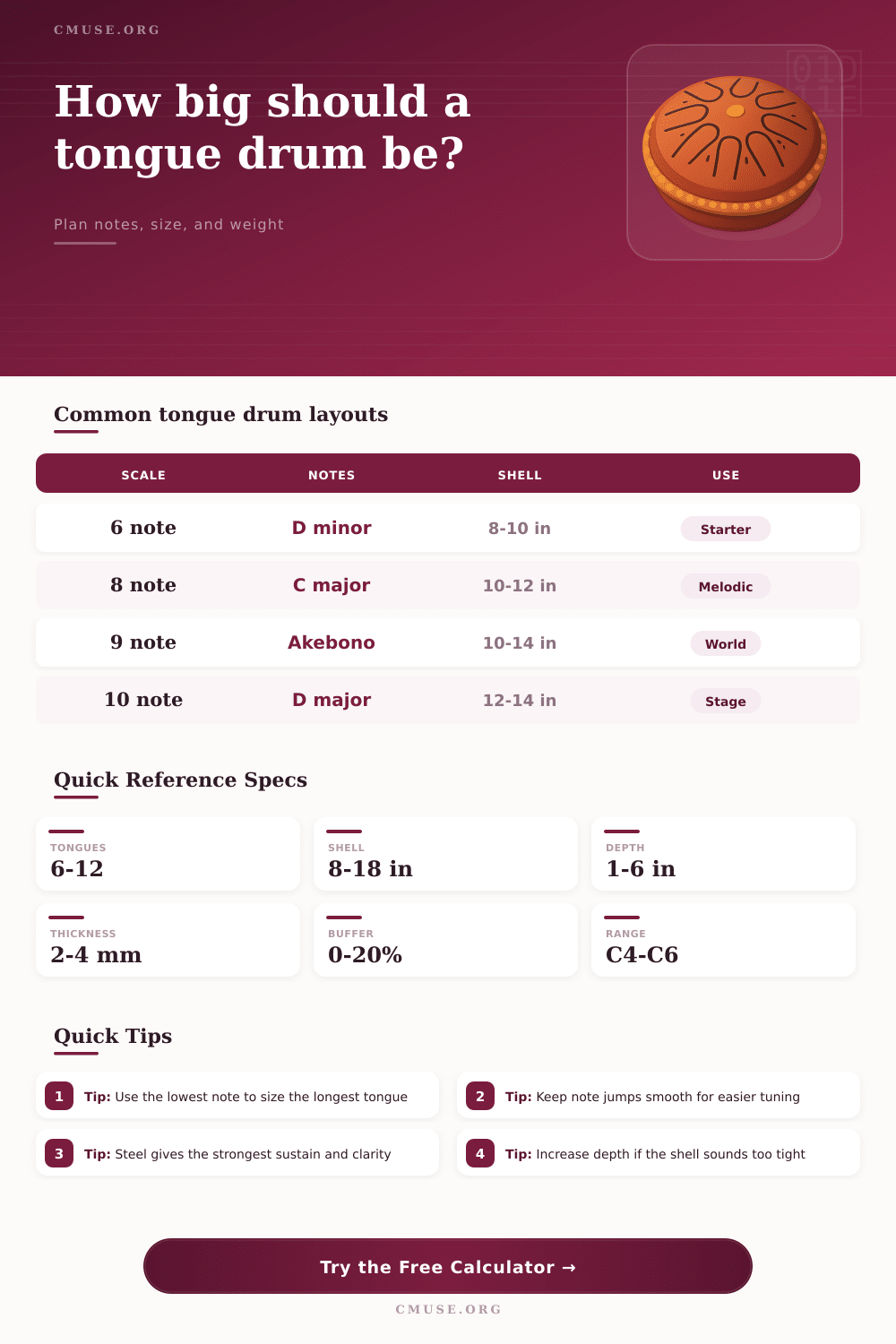
| Diameter | Count | Scale | Feel |
|---|---|---|---|
| 8-10 in | 6 | Minor | Compact |
| 10-12 in | 8 | Pentatonic | Balanced |
| 12-14 in | 9 | Diatonic | Full |
| 14-18 in | 10-12 | Extended | Deep |
| Scale | Root | Notes | Use |
|---|---|---|---|
| D minor pentatonic | D | 6 | First build |
| C major | C | 8 | Melody |
| A minor pentatonic | A | 6 | Warm |
| Akebono | D | 6 | Zen |
Tongue drum is percussion instrument, also called steel tongue drum, tank drum or hank drum. It belongs to the idiophone family of percussion instruments. Idiophone is instrument that makes sound by its own vibration.
Tongue drums are new creation that appeared around the 2000s
What is a Steel Tongue Drum?
You make steel tongue drum from empty tank, commonly 20-lb propane tank. You flip the tank and cut the base off. In the bottom you cut seven to ten tongues radially, which forms the top of the instrument.
When you strike tongue with stick, it vibrates, and the whole cavity of the drum resonatse the sound.
Every tongue gives musical note that you can play by direct hit with hands, mallets or silicone finger protectors. On one of the two shells, usually the bottom where there are no tongue cutouts, you drill hole, so that the body works as resonance chamber. The instrument is known for its relaxing sounds, easy play and unique flying saucer look.
It does not require prior musical or technical experience.
Single sided drums sound much more loudly than double sided. Double sided have more versatility. Thicker steel gives denser and hollow sound, but other factors also affect it.
Most of steel tongue drums are not chromatic. They are mostly pentatonic, hexatonic or diatonic. That helps to easily play them, but limits the diversity.
From high quality steel you form tongue drums with carefully shaped tongues on the surface. They give rich, calm tones, ideal for music therapy, sound healing, meditation and rest. The quiet sound requires you to calm the mind to enjoy it.
The drum helps well with meditation.
Steel tongue drum you consider relatively easy to learn compared to many other percussion instruments, so it works for many folks. Cheap tongue drums are usually quiet, have short sustain, untuned harmonies and require mallets to play. Cheap copy works well for sound bath vibrations, but it does not give the quality or sound of good tongue drum.
Some tongue drums are tunable, so the player must not stay at one scale. Certain models come with magnets to change tunings. The tongue drums come in bass and tenor sizes, from ash or padouk wood.
Some big tongue drums have feet on one side. Classical compositions of Bach and Beethoven sound great on steel tongue drum. Popular bits like the Canon in D by Pachelbel can be adapted also.