Tonearm Resonance Frequency Calculator
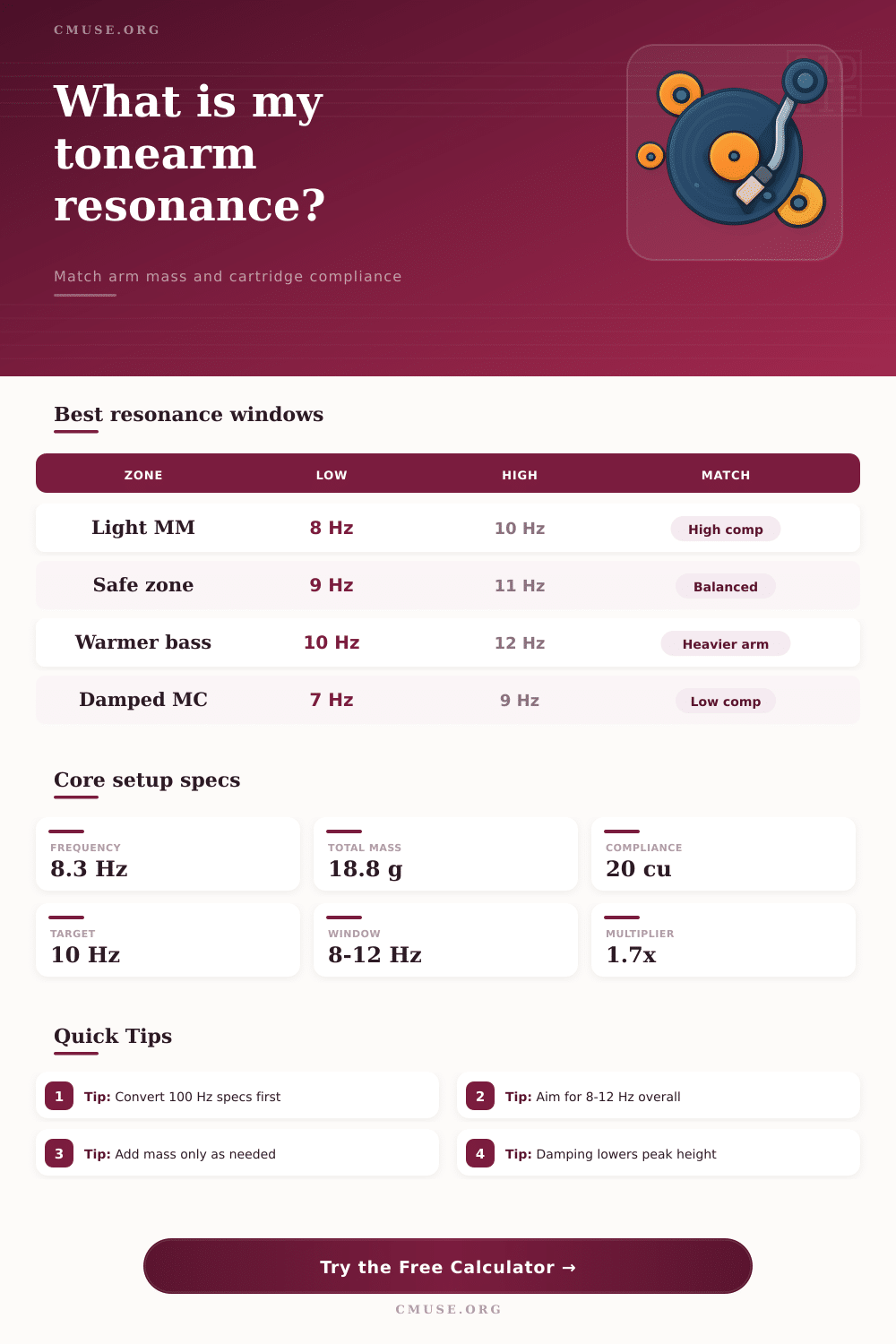
Check arm mass, cartridge mass, and compliance together so you can keep the arm/cartridge resonance inside the safe 8-12 Hz window.
🎧 Real-World Presets
⚙ Tonearm Inputs
Tonearm resonance formula
Resonance is estimated as fr = 159.15 / sqrt(total moving mass × compliance), with mass in grams and compliance in cu.
📊 Setup Snapshot
📈 Recommended Resonance Windows
| Use case | Low | High | Match note |
|---|---|---|---|
| High-compliance MM | 8 Hz | 10 Hz | Light arm |
| General playback | 9 Hz | 11 Hz | Balanced |
| Heavier MC rigs | 9 Hz | 12 Hz | Medium arm |
| Damped systems | 7 Hz | 9 Hz | Low comp |
📋 Tonearm Mass Classes
| Mass class | Range | Best with | Example arm |
|---|---|---|---|
| Very low mass | Under 10 g | 20-35 cu | SME 3009 |
| Low mass | 10-14 g | 15-25 cu | Rega RB330 |
| Medium mass | 14-20 g | 10-20 cu | Linn Ittok |
| High mass | Over 20 g | 6-12 cu | Broadcast arm |
🔍 Compliance Conversion Guide
| Source | Multiplier | Why it helps | Note |
|---|---|---|---|
| 10 Hz spec | x1.0 | Use as-is | Direct match |
| 100 Hz mild | x1.7 | Common estimate | MM and MC |
| 100 Hz medium | x1.8 | Stiffer stylus | Check data |
| 100 Hz heavy | x2.0 | Very low quoted | Use carefully |
🎵 Preset Comparison Table
| Preset | Mass | Compliance | Expected f_r |
|---|---|---|---|
| SME 3009 + V15 III | 12.4 g | 30 cu | About 8.2 Hz |
| Rega RB330 + 2M Blue | 18.8 g | 20 cu | About 8.2 Hz |
| Technics + VM95E | 18.7 g | 17 cu | About 8.9 Hz |
| FR-64s + DL-103 | 29.1 g | 9 cu | About 9.8 Hz |
💡 Practical Notes
Resonance frequency is a measurement of the natural vibration of the tonearm, cartridge, and stylus when they all moves in synchronization with the record. Each of these components has a certain resonance frequency when they is all functioning as a spring-mass system. The cartridge has a measurement of compliance, which is a measure of how much the suspension within the cartridge can flex when force is exerted upon the cartridge.
If the compliance of the cartridge dont match with the mass of the tonearm, the resonance frequency can fall within an audible range of 5 to 15 hertz. Within this audible range, the resonance frequency will cause distortions to the music being played, as well as amplify vibrations from footsteps or warp records. To play music of high quality, the total moving mass should be matched to the compliance of the cartridge.
Match Tonearm Mass and Cartridge Compliance
The match of these two component will ensure that the resonance frequency of the cartridge, tonearm, and stylus system falls outside of the frequency spectrum of music. Furthermore, 8 to 12 hertz are the ideal range of resonance frequency for cartridge systems. If the resonance frequency is set to a value that is too low, such as under 7 hertz, vibrations from the environment will still affect the tonearm and cartridge.
If the resonance frequency is too high, such as over 12 or 13 hertz, the bass of the music will lose it foundation. The compliance specifications of cartridges are often provide at frequencies of 100 hertz. To find the compliance of the cartridge at 10 hertz, which is the value that determine the resonance frequency of the system, those specifications should be divided by approximately 1.7.
Effective mass is a value that indicate how the tonearm behaves at the headshell end of the arm, which may be different than the weight of the arm. The effective mass also take into account the length of the arm and the dynamics of the pivot of the arm. Additionally, one should consider the mass of the cartridge body and the mounting hardware of the cartridge.
The cartridge body and hardware can add between 7 and 9 grams of mass to the system. A light tonearm with an effective mass of 10 grams can have a cartridge with a compliance of 20 or more. A heavier tonearm with an effective mass of 20 grams will require a cartridge with a compliance value between 8 and 12.
Environmental factor will influence the selection of the desired resonance frequency. For example, if the individual owns records that are often warped or if they live on a floor that vibrates easy, they should select a resonance frequency of approximately 11 hertz to naturaly dampen the vibrations that affect the system. For individuals with very quiet room, however, a resonance frequency of 9 hertz will help to provide better control of the cartridge.
Additionally, damping fluids and compounds can be utilize within the cartridge to lower the Q factor of the system. Lowering the Q factor will ensure that vibrations of the tonearm are eliminated more quick. One mistake that should of been avoided is ignoring the mass of small hardware component.
For example, small hardware components can add 0.5 to 1 gram of mass to the system, which could impact the resonance frequency of the system by as little as 0.5 hertz. There are different combinations of mass and compliance that create different sounds from the turntable. Individuals who would like their music to have warmer bass may opt for a system with medium mass tonarms and moderate compliance cartridges such that the resonance frequency are between 10 and 12 hertz.
Those who would like more precision in their record players may tune their systems to a resonance frequency of between 9 and 11 hertz. Using cartridges with high compliance with light tonarms will result in a resonance frequency between 8 and 10 hertz. Finally, a user may pair low compliance cartridges with heavy tonarms to achieve a resonance frequency between 7 and 9 hertz (if damping is also utilize).
Finally, to adjust the tonearm and cartridge system to the desired specifications, certain adjustment may be made. For example, adding mass rings to the tonearm can adjust the effective mass of the tonearm, or replacing the cartridge can adjust the compliance of the system. However, changing the cartridge will have a greater impact upon the resonance frequency of the system than adding mass to the arm.