🎵 Tonearm Resonance Frequency Calculator
Calculate the resonant frequency between your tonearm and cartridge for optimal vinyl playback matching
⚡Quick Presets
🎧Tonearm & Cartridge Specifications
📊 Resonance Analysis Results
📋Tonearm Mass Classification
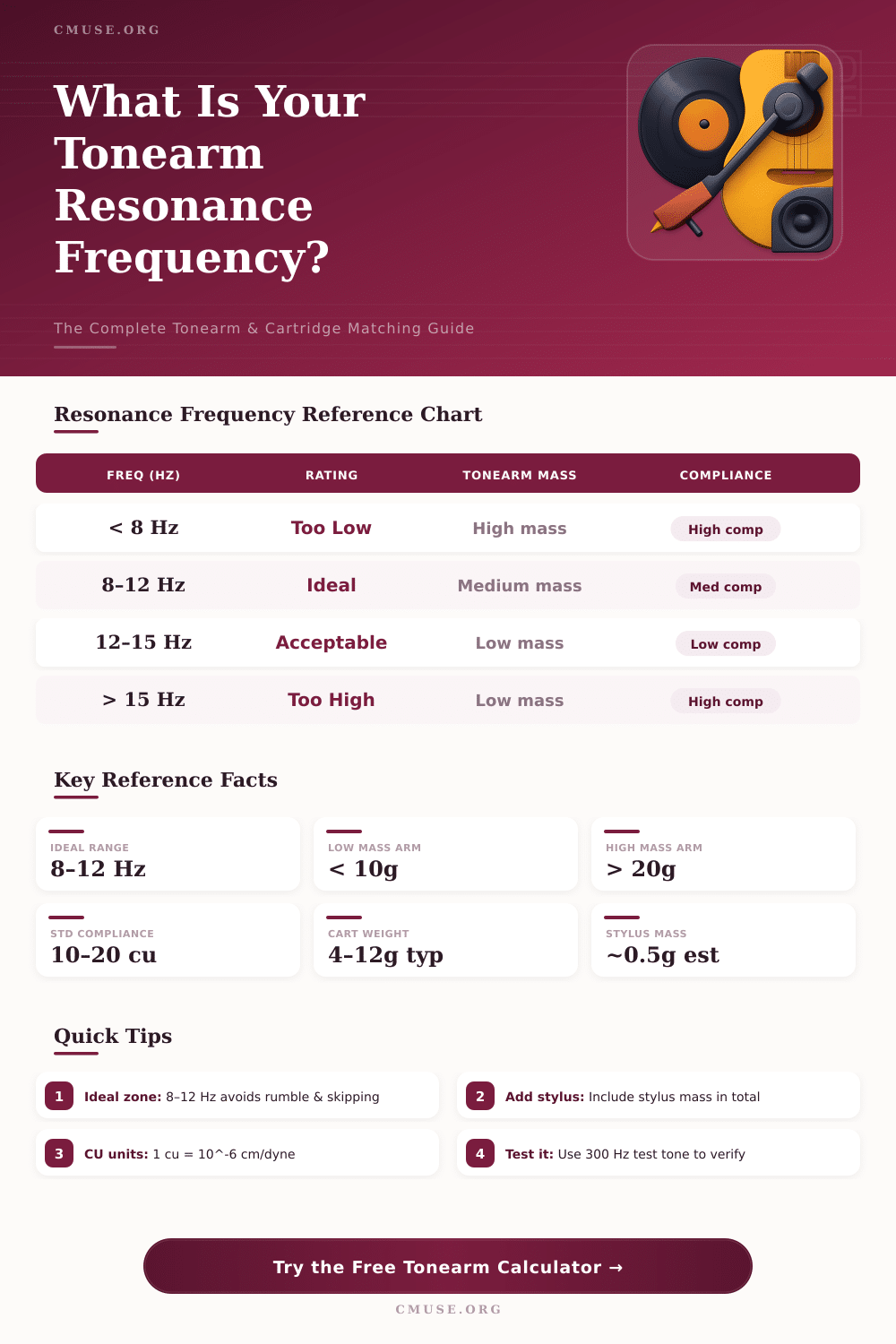
📐Resonance Frequency Rating Guide
| Frequency Range | Rating | Effect on Playback | Recommendation |
|---|---|---|---|
| < 4 Hz | 🔴 Critically Low | Severe warp-induced mistracking | Incompatible pairing — do not use |
| 4 – 7 Hz | 🟡 Too Low | Warp sensitivity, low-frequency boom | Reduce tonearm mass or use stiffer cart |
| 8 – 12 Hz | 🟢 Ideal | Excellent tracking, warp rejection | Perfect match — proceed with confidence |
| 12 – 15 Hz | 🟡 Acceptable | Slight bass resonance possible | Usable; fine-tune if possible |
| 15 – 20 Hz | 🟠 Too High | Bass distortion, groove mistracking | Increase arm mass or use lower-compliance cart |
| > 20 Hz | 🔴 Critically High | Severe groove distortion, stylus damage | Incompatible pairing — do not use |
🔄Common Tonearm Effective Mass Reference
| Tonearm Model | Effective Mass | Mass Class | Best Compliance Range |
|---|---|---|---|
| Rega RB330 | 11.0 g | Low-Medium | 15–30 CU |
| Pro-Ject 9cc | 8.5 g | Low | 20–45 CU |
| SME 3009 S2 Imp. | 6.5 g | Ultra Low | 30–50 CU |
| Technics EPA-100 | 12.0 g | Medium | 12–25 CU |
| SME 3012R | 14.0 g | Medium | 10–22 CU |
| Jelco SA-750D | 16.0 g | Medium-High | 8–18 CU |
| Ortofon RS-212D | 23.0 g | High | 5–12 CU |
| Denon DA-307 | 28.0 g | High | 5–10 CU |
📦Common Cartridge Compliance & Weight Reference
| Cartridge | Weight (g) | Compliance (10 Hz CU) | Ideal Arm Mass |
|---|---|---|---|
| Ortofon 2M Red | 7.2 | 20 CU | 10–18 g |
| Ortofon 2M Blue | 7.2 | 20 CU | 10–18 g |
| Shure M97xE | 6.6 | 25 CU | 8–16 g |
| Audio-Technica VM95E | 6.1 | 35 CU | 6–12 g |
| Denon DL-103 | 8.5 | 5 CU | 20–30 g |
| Denon DL-110 | 5.3 | 40 CU | 6–14 g |
| Grado Prestige Gold | 5.5 | 20 CU | 10–20 g |
| Nagaoka MP-110 | 6.5 | 13.5 CU | 12–22 g |
| Sumiko Blue Point No. 2 | 9.0 | 12 CU | 14–24 g |
| Ortofon SPU Classic | 30.0 | 5 CU | 25–40 g |
🧮Resonance Frequency Formula & Conversion Reference
| Parameter | Symbol | Unit | Notes |
|---|---|---|---|
| Resonance Frequency | Fr | Hz | Fr = 1000 / (2π × √(M × C)) |
| Effective Tonearm Mass | Meff | grams | Arm mass + cartridge + stylus |
| Dynamic Compliance (100 Hz) | C100 | CU (μm/mN) | Multiply by ~1.7 for 10 Hz equivalent |
| Dynamic Compliance (10 Hz) | C10 | CU | Used directly in formula |
| CU to μm/mN | — | — | 1 CU = 1 μm/mN (numerically equal) |
| Ideal Range | — | Hz | 8 to 12 Hz for all standard tonearms |
The resonance frequency of a tonearm and a cartridge is the specific frequency at which the two component interact with each other. The tonearm and the cartridge can be understood as a spring mass system, and as such, will naturaly resonate at a specific frequency based off its physical properties. The physical property that relate to resonance are the effective mass of the tonearm, and the compliance of the cartridge.
The effective mass of a tonearm is the total weight of the tonearm from the pivot point to the stylus. The compliance of the cartridge is a measurement of how much that cartridge can flex under a specific amount of force. Thus, the effective mass of the tonearm and the compliance of that cartridge determine the resonance frequency of a tonearm and cartridge system.
Resonance Frequency of Tonearm and Cartridge
Resonance frequency must be managed in that any vibration in the system (caused by turntable motor, footfalls upon the turntable, and warped records) can introduce rumble into the music that is played through the turntable. Rumble occur at frequencies below 20 Hz, but the resonance frequency of the tonearm and cartridge should ideally fall between 8 and 12 Hz. If the resonance frequency of a tonearm and cartridge system are too low, it can cause the tonearms stylus to bounce upon warped records.
However, if the resonance frequency is too high, it can cause the bass of the music to distort. Thus, the resonance frequency of a tonearm and cartridge system should of be set to a frequency that is below the audible range of human hearing yet high enough to avoid rumble from the turntables vibrations. In order to achieve the proper resonance frequency for a tonearm and cartridge system, a person must understand the relationship between the effective mass of the tonearm and the compliance of the cartridge.
Cartridges with higher compliance work best with tonearms with