Tom Pitch Interval Calculator
Build a rack-to-floor tom tuning map from a starting pitch, tom count, musical interval, shell size set, head offsets, damping, and measured drum frequencies.
Load a practical drum-set tuning target, then adjust the interval and measured pitches. Tom 1 is treated as the highest/smallest tom and each following tom moves lower unless you choose a low-to-high anchor.
Enter measured frequencies after tuning to compare each drum with the calculated interval map. Leave a tom blank if it is not part of the kit.
Tom Pitch Interval Breakdown
| Tom | Shell Size | Target Pitch | Nearest Note | Batter Head | Resonant Head | Measured Error |
|---|---|---|---|---|---|---|
| Tom 1 | 10 in | 196 Hz | G3 | 196 Hz | 200 Hz | Enter measured Hz |
| Tom 2 | 12 in | 164.8 Hz | E3 | 164.8 Hz | 168.2 Hz | Enter measured Hz |
| Tom 3 | 13 in | 138.6 Hz | C#3 | 138.6 Hz | 141.5 Hz | Enter measured Hz |
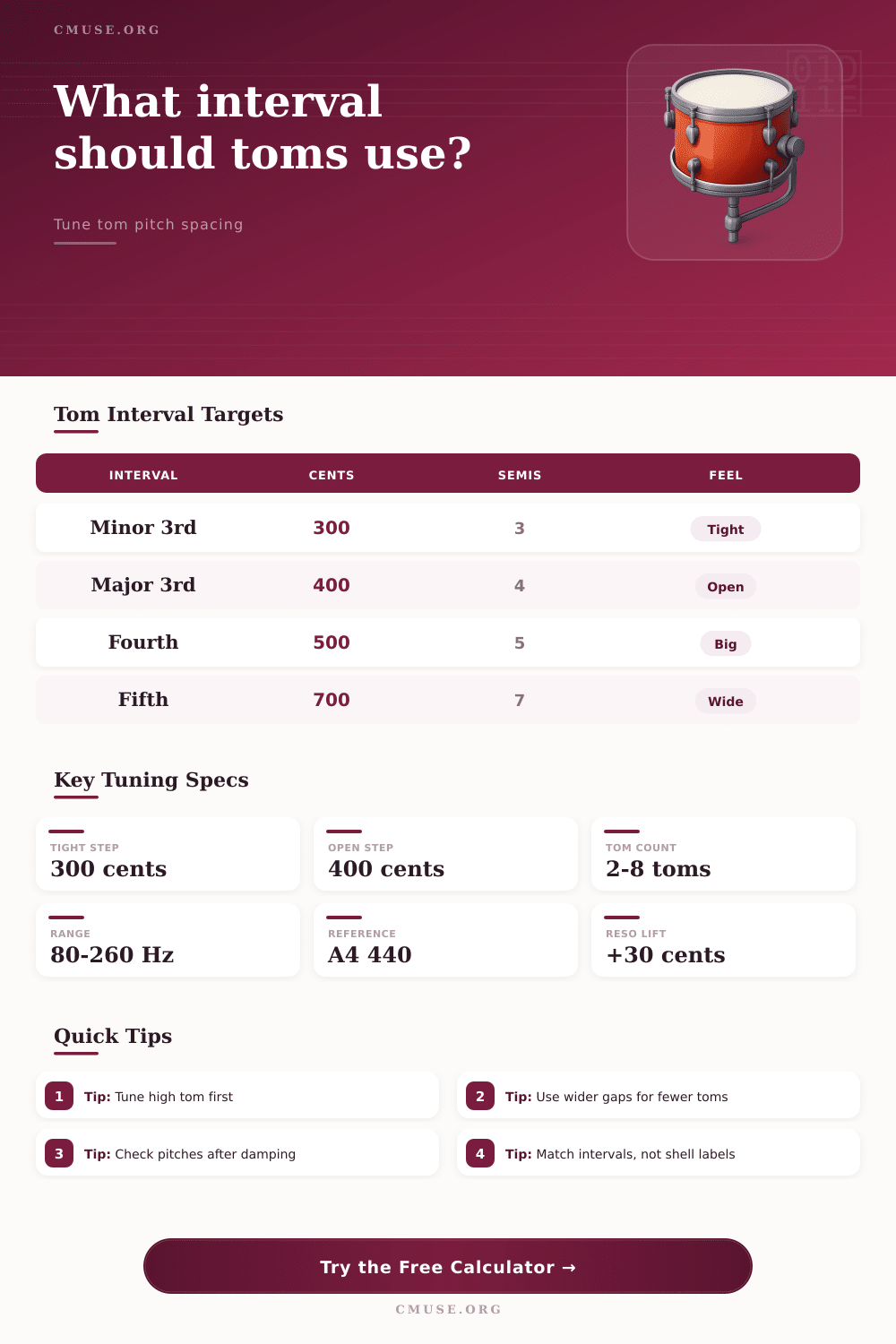
Minor-third spacing for compact kits
Major-third spacing for open fills
Fourth spacing for large tom drops
Common resonant head lift
Typical drum-set tom fundamentals
Supported rack and floor tom count
Default note-name reference pitch
Practical tolerance for measured tuning
| Interval Name | Cents | Frequency Ratio | Tom Count Fit | Practical Character |
|---|---|---|---|---|
| Whole step | 200 cents | 1.1225 | 6 to 8 toms | Very close Smooth melodic runs, but low toms can bunch together. |
| Minor third | 300 cents | 1.1892 | 4 to 6 toms | Balanced Common spacing for musical rack-to-floor movement. |
| Major third | 400 cents | 1.2599 | 3 to 5 toms | Open Clear separation without sounding extreme. |
| Perfect fourth | 500 cents | 1.3348 | 2 to 4 toms | Big drop Strong floor-tom fall and dramatic fills. |
| Perfect fifth | 700 cents | 1.4983 | 2 to 3 toms | Wide Useful when each drum needs a separate register. |
| Shell Diameter | Common Fundamental Range | Higher Tuning Feel | Lower Tuning Feel | Best Interval Role |
|---|---|---|---|---|
| 8 in | 200-260 Hz | Bright and fast | Can sound papery | Top tom in fusion or extended kits |
| 10 in | 160-220 Hz | Clear rack tom cut | Round but still articulate | High anchor for 3 to 5 tom setups |
| 12 in | 120-180 Hz | Focused mid rack voice | Warm lower rack voice | Middle tom in thirds or fourths |
| 13 in | 105-165 Hz | Rock rack fullness | Can overlap 14 in floor tom | Bridge between rack and floor toms |
| 14 in | 90-140 Hz | Compact floor tom punch | Deep but controlled | Low tom in jazz, middle floor in big kits |
| 16 in | 70-120 Hz | Strong floor tom body | Large drop and longer decay | Lowest tom for many four-piece kits |
| 18 in | 55-95 Hz | Big stage floor tone | Can get indistinct when damped | Low endpoint for rock and metal kits |
| Preset | Tom Count | Anchor Pitch | Interval | Head Plan | Use Case |
|---|---|---|---|---|---|
| Jazz Bop Two-Tom | 2 toms | 174.6 Hz | Perfect fourth | Resonant +45 ct | Open 12 and 14 in melodic response. |
| Classic Rock Three | 3 toms | 196 Hz | Minor third | Resonant +25 ct | Familiar rack-to-floor spacing. |
| Fusion Four-Tom | 4 toms | 220 Hz | Major third | Resonant +35 ct | Clear 8, 10, 12, 14 in separation. |
| Gospel Five-Tom | 5 toms | 246.9 Hz | Minor third | Resonant +50 ct | Fast descending runs with lift. |
| Metal Six-Tom Drop | 6 toms | 233.1 Hz | Wide whole step | Batter -10 ct | Large kit with controlled low toms. |
| Octave Eight-Tom Run | 8 toms | 261.6 Hz | Whole step | Even head targets | Chromatic-like extended tom sweep. |
| Head Relationship | Typical Offset | Sustain Effect | Pitch Behavior | Useful When |
|---|---|---|---|---|
| Matched heads | 0 cents | Even and predictable | Clear tuner reading near the target | You want simple repeatable intervals. |
| Resonant slightly higher | +20 to +50 cents | More lift and singing decay | Perceived pitch can rise after attack | Rack toms need more life. |
| Resonant much higher | +80 to +150 cents | Shorter, tighter response | May emphasize attack over body | Fast fills need definition. |
| Resonant lower | -20 to -80 cents | Drop-like decay | Pitch can sag after the hit | Floor toms need a deeper tail. |
| Batter lower than target | -20 to -60 cents | Softer stick feel | Fundamental can bloom below attack | You want a darker, rounder voice. |
A drum kit is only ever going to sound like one coherent instrument if distance between each tom match. Our human ears do not understand pitch in a linear way but rather logarithmically. This means that when a musician think about pitch, our naturaly intuition is often wrong and we perceive it in a linear manner. Imagine a fill spanning four drums where you are hearing pitches that go from C1 to E1, and then G1. Those notes would feel very different depending on whether you’re hearing them in isolation or as part of a rapid fill.
That’s why I’ve created the calculator above which can take your interval of choice and calculate true frequencies for you. Drummers begin with some form of guesswork as they tension lugs towards an even-looking head, yet fail to consider how those frequencies plays together. Tuning to intervals create a chord-like structure using percussive instruments instead.
Why Drum Tuning Matters
A three-semitone or minor third interval is neither too large a leap nor too small a step to feel musical, and it sounds good on its own. This is why it’s become the default. Perfect fourths is wider. While they are fine for sparser setups, they produce large jumps that may leave empty spaces on a five-drum rack.
Once you know your starting pitch, or anchor, simply input your target interval and calculator does the maths. No need to guesstimate any more conversions. So what about the interval? Choosing an anchor point is arguably more important then choosing an interval. Will it be bottom end of your kit (the lowest floor tom) or the top (your highest tom)? Either way, the calculator will step down from this starting point so that each following drum fall into a logical harmonic relationship with all the others.
The result is that your floor tom won’t be a half-step away, not an odd place to end up, and neither are your higher toms, which can easily crowd one another. It provides a ladder that’s comfortabley for both your ears and your hands.
Then there is addition of head tuning, a layer of complexity that many players overlook. Tuning the resonant and batter heads precisely to each other give you a single consistent pitch. However, increasing the tension of the resonant head by twenty to fifty cents can give the drum more sustain and life. Raising the resonant head by twenty to fifty cents enables sympathetic resonance which allows the drum to sing whilst avoiding ringing out too much.
From the reference table on the page we see how gospel kits may spread out their intervals for open fills whereas metal setups tighten them all up for speed. Your ultimate tuning stability is also affected by temperature and dampening. Softening of the drum head from a warm room environment will tend to flatten your notes with extended use on a long set. Tuning in a cool practice room but performing on a heated stage can also throw off your intervals enough to not sound good. Consider these variables when accounting for how your tuning might shift if you tune in a cold practice space and then move to a heated stage.
Damping materials muffle higher frequencies, so the fundamental tone is obscured from the transient attack, making reading of the tuners less reliable. Using a pitch interval calculator shouldn’t make you obsessive about being exact down to the single cent. There are so many variables in drumming: shell construction, head type, stick angle, etc. This is a tactile art form. The idea is to have something theoretical to aim for as a starting place before you start dialing in by ear. And it helps avoid analysis paralysis when faced with a row of dark drums.
Set the interval and generate the frequencies. Then, get your lug settings close enough for tuner to confirm you’re within shouting distance. After that, let your ears take over for the finishing touches. Ultimately, tuning is just about being consistent. If you prefer to use whole steps for smooth runs or major thirds for bold, separate voices, do that! But be consistent with your choices. The instruments becomes easier to play and you begin to use them expressively instead of struggling against them.
Next time you pull out your drum set, map out your intervals before sitting down. It only takes a few minutes to establish but would of saved you hours of frustrated tweaking later on. Your tones will blend together, your fills will sound tighter and the entire kit will suddenly feel unified instead of a bunch of separate instruments. That’s when technical profishency becomes real music.