Time of Flight Calculator
Convert an acoustic path length into arrival delay, round-trip echo time, samples, wavelength position, and phase offset for studio, stage, hall, and instrument measurements.
🎵 Real Audio Presets
Choose a working scenario or enter your own distance. Air calculations use the standard temperature relationship c = 331.3 + 0.606T in meters per second; other media use typical reference velocities for comparison and instrument work.
⚙ Path, Medium, and Timing Inputs
📊 Live Timing Summary
🎻 Audio and Instrument Propagation Grid
📐 Speed of Sound Reference
| Medium or Condition | Speed | Delay per Foot | Delay per Meter | Typical Audio Use |
|---|---|---|---|---|
| Air at 0°C / 32°F | 331.3 m/s | 0.920 ms | 3.018 ms | Cold outdoor stage or venue check |
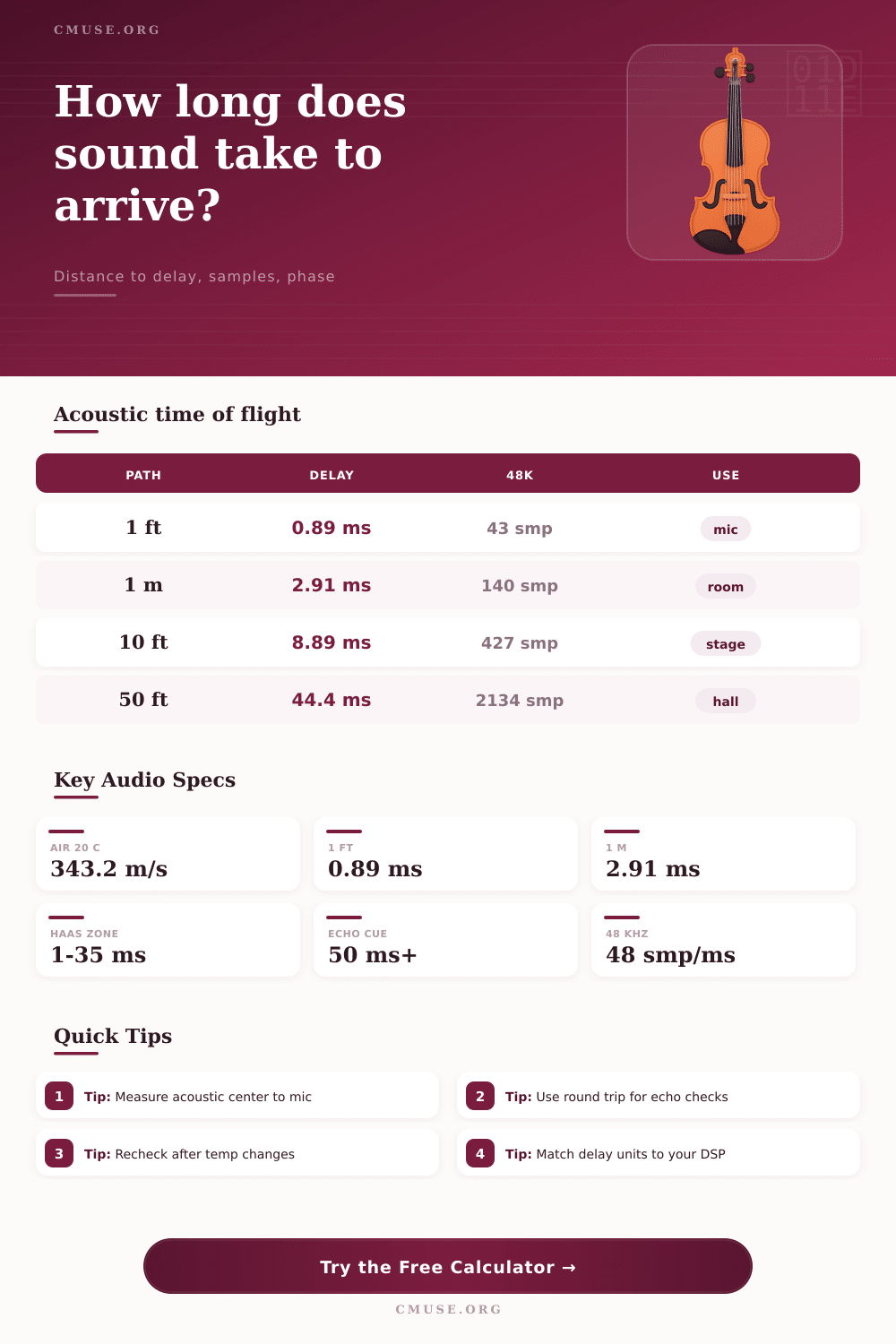
| Air at 20°C / 68°F | 343.2 m/s | 0.889 ms | 2.914 ms | Studio and room default |
| Air at 30°C / 86°F | 349.5 m/s | 0.872 ms | 2.861 ms | Warm stage or club |
| Fresh water | 1482 m/s | 0.206 ms | 0.675 ms | Hydrophone and underwater recording |
| Helium gas | 1007 m/s | 0.303 ms | 0.993 ms | Lab comparison, not room timing |
| Carbon dioxide gas | 259 m/s | 1.177 ms | 3.861 ms | Gas comparison and demonstrations |
⏱ Distance to Delay Table in Air
| Path Length | One-Way Delay | Round Trip | 48 kHz Samples | Practical Cue |
|---|---|---|---|---|
| 8 in / 20.3 cm | 0.59 ms | 1.19 ms | 28 samples | Close snare or vocal mic spacing |
| 1 ft / 0.305 m | 0.89 ms | 1.78 ms | 43 samples | Small mic placement difference |
| 3 ft / 0.914 m | 2.67 ms | 5.33 ms | 128 samples | Guitar cab or floor wedge path |
| 10 ft / 3.05 m | 8.89 ms | 17.78 ms | 427 samples | Near speaker-to-listener distance |
| 30 ft / 9.14 m | 26.67 ms | 53.34 ms | 1280 samples | Stage fill or balcony offset |
| 100 ft / 30.5 m | 88.90 ms | 177.8 ms | 4267 samples | Outdoor delay tower range |
🎚 Sample Rate Conversion Table
| Sample Rate | Samples per ms | 1 Sample Time | 10 ms Delay | Best Use |
|---|---|---|---|---|
| 44.1 kHz | 44.1 | 0.02268 ms | 441 samples | Music production sessions |
| 48 kHz | 48.0 | 0.02083 ms | 480 samples | Live sound, video, DSP defaults |
| 88.2 kHz | 88.2 | 0.01134 ms | 882 samples | High-rate music work |
| 96 kHz | 96.0 | 0.01042 ms | 960 samples | Low-latency measurement sessions |
| 192 kHz | 192.0 | 0.00521 ms | 1920 samples | Specialized lab capture |
🎧 Perception and Alignment Guide
| Timing Range | Distance in Air | Musical Meaning | Common Adjustment | Watch For |
|---|---|---|---|---|
| 0.02-0.10 ms | 0.27-1.35 in | Single-sample to tiny phase shift | Sample nudging or all-pass work | Comb filtering at high frequencies |
| 0.3-1 ms | 4-13.5 in | Close mic spacing differences | Move mic or enter sub-ms delay | Snare, guitar cab, stereo mic tone |
| 1-10 ms | 1.1-11.2 ft | Short acoustic arrival offset | Delay nearer speaker or track | Image shift and punch loss |
| 10-35 ms | 11.2-39.4 ft | Haas precedence region | Delay fills below main arrival | Localization pulling forward |
| 50 ms+ | 56.2 ft+ | Distinct echo can be perceived | Add delay or reduce reflection level | Slapback from walls and balconies |
Until you’ve tried to align a PA system and found out what happens when the mix sounds muddy, it’s likely you never thought about time-of-flight for sound. Three feet might not seem like far but there is no such thing as nothing in way of a PA system speaker to your ears. Sound travels through air. And air is a physical substance with a hard limit on timing accuracy.
That’s why a vocal track may be behind the beat. A live mix may also lack punch if front of house monitor isn’t aligned with main speakers. Knowing the concept of sound travel time turn these vague mixing problems into solvable math problem.
The Importance of Sound Travel Time
To get an idea, most engineers has some sort of approximation in their head like “sound takes about 0.9 milliseconds to go 1 foot.” While this will get you pretty close if you’re checking something quickly, you’ll be lost when accuracy counts. You tell it what environment and path you want, and it figures out the math for you.
It goes further then just distance by considering how temperature can changes the speed of sound quite a bit. Sound travels quicker in warm air, which reduces the delay window slightly, enough to mess with critical phase alignment in large spaces. Leaving temperature out is a big omission, as it results in drifting over time in studios where control room is heated up or at a long festival outdoors.
Inches become samples when you put mics on a drum kit. Just a couple of inches of separation between mic’ed tom and snare can cause phase cancellation, especially at higher frequencies. This can thin out the sound before you’ve hit record.
The tool takes those physical distances and turns them into sample counts depending off your session’s sample rate. Digital audio workstations operates in samples, not inches. Because a ten-foot speaker offset translates into more than four-hundred samples at 48 kHz, you can program delay towers with sample accuracy instead of using guesswork. It connects the physical world to the digital grid.
Directionality in audio is controlled by something known as precedence effects (also referred to as the Haas effect). In essence, if two sounds arrives at your ears one after another and they are separated by less than thirty-five milliseconds, your brain combines both into a single image. What this means for us is we can place our delay speakers out on a balcony and not have the sound seem to be coming from those secondaries. When you cross beyond the fifty-millisecond mark, you hear an echo which is separate from the original sound. Understanding where that line exists lets you create systems that feel large and deep instead of disjointed and repetitive.
Another important area is phase rotation. Even a slight delay as short as one millisecond can flip polarity of high-frequency content and create comb filtering, which makes vocals sound nasal or hollow. With this tool, you can use the calculator to view the amount of rotation occurring at a given reference frequency. This information enable you to make decisions about tweaking your mic position by inches or adding a small digital delay for proper alignment. It turns what we hear subjectively into something measurable.
It’s these concepts that instrument builders apply to the study of how waves travel through metals and wood too. Spruce soundboards transmit sound much faster then do steel strings. These are the reference numbers found on the calculator, but in real use, it is also about mass and tension.
It’s all about time of flight, which means the time it takes for energy to travel through anything from a source to a receiver. Tune a piano and a stadium show are no different in terms of physics. That means thinking of sound not just as something with a level but as something that travels through air and requires time to get there.
That causes you to think different about all aspects of audio engineering. Timing and space take the place of volume levels. Respecting the medium itself replaces struggling against muddiness in your mix. You start designing instead of fighting mixes.
Next time you set up a speaker array, or position a microphone, recall: the air is always running its own clock. Get in sync with it, and everything else will fall into line.