Time Alignment Distance Calculator
Turn speaker or microphone distance into the exact delay in milliseconds and samples needed to time-align your sources, with speed of sound adjusted for temperature
Full Calculation Breakdown
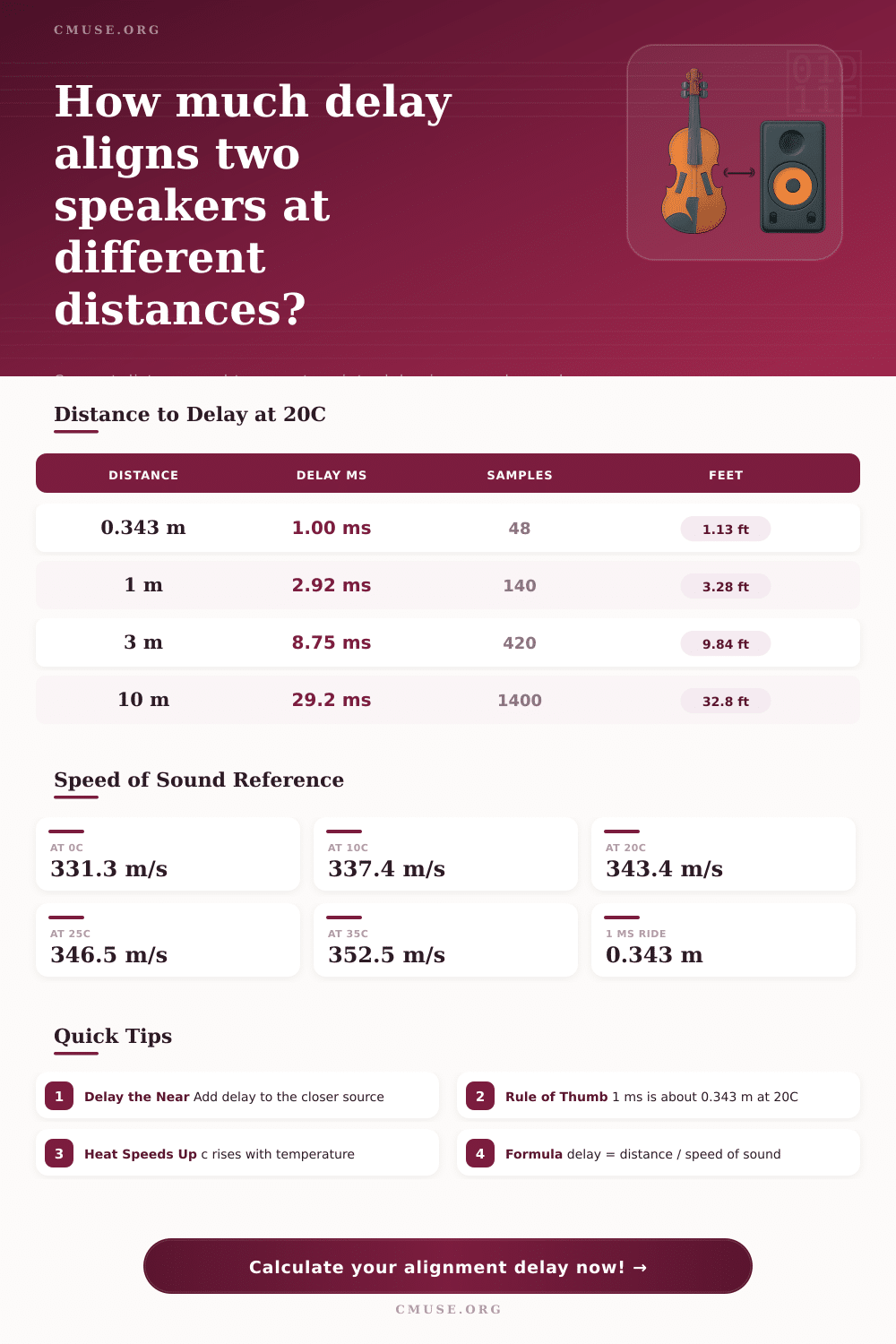
| Distance | Delay ms | Samples | Feet |
|---|---|---|---|
| — | — | — | — |
| Temp (°C) | Speed (m/s) | 1 ms = distance | Delay per meter |
|---|---|---|---|
| 0 (freezing) | 331.3 | 0.331 m | 3.02 ms |
| 10 (cool) | 337.4 | 0.337 m | 2.96 ms |
| 15 (mild) | 340.4 | 0.340 m | 2.94 ms |
| 20 (room) | 343.4 | 0.343 m | 2.91 ms |
| 25 (warm) | 346.5 | 0.346 m | 2.89 ms |
| 35 (hot) | 352.5 | 0.352 m | 2.84 ms |
| Distance | Delay (ms) | Samples @48k | Samples @44.1k |
|---|---|---|---|
| 0.343 m | 1.00 ms | 48 | 44 |
| 0.5 m | 1.46 ms | 70 | 64 |
| 1 m | 2.91 ms | 140 | 128 |
| 2 m | 5.82 ms | 280 | 257 |
| 5 m | 14.56 ms | 699 | 642 |
| 10 m | 29.12 ms | 1398 | 1284 |
| 30 m | 87.36 ms | 4193 | 3853 |
| Feet | Meters | Delay (ms) | Samples @48k |
|---|---|---|---|
| 1 ft | 0.305 m | 0.89 ms | 43 |
| 1.13 ft | 0.343 m | 1.00 ms | 48 |
| 3 ft | 0.914 m | 2.66 ms | 128 |
| 10 ft | 3.048 m | 8.88 ms | 426 |
| 20 ft | 6.096 m | 17.75 ms | 852 |
| 50 ft | 15.24 m | 44.38 ms | 2130 |
That’s because you’ve piled up your subwoofers in a delay tower and hoofed it out to the venue. Tight, physical-sounding bass is what you want. All you hear are a muddy thud that lingers in space. It’s not a lack of equipment; it’s physics. Because the bottom speaker is only three meters from your ear while the top one is three meters farther away, its sound reaches your ears almost ten millisecond after the other. To your brain, that small time difference sounds like one source with smear definition.
Fixing that are called time alignment. It makes everything talk at once. That’s how it goes from chaotic to clear. Once you know how far you need to send the signal, the rest of the math is done for you by the calculator above. No need to guess any coefficient or hunt around for a reference chart. The calculator even takes into account temperature, something most audio engineers fail to consider until they’re out on a sweltering stage.
How to Fix Bass Timing Problems
Molecules in warmer air possess greater kinetic energy, so they’re able to transmit the pressure wave faster. At zero degrees Celsius, sound travels at approximately 331 meters per second. In warmer temperatures (twenty degrees), it speed up to nearly 343 meters per second. On paper, that doesn’t seem like much of a difference. But when considering a thirty-meter flight path, it changes your delay window by several samples. If you don’t take into account the heat coming from your amplifiers and stage lights, you will be out of sync. And that’s where that residual muddiness comes from. A little thing, but it counts.
Knowing the proper sample rate is something else that makes for a great mix different than just a good one. Digital delay isn’t measured in time alone; it is also counted in discrete samples. A millisecond at 48,000 Hz are forty-eight samples. At 96,000 Hz, it takes ninety-six samples. That’s why the tool transforms your physical measurement into those very digital ones. You can then punch it right into your DSP processor or console and have the exact number. Rounding up to the next whole sample leaves you with phase errors that compound on each channel.
This precision guarantee that the transient attack of your snare drum from a close overhead mic matches the room tone picked up by a distant pair exactly. Let’s look at some real world examples for establishing a large PA system. So here you’ve got your main array and then you’re adding a fill speaker, twenty feet behind it, serving the front rows. Well within a split second, everyone sitting between those two adult-sized sofa is getting two signals, each arriving a few milliseconds apart. This causes comb filtering that thin the low end and makes vocals hollow.
Here’s how: Measure the distance from the listening position to the main array. Now subtract the distance to the fill speaker. What you’re left with is the path difference that you plug into the calculator. From this you’ll know precisely how much time to add to the nearer fill speaker to bring the audio wave in sync with that coming from the main array. And it’s not merely about covering them with sound, it’s also about keeping the whole thing phase coherent throughout the venue floor.
One problem is that people aren’t thinking about the listening position. They’re either mis-measuring or completely leaving it out. Wherever the humans are standing, that’s the point of view they use when calculating alignment. When the dance floor extends back, their sweet spot does too, making all those old delay settings useless. Think you’ve got it dialled? If you move the crowd, your sound will get worse again.
The tool comes with some reference tables which let you quickly check common scenarios such as aligning a snare mic to a drum overhead or aligning a sub to a top at two metres. These presets act as sanity checks so your custom calculation should of been in line with expected results. Time aligning makes sense because the ear localizes based off sound arrival times. Two transients that hit simultaneously will add to one another. Those that lag will cancel out frequencies and smear details.
You don’t have to be a physicist to solve this problem. But you should know that distance is just another frequency in the mix. If you can treat time like another factor to control with the same precision as EQ or gain, then you reclaim definition from the room. The bass punches again. Vocals cut through with purpose. That muddled thud resolves into the tight, physical impact you’d hoped for.
Sound moves at a known speed so why does your mix have to accept whichever gets there first?