Tied Note Duration Calculator
Add tied note values across beats, bars, tuplets, and dots, then convert the total rhythm into beats, seconds, milliseconds, measure position, MIDI ticks, and notation-friendly breakdowns.
Load a named notation scenario, then change tempo, meter, note values, dots, tuplets, start beat, and sequencer resolution. Each preset calculates immediately.
Each slot is one written note in the tie chain. Set unused slots to zero count. Dot and tuplet settings are applied before all slots are added together.
Slot A
Slot B
Slot C
Slot D
Duration Breakdown
1 dot
Adds half of the written value
2 dots
Adds 3/4 beyond the base value
Triplet
Each note lasts two thirds of normal
PPQN
Ticks per quarter note in MIDI timing
| Written Value | Whole-Note Fraction | Quarter-Beat Length | Dotted Length | Triplet Length |
|---|---|---|---|---|
| Whole note | 1 | 4 beats | 6 beats | 2.667 beats |
| Half note | 1/2 | 2 beats | 3 beats | 1.333 beats |
| Quarter note | 1/4 | 1 beat | 1.5 beats | 0.667 beat |
| Eighth note | 1/8 | 0.5 beat | 0.75 beat | 0.333 beat |
| Sixteenth note | 1/16 | 0.25 beat | 0.375 beat | 0.167 beat |
| Thirty-second note | 1/32 | 0.125 beat | 0.188 beat | 0.083 beat |
| Meter | Bar Length In Quarters | Typical Tie Use | Full-Bar Written Equivalent | End-Beat Check |
|---|---|---|---|---|
| 2/4 | 2 quarter beats | March accents and anticipations | Half note | Beat 1 after 2 beats |
| 3/4 | 3 quarter beats | Waltz suspensions and phrase holds | Dotted half note | Beat 1 after 3 beats |
| 4/4 | 4 quarter beats | Syncopation across beats 4 and 1 | Whole note | Beat 1 after 4 beats |
| 6/8 | 3 quarter beats | Compound dotted-quarter group ties | Dotted half note | Beat 1 after 6 eighths |
| 9/8 | 4.5 quarter beats | Three dotted-quarter pulse spans | Dotted half plus dotted quarter | Beat 1 after 9 eighths |
| 12/8 | 6 quarter beats | Blues shuffle and compound holds | Dotted whole note | Beat 1 after 12 eighths |
| Tied Pattern | Total Quarter Beats | Milliseconds At 120 BPM | Common Meter | Notation Result |
|---|---|---|---|---|
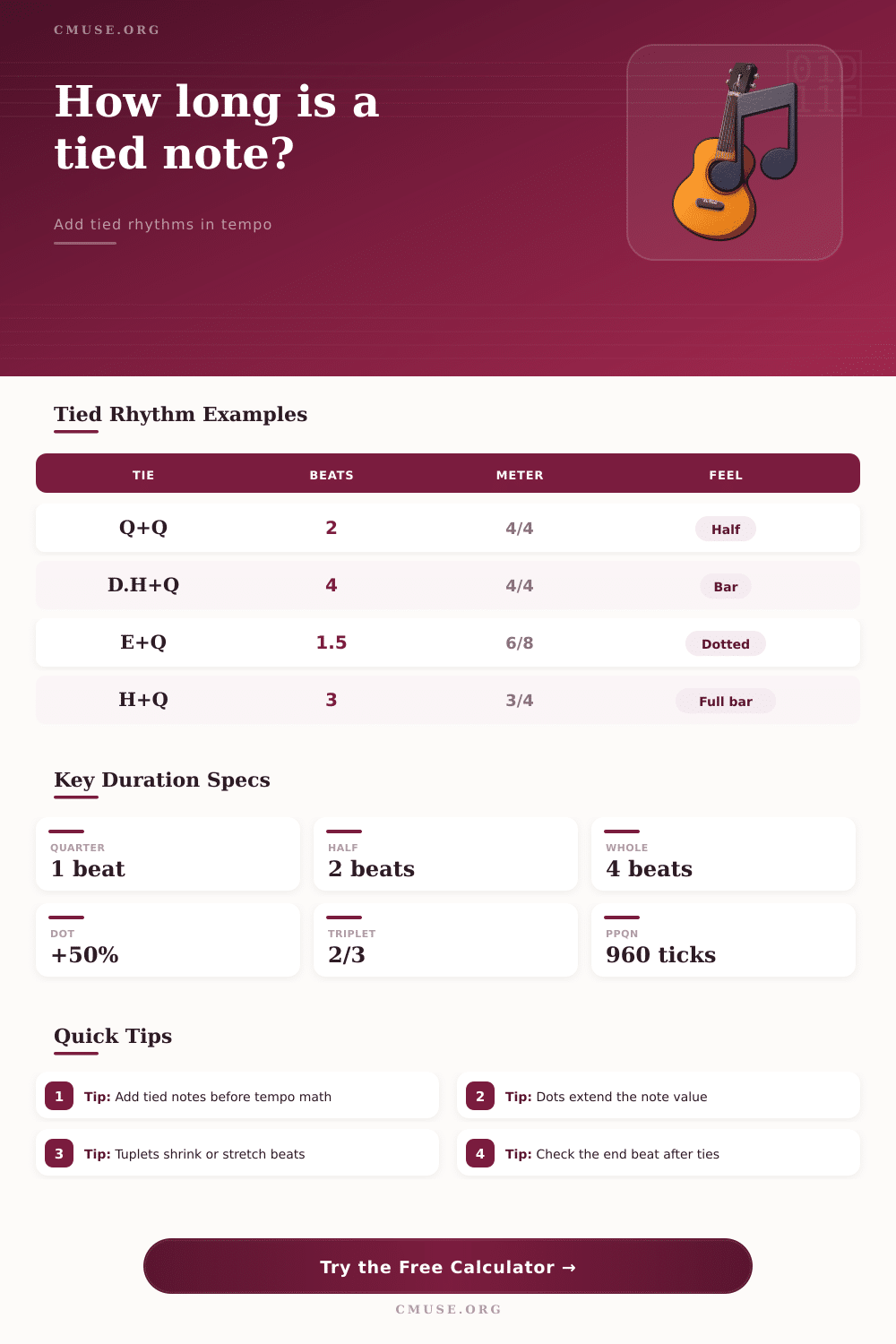
| Quarter tied to quarter | 2 | 1000 ms | 4/4 | Sounds like a half note, written across a beat or barline. |
| Dotted quarter tied to eighth | 2 | 1000 ms | 4/4 or 6/8 | Completes a two-beat span while showing subdivision. |
| Half tied to quarter | 3 | 1500 ms | 3/4 or 4/4 | Equals a dotted half duration. |
| Eighth tied to quarter | 1.5 | 750 ms | 6/8 | Matches one dotted-quarter compound pulse. |
| Quarter triplet tied to quarter triplet | 1.333 | 667 ms | 4/4 | Two notes inside a quarter-note triplet group. |
| Whole tied to half | 6 | 3000 ms | 4/4 or 12/8 | Long sustain over one and a half 4/4 bars. |
| Grid | Quarter-Beat Fraction | Ticks At 960 PPQN | Use Case | Watch Point |
|---|---|---|---|---|
| Quarter | 1 | 960 | Simple beat-length tied notes | Clean in most meters. |
| Eighth | 1/2 | 480 | Anticipations and backbeat ties | Check swing feel if enabled. |
| Sixteenth | 1/4 | 240 | Pop syncopation and short pickups | Very common for tied pushes. |
| Eighth triplet | 1/3 | 320 | Shuffle, swing, and triplet ties | Do not quantize to straight eighths. |
| Sixteenth triplet | 1/6 | 160 | Fast fills and drum notation | Needs tuplets displayed clearly. |
| Thirty-second | 1/8 | 120 | Fast ornaments or edits | May be too detailed for lead sheets. |
If you’ve ever glanced through some sheet music you may have noticed they writes out three quarter notes with ties rather than a single dotted half note. This is because, in addition to being about sound, it is also about visual rhythm and there can be a difference between those two things. Even though the sustain continues across a barline, it may be where the beats fall and so a composer would indicates this by tying across the barline.
That is where most musician get themselves into knots, based off what they see on the page and what they hear. In theory it’s simple mathematics; in practice, it’s somewhat of a mess. You’re plugging in fractions with no guaranteed common denominator then converting them from one unit of time to another, such as from seconds to MIDI ticks or vice versa.
How Musical Ties Work
That’s the job the calculator does for you up there: reads what you write in and turns it into dots and tuplets and actualy indicates when the note will conclude, in relation to the next downbeat. Take for instance the dotted half note in 3/4 time. That’s a full measure. What if you begin with the second beat of the measure though? Now you’ve got two beats left in the bar but no more space. The quarter note will spill over and continue in the following measure, a tie connects them.
Things become even trickier when we reach compound meters such as 9/8 or 6/8. These group pulses differently. This frequently results in counting errors because there is no way to check the span. But tempo makes all the difference. At 120 bpm, a two-beat hold lasts a second; double that to 240 and it shortens to half a second. Milliseconds count for musicians syncing live electronics as well as video editors cutting music into film.
The chart on the page clearly shows how time relates to speed… In other words, how much does each beat last? From there, how long will a particular rhythm run at different frame rates? You can calculate right here how many frames any rhythm will occupy at either 24 fps or 30. That precision is vital if you need an audio cue to match a visual cut. Even if the audience doesn’t know what’s wrong, they’ll sense that the sync isn’t quite right if you’re just a fraction of a beat out.
Then there’s the added twist of tuplets. Instead of dividing a beat in half, as in a dotted quaver (or eighth note), a triplet divides a beat into thirds. In other words, notes will fall on odd spaces on your screen or DAW software grid. If you tie them across, you are spanning unequal distances. To the calculator these inconsistent durations translates into ticks, the common denominator for every type of sequenced music. Once you know this particular chain of ties equates to precisely 320 ticks, you can enter them without guesswork.
Single and double dots extends note values by half, then half again. It’s easy enough arithmetic, but complicated by tempo variations and ties on notes. If you tie a dotted quarter to an eighth, this results in a total duration that equals a whole number, provided you do not mess up the addition. Too many novices attempt to round up both numbers separately before adding them together, making a rounding error. In practice, the app first sums all the durations as they appear so the final value produced is mathematicaly correct whatever the apparent complexity of written music.
Meter capacity is key here too. So how do you know if you really need to use a tie? A whole note will cleanly fit into a bar of 4/4. There’s no reason to ever tie four quarter notes together like this to fill space. However, ties is often vital for clarity in cross rhythmic passages or an irregular meter. They can indicate where a performer should accent and where there should be a breath.
The breakdown section on the calculator shows you if length of any tie fits the chosen meter. This helps you catch notational mistakes before they reaches the stand.
In conclusion, rhythm is about flow. The structure doesn’t change whether you’re programming the beats into a sequencer or counting them out in your head. The ties joins one moment to another and link them together to form an extended thought. If the duration isn’t correct then the music does not breathe how it should of. This clarity lets the listener concentrate on the melody without having to fight against confusing accents or mistimed entries. Starting from fractions and finishing with feel, this is the whole point of putting it all together in the first place.