Thiele-Small Parameters Box Calculator
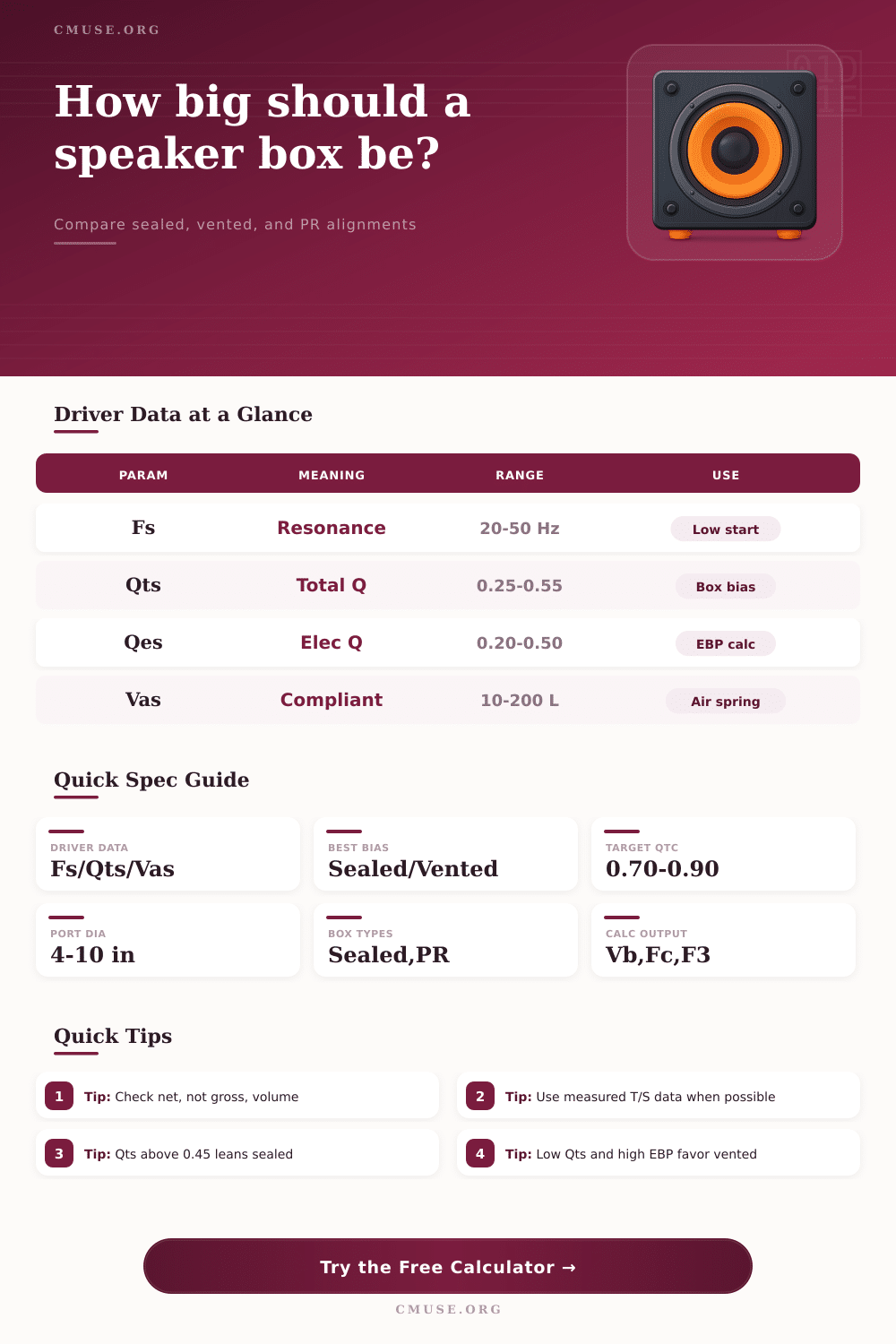
Turn Fs, Qts, Qes, and Vas into a practical enclosure plan with sealed box volume, Fc, F3, EBP, and a port-length reference that actually matches the driver data.
🎧 Real-World Presets
⚙ Driver Inputs
Full breakdown
📋 Comparison and spec grid
📈 Reference tables
| Parameter | Meaning | Why it matters | Unit |
|---|---|---|---|
| Fs | Free-air resonance | Starts the low-frequency picture before the box loads it | Hz |
| Qts | Total damping | Drives the sealed target volume and box style | Unitless |
| Qes | Electrical damping | Feeds EBP and helps judge sealed versus vented bias | Unitless |
| Vas | Compliance volume | Represents the air spring equivalent of the suspension | L |
| Qts range | EBP range | Bias | Practical note |
|---|---|---|---|
| Below 0.25 | Above 100 | Vented or PR | Strong motor control likes a tuned alignment |
| 0.25 to 0.40 | 60 to 120 | Flexible | Modern woofers often work in either family |
| 0.40 to 0.55 | 40 to 80 | Sealed first | Sealed boxes often keep the low end tidy |
| Above 0.55 | Below 60 | Sealed | Higher damping usually wants a compact air spring |
| Geometry | Formula | Use | Note |
|---|---|---|---|
| Rectangular | L x W x H | Most box builds | Fastest way to check a cabinet shell |
| Wedge | L x W x avg H | Sloped back panels | Use the average of front and rear height |
| Custom gross | Direct liters | Known shell volume | Use when the draft already exists |
| Net volume | Gross - disp + fill | Final fit check | Subtract hardware before you cut wood |
| Vent data | Formula piece | What changes it | Note |
|---|---|---|---|
| Port area | PI x r2 x count | Diameter and port count | More area reduces air speed |
| Equivalent D | Area to diameter | Total vent area | Lets one formula handle many vents |
| Port length | Standard vent equation | Fb and volume | Longer ports usually mean lower tuning |
| Cone move | Sd x Xmax | Area and travel | Shows how much air the driver can shift |
📐 Tips
The Thiele-Small parameter are a set of mathematical measurement for describing the behavior of speaker driver when placed within an enclosure. Each of the parameter describes the relationship between the speaker driver and an air within the enclosure, as the air within the enclosure create the pressure that pushes against the speaker driver. By using the Thiele-Small parameters correct, it is possible to design a speaker box that will produce clean bass.
However, if those parameter are used incorrectly, the speaker box may produce both uncontrolled bass and poor sound quality from the speaker box. One of the Thiele-Small parameter is Fs, or the free-air resonance frequency of the speaker. This is the frequency at which the speaker driver naturally vibrate when it is not within any enclosure.
Thiele-Small Parameters and Speaker Boxes
Another of the parameter is Qts, or the total damping of the speaker. This parameter is comprise of both electrical damping and mechanical damping factor combined into a single value. This parameter can help to determine in what type of enclosure the speaker is best suited.
If the value of Qts is below 0.4, the speaker is best suited to a vented enclosure. However, if the value is above 0.4, the speaker driver are best suited to a sealed enclosure. Finally, Vas is the third parameter.
This parameter measure the equivalent volume of air of the compliance of the speaker driver. A low Vas indicate that the speaker driver requires a small enclosure, while high Vas indicate the need for a large enclosure to avoid over-damping the speaker driver. The Thiele-Small parameters can help to determine in what type of enclosure a speaker driver is to be house.
Enclosed speaker can act as an air spring and are relatively easy to build. However, they do not provide deep bass. For enclosed speaker, the system resonance (Fc) will be higher than the resonance frequency (Fs) of the speaker driver.
Additionally, the F3 point of an enclosed speaker driver is the frequency at which bass begin to roll off. Thus, it can indicate the limit of the bass that the enclosure will produce. For vented enclosure, the boxes include a port to extend the bass that is produced.
They can reach lower frequency. However, the enclosure are tuned to a specific frequency (Fb). If the diameter of the port is too narrow, the enclosure can produce chuffing noise.
Another factor to consider in speaker box construction is the Efficiency Bandwidth Product (EBP). The EBP is calculated as Fs divided by Qes. This value can help to indicate in what type of enclosure the speaker should be used.
If the EBP is above 100, the speaker can be used in a vented enclosure. If the EBP is between 50 and 100, the speaker can be used in either enclosure. If the EBP is below 50, the speaker should be used in a sealed enclosure.
In building a speaker box, it is important to account for the displacement of the speaker driver. The displacement of the speaker is the physical volume of the speaker driver within the speaker box. This value can be subtracted from the total volume of the speaker box.
If more than one speaker driver is to be used within the speaker box, the Vas of that system will increase. Thus, the speaker box will have to be larger to accommodate the increased Vas of the system. The ports of the speaker box will also need to be large enough to allow sound to exit the speaker box at air speed below 17 meters per second.
Another of the Thiele-Small parameter is Qtc. The Qtc value can be targeted in the construction of a speaker box. If a speaker box is to have a flat response in the bass frequency, the targeted value for Qtc should be 0.7.
For application like home theaters, a value of 0.9 for Qtc will produce a more “punchy” sound than 0.7. Depending on the targeted Qtc value, the net volume of the speaker box can be calculated. Additionally, the length of the ports of the speaker box can be calculated, using the tuning frequency, the volume of the box, and the diameter of the ports.
To ensure the most accuracy for the speaker driver, the individuals themselves that build the speaker box should measure the Thiele-Small parameter for that speaker driver. Finally, there are different type of speakers, each of which use different type of enclosures. For example, bass guitar speaker often use sealed enclosure.
However, professional audio speaker use vented enclosure. Studio monitor use small sealed enclosure. When constructing the enclosure itself, 3/4-inch MDF is the recommended material.
The 3/4-inch thickness of the MDF will provide rigidity to the enclosure. Rigidity will prevent the enclosure from vibrate. Additionally, brace should be placed every 12 inches on the enclosure to prevent the side from flexing.
By understanding the Thiele-Small parameters for speaker driver, it is possible to construct functional speaker box for a variety of speaker type.