Tension Per Semitone Calculator
Estimate current string pull, tune by half steps, and see the exact tension ratio, pounds per semitone, newtons, and break-load margin.
🎯 Real string presets
📏 Units and tension source
⚙ String and semitone inputs
Calculation breakdown
🔬 Live string specs
🎸 String type comparison grid
📊 Live semitone tension table
| Shift | Target pitch | Ratio | Tension | Change |
|---|
📘 Equal-tempered semitone ratio table
| Semitone shift | Frequency ratio | Tension ratio | Tension change | Example from 20 lb |
|---|---|---|---|---|
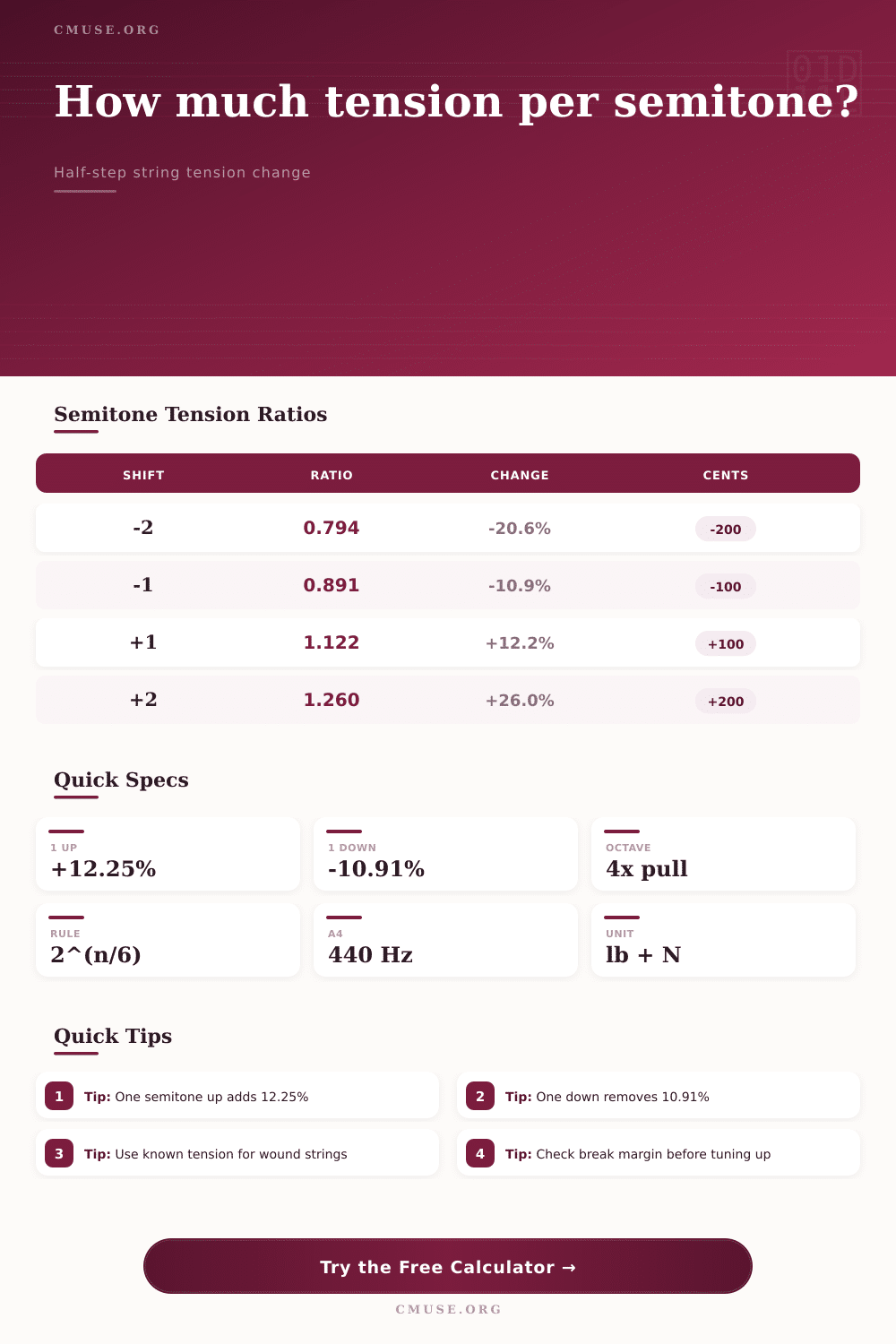
| -6 | 0.7071 | 0.5000 | -50.00% | 10.00 lb |
| -4 | 0.7937 | 0.6300 | -37.00% | 12.60 lb |
| -2 | 0.8909 | 0.7937 | -20.63% | 15.87 lb |
| -1 | 0.9439 | 0.8909 | -10.91% | 17.82 lb |
| +1 | 1.0595 | 1.1225 | +12.25% | 22.45 lb |
| +2 | 1.1225 | 1.2599 | +25.99% | 25.20 lb |
| +4 | 1.2599 | 1.5874 | +58.74% | 31.75 lb |
| +6 | 1.4142 | 2.0000 | +100.00% | 40.00 lb |
| +12 | 2.0000 | 4.0000 | +300.00% | 80.00 lb |
🎼 Guitar semitone examples at 25.5 inches
| String | Start pitch | Start tension | One down | One up | Per-up gain |
|---|---|---|---|---|---|
| .010 plain steel | E4 | 16.2 lb | 14.4 lb | 18.2 lb | +2.0 lb |
| .013 plain steel | B3 | 15.3 lb | 13.6 lb | 17.2 lb | +1.9 lb |
| .017 plain steel | G3 | 16.7 lb | 14.9 lb | 18.7 lb | +2.0 lb |
| .026 nickel wound | D3 | 18.4 lb | 16.4 lb | 20.6 lb | +2.2 lb |
| .036 nickel wound | A2 | 19.5 lb | 17.4 lb | 21.9 lb | +2.4 lb |
| .046 nickel wound | E2 | 17.5 lb | 15.6 lb | 19.6 lb | +2.1 lb |
🎵 Bass and drop-tuning semitone table
| Scenario | Scale | Start | Shift | Ratio | Result feel |
|---|---|---|---|---|---|
| Bass .105 E to Eb | 34 in | 40.0 lb | -1 | 0.891 | 35.6 lb, looser |
| Bass .105 E to D | 34 in | 40.0 lb | -2 | 0.794 | 31.7 lb, soft |
| Baritone B to A | 27 in | 22.0 lb | -2 | 0.794 | 17.5 lb, lighter |
| Drop D return | 25.5 in | 14.0 lb | +2 | 1.260 | 17.6 lb, normal |
| Capo-style raise | 25.5 in | 18.0 lb | +2 | 1.260 | 22.7 lb, firm |
| Octave-up test | any | 18.0 lb | +12 | 4.000 | 72.0 lb, unsafe |
⚠ Semitone risk guide
| Shift size | Tension change | Typical use | Check before using |
|---|---|---|---|
| -1 semitone | -10.91% | Eb tuning, singer-friendly key | Buzz or floppy attack |
| -2 semitones | -20.63% | D standard, drop tuning | Heavier gauge may help |
| +1 semitone | +12.25% | Quick tuning correction | Break-load percentage |
| +2 semitones | +25.99% | Returning drop D to E | Neck load and old strings |
| +4 semitones | +58.74% | Short-scale experiments | Usually change gauge |
| +6 semitones | +100.00% | Half-octave pitch move | Often unsafe on same string |
We’ve all been there: snap! Every guitar player has heard that sound. What’s worse is that it always seems to happen when we least expect it. In the midst of a solo? Just warming up for a gig? Well, the string goes whizzing past, striking an eye with all the drama and pain you would expect.
It’s also predictable once you get the physics behind it. The tension per semitone calculator runs numbers for you. That brings change from frequency (an abstract measurement) into pounds of tension (a more concrete one). So, you can literaly see how much force you are putting on your neck before you turn that peg.
How Changing Tuning Changes String Tension
The problem is that human brains aren’t great at imagining exponential growth. When you tune something up one semitone, it doesn’t feel like a slight increase in tension; it jumps by about twelve percent. Manageable, right? That sounds fine in isolation. Tune it up by two semitones, though, and you’re at a twenty-six percent rise in tension. Tune it up three semitones, and you’re now facing a thirty-nine percent rise.
And here’s where the figures add up fast: One small tweak seems like a huge change to how the instrument behaves. You’re not simply adjusting its pitch. You are fundamentally changing what the wood, the metal, and the glue must endure physicaly.
This is something most players take a stab at. Tune up a half step, feel the tension increase on the string and go from there. Then repeat. And repeat. Repeat until the string snaps or the neck bends so far forward that the action has become unplayable.
The beauty of this tool is that it anchors that guessing into reality. With your particular scale length and string gauge, it will tell you precisely what you are looking at. You may find that with combination of a short scale and thin strings, you have oodles of room. Or maybe you are working with a longer scale bass with heavy gauge strings and a half step tuning change puts you dangerously close to the danger zone.
The math is just part of the equation. So is the context. This also has a structural component that people forget. String tension pull forward and constantly puts pressure on a guitar’s neck. What counteracts this is internal truss rod pushing it back. Adding any additional pull on those strings move this equilibrium.
Although you might not break a string, the extra pull can warp the neck relief, which makes your higher frets rattle or your middle frets buzz. It’s a feedback process that occurs subtly. Bigger string bows mean intonation becomes affected, so then you tune even tighter. Rinse. Repeat. Until something gives.
If you know how much the total tension change, you can guess how much the neck can handle before it needs an immediate adjustment.
Another thing to keep in mind is strings themselves. Are they new? If so, they haven’t had time to settle and stretch out to their final position. They’re brittle and under more tension initially than what they will be once they’ve played a bit. Tuning them up with brand-new strings is a recipe for disaster. The break-load ratings assume fresh material, but the fatigue from winding and unwinding weakens metal at the windings. A string that has been sitting at pitch all week is more forgiving than one that has been tuned up and down several times. The calculator provides theoretical limit. Real world wear brings that ceiling way down.
The playing style matter as well. Hard attacks, heavy vibrato and digging into a note with the pick will put more peak stress on a string compared to one gently picked with a light touch. In fact, the peak force during a hard attack can exceed the static tension by a noticeable margin. That’s the kind of dynamic stress that makes the snap happen if your static tension was already approaching the red zone.
The tuning wasn’t the killer; it was the margin for error going away. When you’re near the breaking point, there isn’t room for any enthusiasm.
It’s all clearly laid out in the reference tables on the page that explain how the ratios change according to gauge and octave. What you’ll notice is it’s far safer to tune down as opposed to tuning up. Dropping a semitone releases over ten percent of tension. That’s a relief on both the strings and the neck. A drop of two semitones reduces it by twenty percent. There is almost no risk here except the strings become too floppy to play effectively.
Upward is where the dangers lie as the gains are steep and the consequences immediate.
Be sure to check the numbers first. Maybe you want to try some drop tunings on a guitar using that heavy gauge set? Or perhaps you just like to crank up the pegs for a high-tension look. Where’s your break point? How much of a change in pitch equals how big a change in force? The string doesn’t care; it’s not a musical note. It only cares that it’s under tension. Give it some respect, and it’ll hold a tune long enough for you to finish the song.