Tension Change From Tuning Calculator
Compare current and target tunings string by string, then estimate total neck load, percentage change, semitone movement, and nearby gauge choices.
🎯 Retuning Presets
⚙ String Set Inputs
Calculation Breakdown
🎵 String Comparison Grid
📊 Set Summary Grid
🧮 Per-String Tension Table
| String | Gauge | Current Note | Target Note | Before lb | After lb | Change |
|---|
🔀 Gauge Match Table
| String | Target Note | Current Gauge | Matched Gauge | Nearest Common | Matched lb |
|---|
🎼 Tuning Reference Table
| Tuning | Low to High | Main Change From E Standard | Typical String Strategy |
|---|---|---|---|
| E standard | E2 A2 D3 G3 B3 E4 | Baseline | 9-42 to 11-49 electric sets |
| Drop D | D2 A2 D3 G3 B3 E4 | Lowest string down 2 semitones | Often keep set, or raise low E gauge |
| Eb standard | Eb2 Ab2 Db3 Gb3 Bb3 Eb4 | All strings down 1 semitone | Same gauge feels about 11% looser |
| D standard | D2 G2 C3 F3 A3 D4 | All strings down 2 semitones | Move up one or two gauge sizes |
| Drop C | C2 G2 C3 F3 A3 D4 | D standard with low string down 2 more | Heavier sixth string is common |
| Baritone B | B1 E2 A2 D3 F#3 B3 | Lower pitch with longer scale | Long scale restores tension |
| Bass drop D | D1 A1 D2 G2 | Lowest bass string down 2 semitones | Medium or heavy E string helps |
📏 Semitone Tension Ratio Table
| Pitch Move | Frequency Ratio | Tension Ratio | Same-Feel Gauge Idea |
|---|---|---|---|
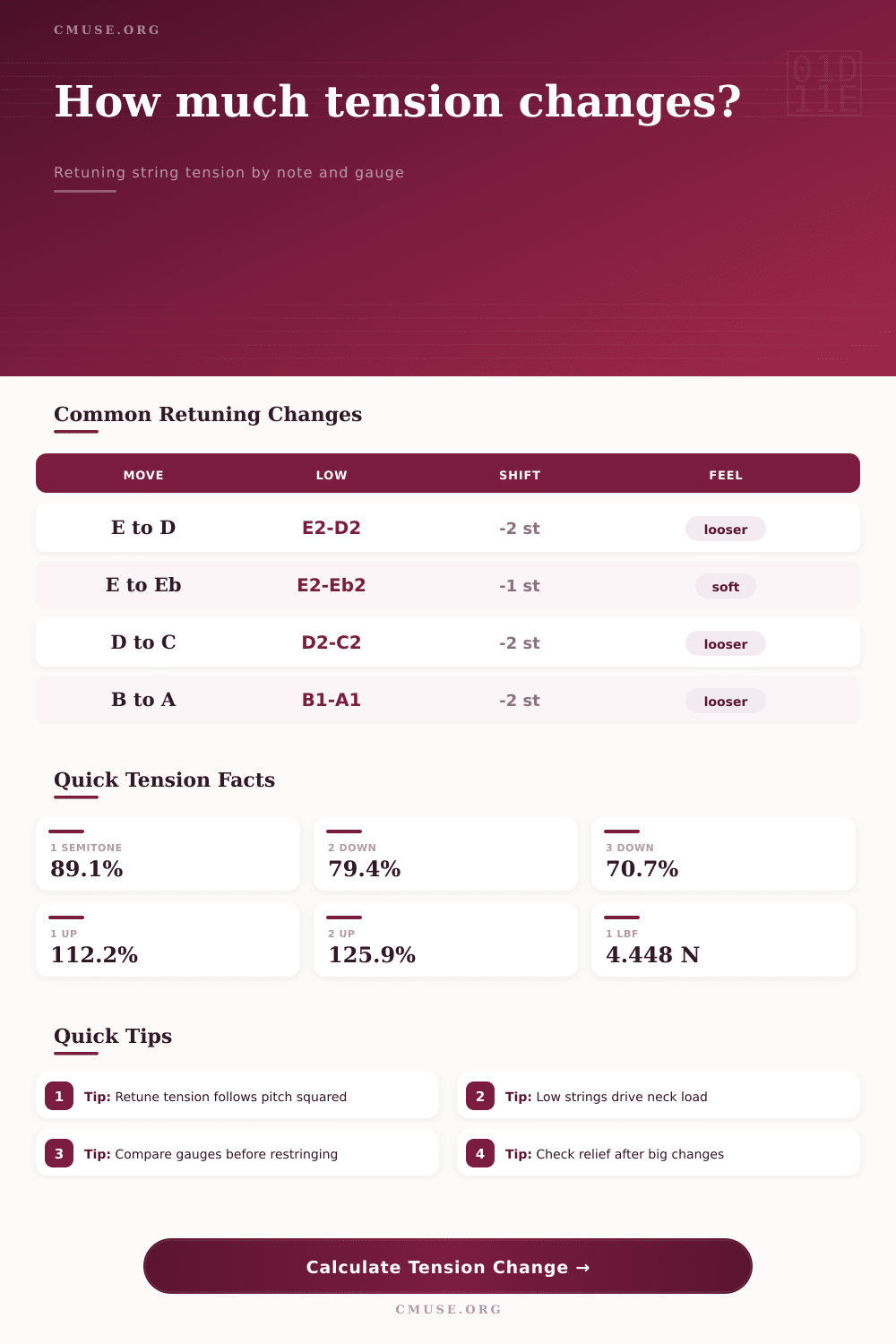
| 1 semitone down | 0.9439 | 89.1% of old tension | Gauge about 5.9% thicker |
| 2 semitones down | 0.8909 | 79.4% of old tension | Gauge about 12.2% thicker |
| 3 semitones down | 0.8409 | 70.7% of old tension | Gauge about 18.9% thicker |
| 1 semitone up | 1.0595 | 112.2% of old tension | Gauge about 5.6% thinner |
| 2 semitones up | 1.1225 | 125.9% of old tension | Gauge about 10.9% thinner |
If you’ve ever done it before then I’m sure you know what I mean. You pick up your pick and turn that low E string to D. Immediately you’re aware of changes in way the guitar feels. Your action seems higher than normal. The intonation has changed ever so slightly sharp. The strings seem softer to the touch. It’s not just in your head; it’s physics.
There are mathematical reasons for these changes, but you don’t have to guess at them because there’s a tension change calculator for that. Tuning for most player is just choosing which note to play. That’s true but what is often overlooked is that a string behaves like a spring. We store energy in the spring when we wind the string around the peg and lower its pitch.
Why Guitar Tension Changes When You Tune
When you let that energy out to tune down, the tension doesn’t decrease in a straight line. It drop at an increasing rate based off the square of the frequency ratio. So if you lower a whole step, you lose about twenty percent tension. Lower again and it cuts even more. And here is what many people miss. They think it decreases in a straight line. But it doesn’t. As it gets lower, the drop-off increases.
This is shown in curve of the calculator and presents you with a realistic idea of how much load you are really removing from your neck. The next section covers scale length. This is the lever arm of your instrument. For any given gauge and pitch, a longer scale length create more tension. This is because there is a greater distance over which the string must stretch.
Translating this into real-world terms, when you go up to a baritone with a twenty-seven inch scale as opposed to a twenty-five-point-five inch scale, you’ll require a much heavier gauge string in order to get the same feel. Being able to play with this variable is essential whether you’re trying to set up an instrument or compare two different ones. Otherwise, these numbers don’t mean anything; but with it, they simply convert right back to the setup.
While scale and pitch matter, the material matters too, though not as much. Steel and nickel wound strings has different densities, and this alters the unit weight in equation for string tension. Similarly, an electric steel string will differ from a phosphor bronze acoustic of equal gauge. To account for the difference between practical use and theoretical perfection, we have created models for both types of materials in the calculator to provide realistic results.
Simply choose your starting gauge set, what you want them tuned to, and it then works out the before and after load on each string separately. Why does this matter? Because different tunings has their sweet spots in terms of total tension on a neck. If your total tension goes down (like with Drop D) it might let the truss rod go slack. That will typically give more relief, sometimes enough that your action at middle frets will be buzzing. Tuning higher will also increase the pull, making the neck flatter and possibly raising the action.
Based on those changes, the tool has a verdict section. It will tell you if you need to check your relief or consider changing gauges to maintain proper tension balance. Then there’s the matter of playability and tone. Down-tuning can mean slinkier, floppier strings which some prefer. You get better bend control and are able to be more expressive.
Other people hate it. They prefer a quick-snap-back string. If you want the sound of Drop D but the tension of regular tuned strings, then what you need is a thicker string. That’s where the gauge match table comes into play. It will give you an idea of a string that should produce roughly the same amount of tension to hit the right pitch while keeping your finger action feeling the same as it did before you dropped the pitch.
Remember that it’s not only the notes you’re playing. It’s how the wood and metal interact with your hands. Be careful; a quick tightening of the string can cause a tuning post to come loose or even warp a headstock. This can result in intonation shifting at the saddle too. Strings will stretch differently depending on what load they have on them. It’s best to give the instrument time to settle after a major retune (a couple of hours).
The calculator gives you the starting point, but your eyes and ears will confirm the rest. But in case you aren’t sure where to start, it should of been done from the presets. The presets will have common starting points such as bass variations, Drop D, Eb standard etc. Then use the inputs to dial in exactly how you are set up.
It’s not about hitting perfect mathematical symmetry. It’s about knowing what changes when you change something so you can then make adjustments. If you’re looking for a bright, crisp attack or maybe a heavy low-end thump, you’ll now know what that tension does. Turn the key and the instrument responds and you adjust. This is the cycle of playing. Because you know how much weight there is, turning the key is easier.