Tape Speed Pitch Calculator
Compare original and playback tape speed in IPS, then convert the speed ratio into semitones, cents, duration change, frequency shift, wow/flutter allowance, and sample-rate equivalent.
Calculation Breakdown
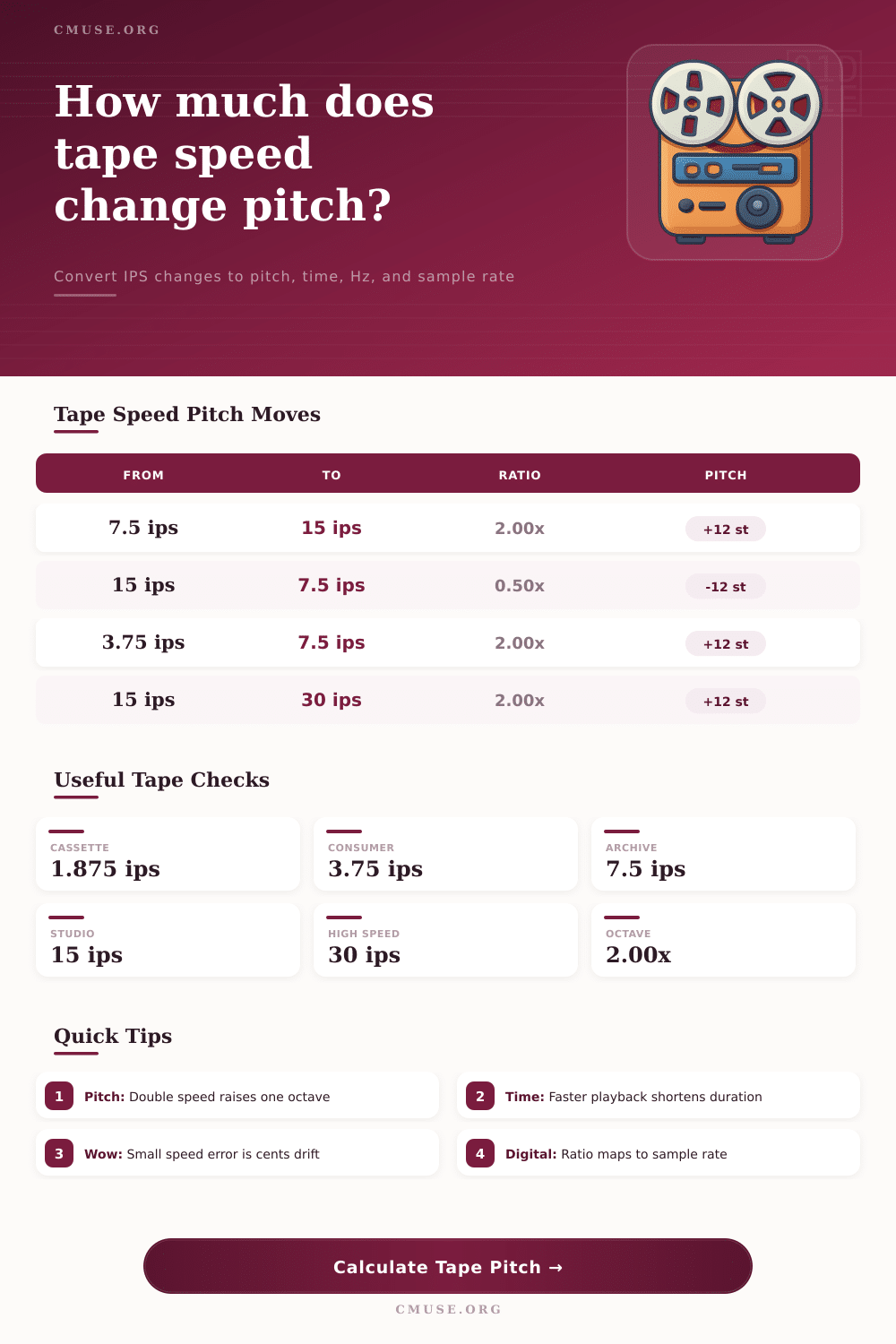
| Original IPS | Playback IPS | Ratio | Pitch Shift | Duration | Use Case |
|---|---|---|---|---|---|
| 1.875 | 3.75 | 2.000x | +12.00 st | 50.0% | Four-track cassette played at double speed |
| 3.75 | 1.875 | 0.500x | -12.00 st | 200.0% | Half-speed cassette texture or low octave transfer |
| 7.5 | 15 | 2.000x | +12.00 st | 50.0% | Archive reel auditioned at studio speed |
| 15 | 7.5 | 0.500x | -12.00 st | 200.0% | Studio reel slowdown for octave-down sound |
| 15 | 30 | 2.000x | +12.00 st | 50.0% | High-speed playback check or bright octave lift |
| 30 | 15 | 0.500x | -12.00 st | 200.0% | High-speed master played at standard studio speed |
| Target Shift | Needed Ratio | Playback IPS from Original | Duration Percent | Frequency Example |
|---|
| Session Rate | Varispeed Equivalent | Pull Back Rate | Samples for Original Duration | Samples After Speed |
|---|
| Source | Original Frequency | New Frequency | With Wow/Flutter | Musical Result |
|---|
| Nominal Speed | Common Format | One Octave Up | One Octave Down | Pitch Note |
|---|---|---|---|---|
| 1.875 ips | Compact cassette and four-track cassette | 3.75 ips | 0.9375 ips | Doubling speed raises every frequency by 2:1. |
| 3.75 ips | Consumer reel-to-reel and lo-fi transfers | 7.5 ips | 1.875 ips | Small capstan drift is audible as cents of detune. |
| 7.5 ips | Archive, broadcast, project studio reels | 15 ips | 3.75 ips | Half/double speed moves exactly 12 semitones. |
| 15 ips | Common professional music recording speed | 30 ips | 7.5 ips | Varispeed by 1% is about 17.23 cents. |
| 30 ips | High-speed professional mastering or tracking | 60 ips | 15 ips | Frequency and tape speed scale linearly. |
Listen carefully and when you play it back again, you’ll hear something isn’t right with the sound of a song. Maybe the drums is racing forward than the vocals? Maybe it’s thin sounding? Often this is a speed issue.
A tape runs at a certain number of inches per second. Unless your playback machine matches that exact speed, all notes move. They rise or fall in pitch and stretch or shrink in time making the whole sound change in ways that are hard to undo later.
Why Tape Speed Matters for Sound
Pitch and speed are deceptively linear. If you cut the time it takes for tape to pass through a machine in half, it will cut each wave across magnetic strip half as often, resulting in a drop of an octave. Double its speed and it will do the same thing to frequency, resulting in a shift of exactly one octave higher.
And the calculator (above) does all this math for you, so you don’t have to guess at what’s a tiny difference worth ignoring and what’s huge. So you can enter your original recording speed along with the speed at which you want to play it back, and it’ll convert these raw, physical movements into semitones and cents so you know just how far off your transfer may be before you burn audio to disk.
Most engineers think of tape speed as something set and not changeable. But it’s a variable instrument. Engineers use small changes in varispeed (the name of the knob found on most high end reel to reel decks) to soften a singer’s harshness or tighten up drums. Moving the knob only a percent may seem like nothing but musically it matters. That little percent equates to about seventeen cents of pitch change. It is enough to create the feeling that the chorus is now a bit sharp compared to the verse which was captured at normal speed.
Knowing this scale will help determine when a transfer require adjustment and when the speed difference is an artistic element worthy of keeping. This is where accuracy meets the enemy: Wow and Flutter. These words refers to tiny fluctuations in playback speed of your tape caused by loose belts or worn out capstans. If you read about wow/flutter specs on machine paperwork, what they’re telling you is how far off the pitch can wobble from its mark.
The tool knows how much variation is possible due to mechanical drift and adds an allowance to all the final frequencies it spits out. Not only does it show you the theoretical pitch, but also the spread of pitches you might audibly experience as a result of those mechanical inaccuracies.
Why does this matter? Because once these timing inaccuracies get baked into waveform, there’s no way a digital transfer can clean them up. In the digital world, sample rate acts much the same way. Changing your sample rate is mathematically identical to changing tape speed. Playing back a file recorded at 44,100 Hz into a system designed for 96,000 Hz without resampling will result in slower audio and lower pitch. A quick glance at table on the page reveals how various sample rates correspond to pitch shift. What it further confirms is that digital audio is nothing more than another example of being governed by the same ratios as a piece of magnetic tape traveling past head.
There’s also a time trade-off for all of this. For instance, if you’re increasing the pitch by speeding up a tape then the resulting track will be shorter. Double-speeding a three-minute song makes it only one and a half minutes long. That might throw off your edit plans or the ability to synchronize audio to video. So you have to keep in mind how many minutes will go missing as you begin bouncing down your tracks. With the duration percent, you’ll see right away what portion of original track will end up getting chopped so you can work out your edit strategy to match.
A lot of folks take the approach that “if it sounds right by my ear, it’s fast enough” but that can lead to trouble; human ears are forgiving in isolation but unforgiving compared to something else. You may be able to live with a small detune until you add a synth or vocal track into the mix that’s dead on tune. Now, the phase beating sounds annoying and is easy to hear. Objective measurement takes out the guessing game. It provides you with a hard number to work against. This way, you know your creative experiments or archive transfer isn’t an accident; it could of been intended.
At the end of the day, control is everything when it comes to tape speed. If you’re trying to design a new texture or restore an old master, you need to know exactly what pitch shift occurs with each fraction of an inch per second. This knowledge puts you squarely in driving seat. The physics don’t change; you no longer react to strange sound but begin to design it. Let the numbers guide your ears, not guesswork. Remember the ratios and check your tolerances.