Tangential Mode Calculator
Calculate two-axis room modes for studios, booths, rehearsal rooms, stages, and listening spaces using room dimensions, active axes, and modal order.
🎵 Quick Presets
🎚 Room And Mode Inputs
📊 Room Mode Diagnostic Grid
📈 Tangential Mode Results
| Rank | Mode ID | Axis Pair | Frequency | Nearest Note | Spacing |
|---|---|---|---|---|---|
| Enter dimensions and calculate to list the first tangential modes. | |||||
🎙 Axis Pair Summary
| Axis Pair | Lowest Mode | Average Spacing | Modes In Range | Cluster Risk |
|---|---|---|---|---|
| Length + Width | Run calculator | Run calculator | Run calculator | Run calculator |
| Length + Height | Run calculator | Run calculator | Run calculator | Run calculator |
| Width + Height | Run calculator | Run calculator | Run calculator | Run calculator |
🎼 Reference Mode Bands
| Band | Frequency Range | Common Instruments | Room Response Focus | Check |
|---|---|---|---|---|
| Sub bass | 20-60 Hz | Kick, synth, organ | Large rooms and long dimensions | Lowest tangential modes |
| Bass | 60-120 Hz | Bass guitar, cello, toms | Most small-room modal buildup | Cluster spacing |
| Low mid | 120-250 Hz | Piano left hand, guitar body | Boxiness and uneven decay | Mode density |
| Transition | 250-400 Hz | Voice warmth, snare body | Shift toward diffuse behavior | Schroeder estimate |
📏 Common Room Size Examples
| Project Space | Dimensions | Best Pair To Check | Typical First Mode | Secondary Concern |
|---|---|---|---|---|
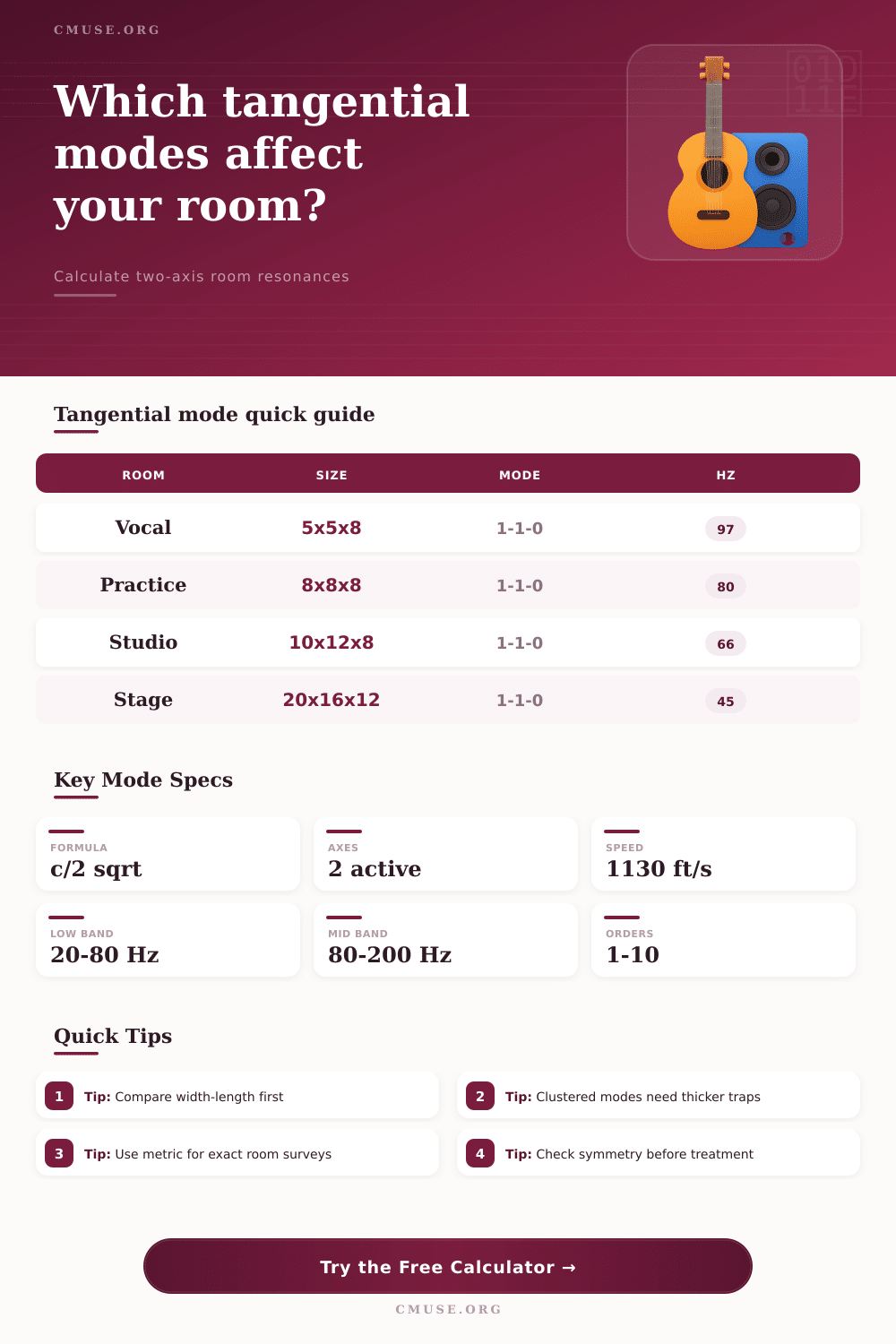
| Recording Booth | 5 x 5 x 8 ft | Width + Height | Near 97 Hz | Square wall symmetry |
| Practice Room | 8 x 8 x 8 ft | Length + Width | Near 100 Hz | Repeated dimensions |
| Home Studio | 10 x 12 x 8 ft | Length + Width | Near 66 Hz | Low-mid stacking |
| Control Room | 15 x 23 x 10 ft | Length + Width | Near 44 Hz | Front-back decay |
| Stage Area | 20 x 16 x 12 ft | Length + Width | Near 45 Hz | Speaker-wall coupling |
📝 Practical Notes
Tangential modes is the resonances that happen when sound reflects between two wall in a room while the third dimension remain relatively quiet. Tangential modes are important to consider in room treatment because the frequencies associated with tangential modes often align with the frequency ranges of bass instruments within a room. Unlike axial modes, which only reflect off of one pair of wall, sound reflects off of two different dimensions in the case of tangential modes.
When two dimensions in a room are equal in length, the standing wave created between those two dimension will reflect a portion of the sound energy that is created in that room. The result will be either for a given note within that room to boom if the standing wave is constructed in a way that reinforces that note, or for that note to dissapear altogether if the standing wave reflects that note in a way that cancels out the vibration of that note. Tangential modes are most common in small room.
What Are Tangential Modes and How to Fix Them
However, they can also be present within larger room in the same way that small rooms can have pair of axial modes that are relatively stubborn and difficult to treat. The calculator that is available on this page will allow you to explore the concept of tangential modes in your own room. You can enter which two dimensions you would like to explore, select the range of order that you would like to evaluate, and you can also enter the temperature in your room to determine the speed of sound within your room.
The calculator will output each of the frequencies within that range of orders and dimension, as well as the modal ID for each of those frequencies. This output will allow you to determine if you have any tangential modes that you would like to treat within your listening space. The way that your room is proportioned will have an impact on the spacing between the frequencies of your tangential modes.
Rooms that are approximately square will have more standing wave in the length and width dimension of the room compared to a long and narrow room. Long and narrow room, however, can still have issues if the height dimension of the room is similar to one of the long dimension of the room. Within the calculation of the tangential modes in your room, you can also factor in the temperature within your room.
As the temperature within the room decreases, the speed of sound decreases as well. Thus, if the calculator indicates that there are certain standing waves at a certain frequency, the cooler temperatures will lower those frequency by a few hertz. Thus, you can calculate the same dimension at different temperatures (summer vs. Winter, for example) to see if there are any issue that is seasonal in their appearance.
The reference table included with this calculator indicate common range of tangential modes that can be problematic in different type of rooms. These tables, however, are not exhaustive in their inclusion of the frequency that may lead to problems. For instance, sub-bass frequency occur below 60 hertz and only tend to exist in the largest room.
In rooms that are typical in homes and small studio, most issue with tangential modes will exist between 60 and 120 hertz. Above 120 hertz, the hearing of humans tends to even out the sound reflection in a room to create an even response to the sound that is played in that space. Eliminating all instance of tangential modes in a room may not be necessary.
For example, it is possible that the music that is played in that room is playing each of the frequencies that the calculator calculates. Furthermore, it is possible that those frequency are not being heard by a listener when they are played. However, if any of those mode are created at the same frequencies as played note in the music in the room, that mode will color the music that is played in that space.
Thus, while the calculator cannot determine if any of these frequency are being played in the music in the room, it can output the frequencies that you can compare to your musical composition. Symmetry in a room can create problem in relation to sound reflections. For example, if two dimension in a room are similar in length, then the first mode that reflects off of length and width dimension will have a similar frequency to the mode that reflects off of the other two dimension that are of similar length.
Thus, each of the standing wave in these dimension will have similar strength. One solution to this problem is to place broadband absorber in the corner where the maximum sound pressure for each of the standing waves coincides. Thus, if the calculator determine that there are four or five tangential modes within a five hertz range, it may be that the corner of the room is a problem area that should of been treated.
The order range that is entered into the calculator will impact the type of information that the calculator provides to you. The lowest order will reveal the frequency of the most basic standing wave, or fundamentals, in a small room. As order increase, however, the standing waves that reflect off of each of the dimension will become more even across the room.
Higher order will eventually become a continuous spectrum of frequency above 200 hertz. Thus, if you enter an order range that is too high, you may end up with so many frequency that it becomes hard to read the information that the calculator outputs. Most user should stop at order six or seven.
Once you have the list of frequency calculated in the room that you are treating, you must decide what to do with those frequency. One solution is to use absorptive treatment in the room that are tuned to the frequency calculated by this tool. These type of treatment will cancel out the standing wave that reflect off of the treatment.
Alternatively, you can use diffusion method on the opposite wall from the standing waves to ensure that they dont reflect back into themselves. You should run the calculator more than once. For example, try each of the different axis pair for your room.
Try changing the temperature in your room. Try each of the different frequency window. By trying each of these different setting, you will begin to recognize which dimension of your room cause the most problem with tangential modes.
This will allow you to anticipate where these problem will be created in other room prior to measuring sound reflection in those rooms. Your goal is not to have a perfectly flat response to frequency in your listening room. Your goal is simply to have a treatment of the room such that the standing wave do not interfere with one another.
You want treat your room for the frequency that are reaching your ears. These calculation will help you to reach that goal, and they will help you to consistently reach that goal.