Syntonic Comma Calculator
Compare two tuning ratios, convert the syntonic comma to cents, hear its frequency offset at a real pitch, and split it across fifths for meantone temperament.
Preset use: Load a familiar comma comparison, then adjust the pitch, reference octave, comma count, and temperament split for your own tuning map.
Calculation Breakdown
| Interval or comma | Ratio | Cents | Relation to syntonic comma |
|---|---|---|---|
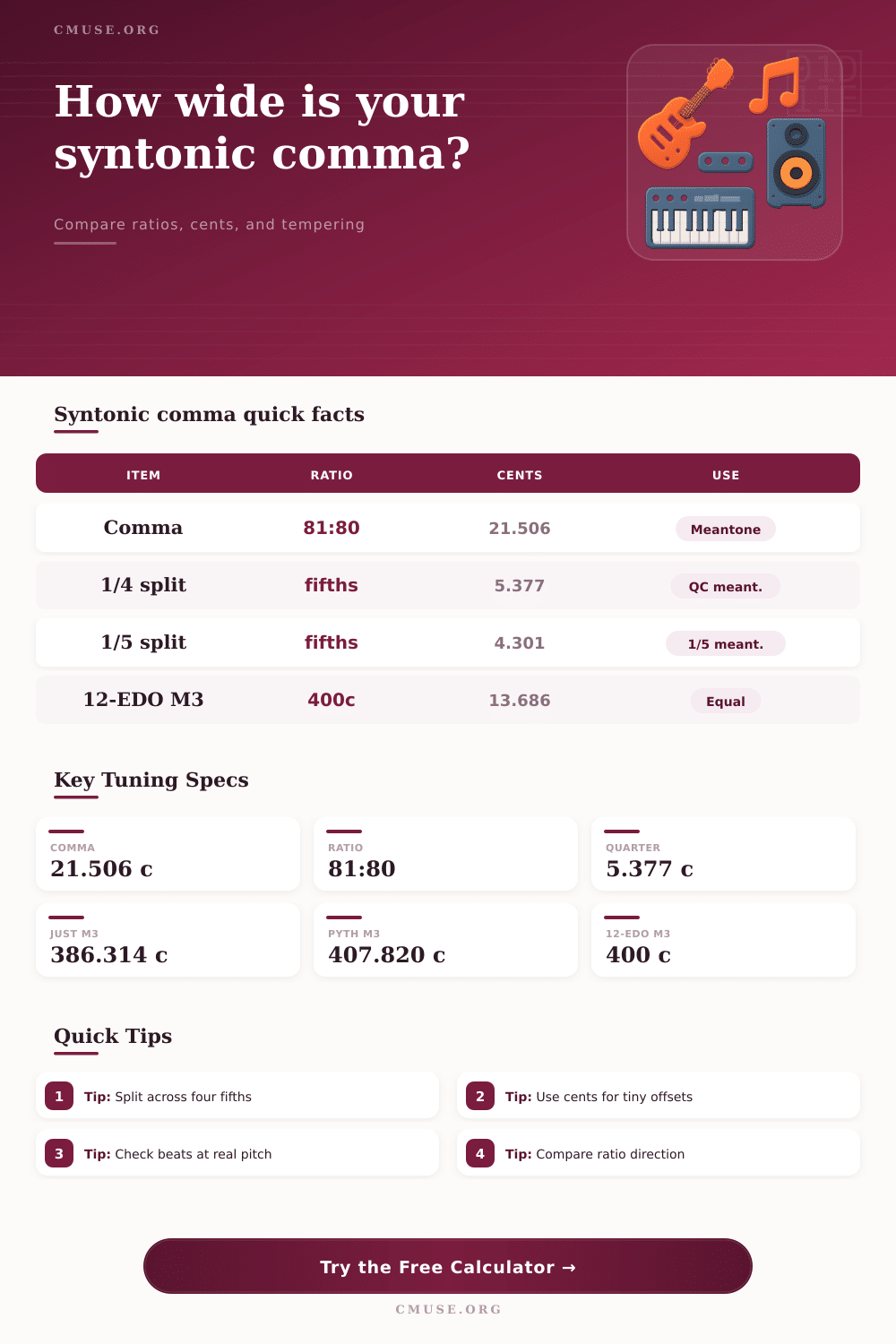
| Syntonic comma | 81:80 | 21.506 | Difference between Pythagorean and just major thirds. |
| Pythagorean major third | 81:64 | 407.820 | Four pure fifths, octave reduced, before comma correction. |
| Just major third | 5:4 | 386.314 | The 5-limit consonant major third targeted by meantone. |
| Major tone | 9:8 | 203.910 | One whole tone above the lower note in 3-limit tuning. |
| Minor tone | 10:9 | 182.404 | One syntonic comma narrower than the major whole tone. |
| Diesis check | 128:125 | 41.059 | Useful nearby 5-limit small interval, not the same comma. |
| Temperament target | Comma fraction | Fifth narrowing | Resulting fifth size |
|---|---|---|---|
| Quarter-comma meantone | 1/4 | 5.377 cents | 696.578 cents |
| Fifth-comma meantone | 1/5 | 4.301 cents | 697.654 cents |
| Sixth-comma meantone | 1/6 | 3.584 cents | 698.371 cents |
| Eighth-comma meantone | 1/8 | 2.688 cents | 699.267 cents |
| No tempering | 0 | 0.000 cents | 701.955 cents |
| System | Major third size | Error from just M3 | Use case |
|---|---|---|---|
| Pythagorean | 407.820 cents | +21.506 cents | Shows the full syntonic comma against 5:4. |
| Quarter-comma meantone | 386.314 cents | 0.000 cents | Pure major thirds inside favored keys. |
| 12-EDO | 400.000 cents | +13.686 cents | Modern keyboard and fretted instrument default. |
| 19-EDO | 378.947 cents | -7.367 cents | Alternate equal temperament with usable fifth cycle. |
| 31-EDO | 387.097 cents | +0.783 cents | Close meantone-like approximation to 5-limit thirds. |
| Preset | Lower note | Main comparison | What to watch |
|---|---|---|---|
| Pythagorean M3 | C4 261.63 Hz | 81:64 against 5:4 | One full syntonic comma wide. |
| Quarter-Comma Fifth | A3 220 Hz | 3:2 fifth split over four | Each fifth narrows by about 5.377 cents. |
| C-G-D-A-E Pump | C4 261.63 Hz | Four fifths versus major third | Comma drift accumulates around the chain. |
| 12-EDO Major Third | C4 261.63 Hz | 400 cents against 5:4 | Equal major third remains sharp of just. |
| 31-EDO Meantone | C4 261.63 Hz | 10 steps in 31 divisions | Very close to just major third. |
The syntonic comma are a specific musical interval that represent the difference between two different ways of calculating a major third. One way to calculate a major third is to stack four pure fifths. The other is to use an fifth harmonic.
These two way of calculating a major third result in two different musical intervals, leaving a gap between the two calculated intervals that is the syntonic comma. Every tuning system must account for the syntonic comma, as it must find a way to handle the distance between these two types of major third. Use the provided calculator to test out different method of handling the syntonic comma.
What is the syntonic comma?
Enter the starting ratio for the interval that you want to calculate, the target ratio for the interval, the reference pitch for the interval, and the number of fifths that will share the correction to form the interval. The calculator will provide an output that indicates how many commas separates the two ratios, the number of cents that the two ratios differ, the number of cents that each fifth must be tempered if the interval is to be formed, the frequency offset for the interval at the reference pitch, and the width of the syntonic comma in cents. The frequency offset will be useful for musicians to set a beat rate for their musical instrument.
Each of the fields that must be filled in with a value will impact the results that the calculator provide. The comma count field will allow the calculator to determine whether the interval widens or narrows as a result of the syntonic comma. The split count field will allow the calculator to determine in how many fifths the calculator will divide the syntonic comma.
If the comma count is changed, the sound of the resulting fifths may change. If the split count is changed, the sound of the resulting major thirds may become too distant from the target ratio. The frequency offset will grow stronger the most higher of the pitches that are tested.
Thus, it is important to test the frequency offset at the same pitch at which the interval will be played. Musicians often use meantone temperament to account for the syntonic comma. Quarter comma meantone temperaments, for instance, narrow each perfect fifth by one quarter of a syntonic comma, creating major thirds that match the ratio create with the fifth harmonic.
Quarter comma meantone temperaments work well for keys that are near C major. However, the narrowness of the perfect fifths created by meantone temperaments cause problems for remote keys from C major. Alternatively, one can use either one fifth comma or one sixth comma meantone temperament.
These temperaments create fifths that sound soft while creating major thirds that are closer to the ratio of the fifth harmonic. Another system of musical tuning is equal temperament. In equal temperament, major third are three cents (13.7 to be exact) wider than those created by the fifth harmonic, which is small enough to be generally unnoticeable.
However, all intervals are slightly impure in this system. Some musicians prefer temperaments that are not equal in relation to all intervals, especially musicians who play within a narrow range of keys. Use of the provided calculator help to compare the intervals of an equal division of the octave against a just interval.
It is common for musicians and musicians to believe that the syntonic comma is a fixed interval. However, the size of the syntonic comma can be divided, doubled, and moved into different musical interval. Musicians can choose which perfect fifths will contain part of the syntonic comma, or which major third will be left wide to accommodate the calculation of the syntonic comma.
The syntonic comma dont exist in isolation. Changing the sizes of the perfect fifths will also change the sizes of seconds, sixths, and diminished fifths. Thus, while the calculator will show the direct comparison between the ratios of the intervals that you requested, it will not show any interval surrounding those requested intervals.
Thus, it is also important to understand the sizes of these surrounding intervals to ensure that introducing the syntonic comma does not negatively impact other intervals. The calculations of the syntonic comma create a musical decision that allow the musician to determine the best temperament for the music that is to be play.