Syncopation Index Calculator
Score rhythmic displacement from offbeat attacks, tied notes, meter accents, rests, and subdivision weighting.
Use lower values for sparse motifs and higher values for busy drum, piano, or guitar patterns.
Syncopation Score
| Meter | Strong positions | Weak positions | Syncopation reading |
|---|---|---|---|
| 4/4 | 1, 3 | 2, 4 and & | Backbeats score lightly; offbeat accents score higher. |
| 3/4 | 1 | 2, 3 and & | Displacement away from beat 1 is easy to hear. |
| 6/8 | 1, 4 | 2, 3, 5, 6 | Cross accents against compound pulse score higher. |
| 12/8 | 1, 4, 7, 10 | Inner triplets | Shuffle layers tolerate more offbeat motion. |
| 5/4 | 1 plus grouping | Split beats | Asymmetry raises the meter denominator weight. |
| 7/8 | Group starts | Internal pulses | Irregular meters amplify unexpected accents. |
| Subdivision | Typical count | Weight | Why it matters |
|---|---|---|---|
| Eighth-note grid | 1 & 2 & | 1.00 | Clear binary offbeats without dense surface motion. |
| Eighth triplet grid | 3 per beat | 1.12 | Swing placement blurs strong and weak attacks. |
| Sixteenth-note grid | 1 e & a | 1.25 | Fine subdivisions make anticipations more active. |
| Sixteenth-triplet grid | 6 per beat | 1.36 | Dense compound grids increase rhythmic tension. |
| Thirty-second grid | 8 per beat | 1.48 | Very fine attacks raise perceived instability. |
| Pattern | Meter | Expected range | Primary driver |
|---|---|---|---|
| Rock backbeat | 4/4 | 22 to 38 | Weak-beat accents on 2 and 4. |
| Charleston | 4/4 | 45 to 62 | Long-short displacement across beat 3. |
| Son clave 3-2 | 4/4 | 64 to 82 | Offbeat attacks and anticipations. |
| Reggae skank | 4/4 | 50 to 70 | Consistent offbeat chord attacks. |
| Funk sixteenths | 4/4 | 58 to 78 | Sixteenth-grid rests, ties, and accents. |
| Jazz comping | 4/4 | 48 to 74 | Anticipated chord punches and rests. |
| Index | Feel | Best description | Check first |
|---|---|---|---|
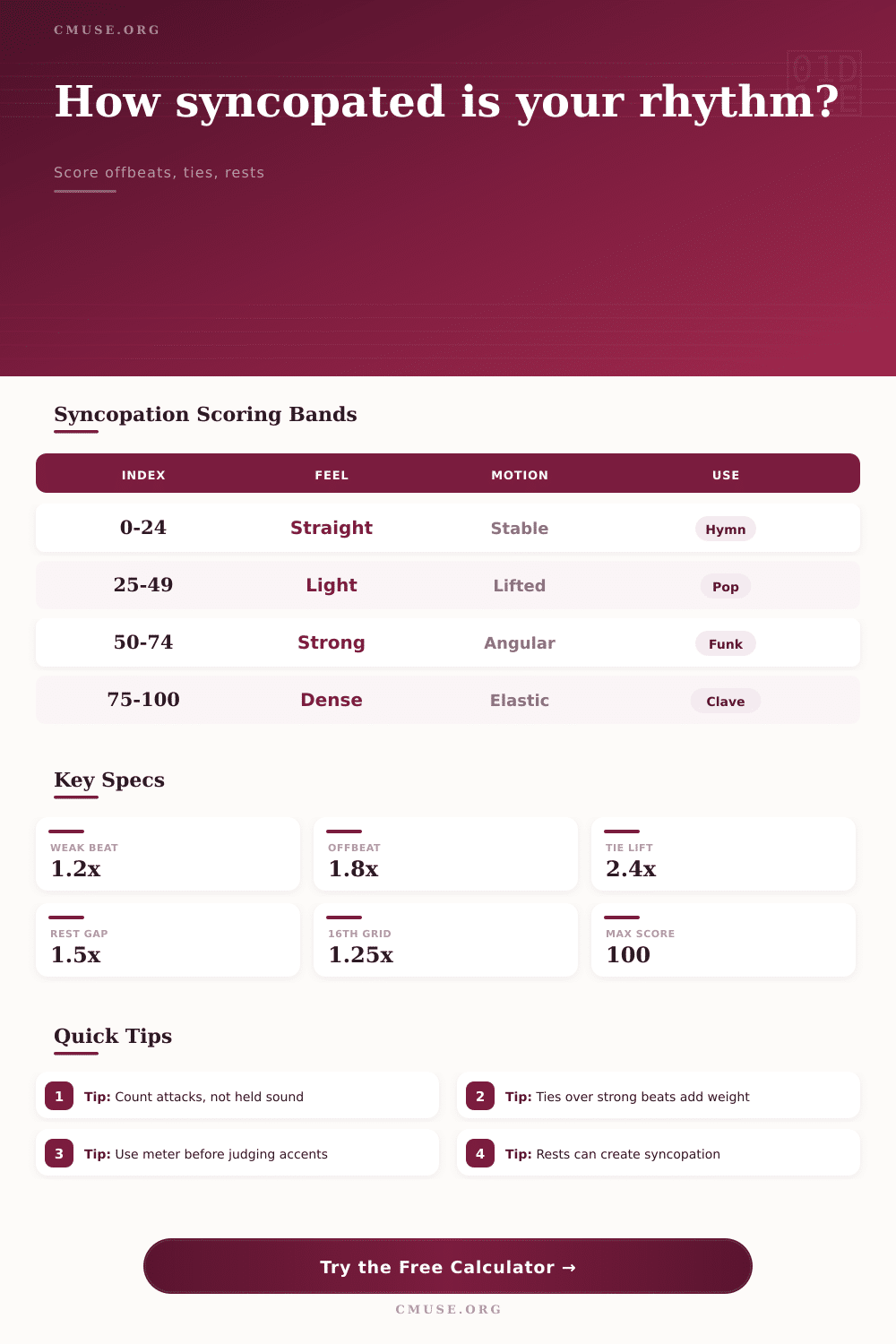
| 0 to 24 | Straight | Main pulse is dominant and predictable. | Count only true offbeat attacks. |
| 25 to 49 | Light syncopation | Backbeat, simple anticipation, or mild lift. | Separate weak beats from offbeats. |
| 50 to 74 | Strong syncopation | Rests, ties, and accents reshape the meter. | Check tie-over-strong-beat count. |
| 75 to 100 | Dense syncopation | Clave-like, cross-rhythmic, or highly displaced. | Confirm denominator and density settings. |
Rhythm has been called heartbeat of music, but really it’s the stumble in the heart beat that compels us to move. It is the instant when a melody doesn’t quite land on the downbeat and you can feel the tension calling out for a resolution. For centuries musicians have experienced this change, but it was always subjective until someone came up with something like the syncopation index calculator.
It doesn’t determine taste. It measures displacement: How many notes are off the grid? And by how much? It applies pressure to our perception of time. Essentially it’s about a simple concept: the pulse of a piece of music and its underlying beats is the solid points around which everything is built. These points are where measures hold together and are therefore generally reliable points of landing. Offbeats occur when something is played between those beats, or at least on a weak one.
What Is Syncopation?
All those moments are measured by the calculator; not every displacement carries equal value. For example, a note placed on the ‘and’ of two do not have the same value as a tied note that stretches sound across a strong beat while your hand continues to move towards the next note. This produces a certain type of tension, a friction if you like, and therefore a tie has a greater coefficient than an offbeat hit alone. It’s nuanced but the maths take this into account and allows for the rich groove of a funk track to score differently from a subtle comping pattern in jazz.
It is important to define your subdivision and meter, since syncopation is relative to whatever grid you place on it. What sounds like crazy displacement in a straight four-four groove will sound perfectly natural in a shuffling twelve-eight. The wrong choice of meter means the tool doesn’t understand what you’re doing. The interface has its own built-in reference table showing how the strong and weak positions in different time signatures are treated.
In three-four time, for instance, it is the first beat. Anything else is considered a dominant accent. Compound meters divide the pulse, creating more motion within them before the score spikes again. Ultimately you tell the tool where home base is, then it measures how far you went.
More important than many novices expect is density. A dense melody may contain 32 notes in four bars and thus have more offbeats than a sparser motif, but that doesn’t make it any more syncopated in spirit. The solution here was to create a density correction slider which balance this disparity. Otherwise, a busy pattern would always come out on top, as if there were any other reason except for sheer volume. To use it, you slide according to how active the surface rhythm is. If you’re scoring a drum break littered with sixteenth notes, crank the slider up. If you’re taking apart a minimalist bass line, back it down. That way the final index isn’t a sign of rhythmic busyness but an actual intention to displace.
Another silent factor in syncopation are rests. These are not neutral either. There is active space in a rest. If there is a rest preceding an accented note, then we have an expectation for something to come and it propels the upcoming note forwards. They break the flow and become important. The tool counts these intervals as equally disruptive as a tied note.
Players tend to think only about where the notes fall, but fail to consider the location of the silences. Wrong. The silence often dictates the groove more than the occupied areas. As such, the tool counts these rest gaps to capture that forward momentum. It gives a better view of the rhythmic tension.
The last score also accounts for style sensitivities: Afro-Caribbean uses complicated cross-rhythms called clave patterns that can appear chaotic when viewed in a classical setting. Because that’s the norm, not the exception, there’s a multiplier for that kind of thing in the calculator. In a strict classical read, deviations get punished more harshly, since that’s not what one wants to see. Stability is the goal. In other words, you choose the lens through which you want to view your music and the tool will adjust its judgment according to your choice. It’s never about right or wrong, but rather accuracy to the tradition in which you work.
In conclusion, the calculator is a diagnostic tool, not a creative crutch. After spending hours practicing, it will help you hear what your ear may have missed. It can tell you if your rhythm section is sitting tight or starting to drift apart. It can reveal whether a melody is too predictable or overly chaotic. The numbers provide a language for feelings that would typically be difficult to describe.
When you know how the input influences the output, you begin to control the tension in your music. No longer do you guess at why a groove sounds loose, but instead plan the precise amount of stumble required. That precision allows abstract rhythm to become concrete design, giving you the ability to craft grooves that hit home, not by chance but by purpose.