Sync Licensing Duration Calculator
Estimate cue length, licensed seconds, number of uses, media weighting, territory term, exclusivity term, and renewal window timing for a music sync clearance plan.
Load a named sync scenario, then adjust cue seconds, versions, term, territory, media type, exclusivity, and renewal timing for your draft license summary.
Sync license duration snapshot
Enter cue and license details to summarize licensed seconds, uses, scope weighting, and renewal timing.
| Media type | Weight | Typical cue duration | Best use |
|---|---|---|---|
| Internal corporate video | 0.65x | 15 to 90 seconds | Private presentations, training, or closed events. |
| Social video or short-form | 0.80x | 5 to 30 seconds | Platform uploads, creator edits, and short campaigns. |
| Online branded video | 1.00x | 15 to 120 seconds | Web ads, product pages, and paid social variants. |
| Broadcast TV spot | 1.30x | 10 to 60 seconds | Linear ad campaigns and scheduled broadcasts. |
| Feature film or documentary | 1.45x | 30 to 240 seconds | Scene cues, credits, festival cuts, and distribution edits. |
| Trailer or promo campaign | 1.85x | 30 to 120 seconds | High-prominence launches, teasers, and theatrical promos. |
| Game, app, or interactive scene | 1.60x | 15 to 180 seconds | Cutscenes, menu loops, app scenes, and interactive media. |
Weights are planning multipliers for comparing scope. They are not pricing rules and do not replace a license agreement.
| Territory | Weight | Term pattern | Renewal note |
|---|---|---|---|
| Local or single city | 0.70x | 3 to 12 months | Short windows suit event-based campaigns. |
| Regional market | 0.85x | 6 to 18 months | Review before expansion into more markets. |
| National | 1.00x | 12 to 36 months | Use a clear renewal reminder before expiry. |
| Multi-territory | 1.25x | 12 to 48 months | Confirm which countries and platforms are included. |
| Worldwide | 1.50x | 12 to 60 months | Leave enough time for broad distribution renewals. |
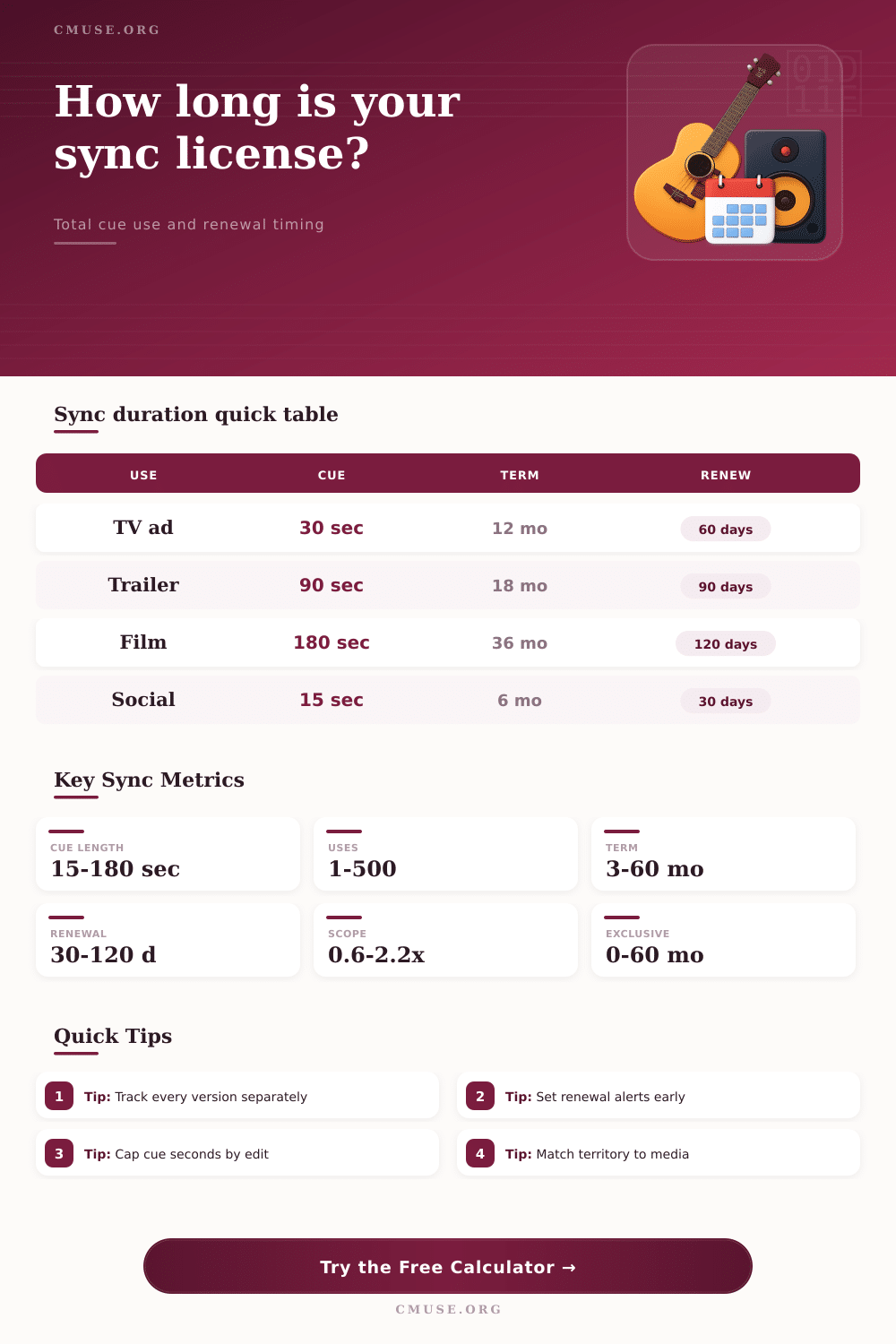
| Renewal window | Use case | What to review | Calculator impact |
|---|---|---|---|
| 30 days | Short social or internal term | Uploads, active links, and cutdowns. | Late review, smaller buffer. |
| 60 days | Standard ad or web campaign | Media plan, versions, and territory. | Balanced renewal reminder. |
| 90 days | Broadcast, trailer, or series | Distribution dates and edits. | Early review for active campaigns. |
| 120 days | Film, game, or worldwide term | Long-tail platforms and exclusivity. | Large buffer before expiry. |
| Preset | Licensed seconds | Uses x versions | Term and territory |
|---|---|---|---|
| TV Ad Campaign | 30 seconds | 12 x 3 | 12 months national. |
| Feature Film Credits | 180 seconds | 1 x 2 | 36 months worldwide. |
| Streaming Series Recap | 45 seconds | 8 x 1 | 24 months multi-territory. |
| Game Trailer Spot | 75 seconds | 5 x 4 | 18 months worldwide. |
| Social Creator Reel | 15 seconds | 40 x 2 | 6 months national. |
| Mobile Game Cutscene | 90 seconds | 6 x 3 | 36 months worldwide. |
When used in a campaign or within a film, the details of a music licensing placement are not about the fee for the placement, but instead the details of the license itself. The details to determine are for how long the license will last, how many versions of the music is licensed, and when the license should be renewed. These details is important in that they will determine whether a license is easy to manage within a campaign, or if it becomes difficult after the campaign is launched with the music.
One of the main details to determine within a license is the length of the musical cue that is to be licensed. In most instances, the team can trim the musical cue to the length required for the campaigns placement of the music. However, it is impossible to license a musical cue for more seconds than exists within the master recording.
Music Licensing for Campaigns and Films
Some teams will license the full length of the musical cue. However, some teams end up licensing the full length of the musical cue yet discover that they paid for minutes of music that were never used within the campaign. Additionally, other teams may license only the length of the edit of the musical cue.
However, those teams may later realize that they need to license an alternate version of the musical cue that exceeds the length of the edited portion. Aside from length, there are two separate factors regarding the number of times that the music is to be used. An advertisement that plays in twelve markets is considered to be one use of the music, assuming that all markets play the same cut of the advertisement.
However, if each market features a different cut of the same advertisement, then the advertisement is considered to contain multiple uses of the music. Additionally, if there are three separate lengths of the same advertisement, there is three versions of the music even if the advertisements using those versions are released in the same geographical territory. The type of media in which the music is to be used changes the importance of the seconds of the musical cue.
For instance, a thirty-second cue used in a thirty-second theatrical trailer has more importance to the campaign than the same thirty-second cue used in an internal training video. Additionally, the type of media that is used to distribute the campaign can change the territory in which the license is valid. For instance, licensing for a campaign that is to play in one country may be sufficient for now, but the client may decide to expand into neighboring countries in the future.
The license calculator mathematically determines the number of licenses based off the countries that are to be included in the campaign and the type of media in which the music is to be used. Additionally, the type of license that is obtained can include clauses regarding exclusivity. For instance, a license with a zero-month exclusivity clause indicates that the rights holder will be licensing the same music to other individuals within the license window.
However, a license with a twelve-month exclusivity clause will prevent the rights holder from licensing the music to other individuals. However, twelve-month exclusivity clauses usually come with more higher fees for the licensing of the music. Additionally, licenses that include exclusivity clauses may have an impact upon the negotiations between the rights holder and the campaign supervisor.
For instance, supervisors may not request that licenses to music be obtained for exclusive rights for the entire planet. This can add further complexity to the negotiations between the rights holder and the supervisor. The license window in which the music is licensed to the campaign includes a period in which the license can be renewed.
For instance, a sixty-day license window ensures that the media team has time to determine whether they would like to license the music for the same campaign, or if they will produce a new campaign that utilizes the music. The length of this time period may differ between social media campaigns and campaigns that are distributed as film or games. Additionally, the date that is provided as part of the licensing calculation is the date that the license file should be reopened.
However, it isnt the deadline by which the license must be renewed. A variety of mistake may be made in licensing music for campaigns. For instance, some teams will assume that the start date of the license is the date upon which the campaign is to be launched.
Instead, the license start date is the date upon which the license is to be signed. Additionally, the license may be forgotten to include separate entries for different versions of music that are licensed for different territories. Finally, the license may be issued at too late a date for the campaign to be renewed, simply because the licensors believe that the rights holder will be the first to contact them regarding licensing the music.
The tables included with the license calculator illustrate the changes that occur in the factors of the license. For instance, tables illustrate the changes in factors regarding the shift from internal videos to theatrical trailers, as well as the changes in factors regarding shifts from a local license to a worldwide license for the campaign. These tables can help individuals to determine to which row in the license calculator they should move to to reflect their campaign and licensing requests.
Though the license calculator cannot capture the negotiations between the individuals involved in licensing the music to a campaign, it does provide the numbers upon which negotiations can occur. For instance, the rights holder may choose to license the music for a shorter term than calculated by the license calculator. Or, they may choose to extend the exclusivity clause for the license.
Thus, the license calculator allows individuals to determine how many seconds of the music they would like to license, how many versions of the music they are producing, and when they would like to open the conversation regarding renewing the license of the music for the campaign. The license window should be matched to the lifespan of the placement within the campaign, but with sufficient time to allow for future licensing or decision. Therefore, by the date that the license is to be renewed, the file should be open and ready for the license to be renewed.
Thus, if mistakes are avoided when licensing the music for a campaign, it is unlikely that the license will be discovered as expired while the placement is still in use within the campaign. You should of checked the dates more carefuly. Youll want to make sure the license period is correct so that the music dont dissapears from your campaign.
It is alot of work to manage all this luxurios music.