Syllables per Bar Flow Density Calculator
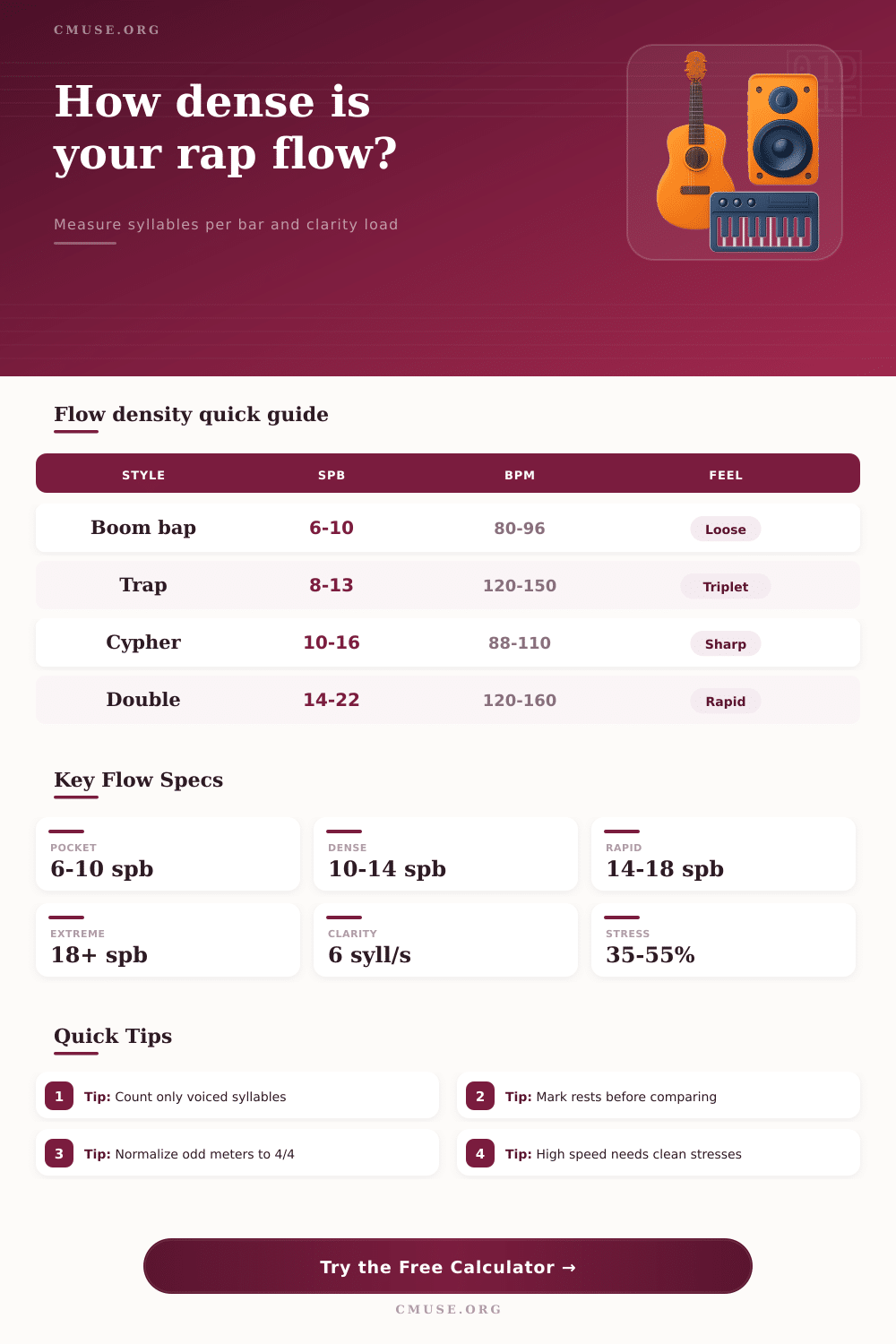
Measure rap flow density from syllable count, bar length, BPM, meter, rest space, delivery feel, stress ratio, and clarity target so different verses can be compared on the same pocket scale.
Preset use: Load a named rap delivery scenario, then replace the syllable count and bar span with your verse, hook, freestyle, or written draft.
| Band | 4/4 normalized SPB | Typical use | What to check |
|---|---|---|---|
| Sparse | Under 6 | Spoken intros, ad-lib breaks, wide hook space | Make sure the pocket still has momentum. |
| 6 to 10 | Boom bap verses, clear storytelling, conversational trap | Place stresses so the line does not feel flat. | |
| Dense | 10 to 14 | Punchline writing, internal rhyme runs, syllable-forward verses | Watch breath marks and consonant clarity. |
| Rapid | 14 to 18 | Double-time phrases, grime bursts, technical cypher passages | Reduce filler syllables if the message blurs. |
| Extreme | 18+ | Short sprints, showcase bars, intentionally crowded flows | Use contrast bars so the ear can reset. |
| Preset | Tempo | Bars | Starting syllables | Flow reason |
|---|---|---|---|---|
| Laid-Back Boom Bap | 88 BPM | 16 | 128 | Roomy verse with pauses and a medium stress ratio. |
| Trap Pocket Verse | 140 BPM | 16 | 176 | Modern pocket with triplet pressure but controlled space. |
| Triplet Bounce | 132 BPM | 8 | 120 | Shorter run where grouped syllables ride inside each beat. |
| Cypher Punchline | 96 BPM | 16 | 224 | Dense multis and stress accents across a full verse. |
| Double-Time Drill | 144 BPM | 8 | 176 | High-speed pattern that needs a higher clarity target. |
| Melodic Hook | 76 BPM | 8 | 56 | Sustained delivery where fewer syllables can feel complete. |
| Meter and tempo | Seconds per bar | 10 SPB rate | 16 SPB rate | Reading cue |
|---|---|---|---|---|
| 4 beats at 80 BPM | 3.00 sec | 3.33 syll/sec | 5.33 syll/sec | Comfortable, words have room. |
| 4 beats at 100 BPM | 2.40 sec | 4.17 syll/sec | 6.67 syll/sec | Dense bars start testing clarity. |
| 4 beats at 140 BPM | 1.71 sec | 5.83 syll/sec | 9.33 syll/sec | Fast pocket, count active rests carefully. |
| 3 beats at 120 BPM | 1.50 sec | 6.67 syll/sec | 10.67 syll/sec | Normalize before comparing to 4/4. |
| 6 beats at 90 BPM | 4.00 sec | 2.50 syll/sec | 4.00 syll/sec | Long bars can hide a light per-beat load. |
| Spec | How this calculator treats it | Best input habit | Common mistake |
|---|---|---|---|
| Voiced syllables | The main numerator for SPB and active speed. | Tap each spoken vowel sound once. | Counting written syllables that are swallowed. |
| Rest beats | Removed from active syllables per second. | Average breath space across the chosen bars. | Leaving rests at zero for chopped flows. |
| Meter | Used to normalize density to a 4/4 bar. | Use the beat count the line actually cycles over. | Comparing 3/4 and 4/4 raw SPB directly. |
| Stress ratio | Estimates rhythmic weight and punch load. | Count hard accents, rhyme hits, and emphasized words. | Treating all syllables as equally forceful. |
| Clarity target | Benchmarks active speed against clean delivery. | Lower it for live takes, raise it for practiced sprints. | Chasing maximum density with no contrast. |
You sit down with a sixteen bar idea and feel the rhythm click. The syllables lock into the pocket, but when you play it back, something doesn’t feel right. There’s too much empty space. Maybe the verse feel too crowded. Or maybe energy just doesn’t match the beat underneath. This is where most writers gets stuck because they have a feel for how it flows but don’t have the words to explain to someone else why some verses lands and others don’t.
That’s where this calculator comes in. Plug in number of bars and how many syllables, and it measures out density. It takes the guessing work out of knowing if you are placing your stresses correctly or rushing. It’s not just about stuffing as many words in each bar as you possibly can. It’s about how many words you use compared to the beat. How are they occupying both space and time?
How This Calculator Helps Your Flow
Six syllables in a bar can make for a powerful verse, when all the syllables lands on a hard accent. Twenty syllables in a bar can make it sound like mud, unless there is clear breath marks and clean consonants. The key to this is knowing what you’re measuring. Isolate the kinetic energy of the performance. Ignore the swallowed endings and rests. What you’re left with are voiced syllable and that’s what you count. This captures weight of the delivery.
Then you look at ratio of active voice to available time. It also normalizes the data based off meter and tempo. For example, how do you compare a trap track at one forty beats per minute versus a boom bap verse at ninety? That’s not just a matter of counting syllables. Because the bar move faster in the first case, the same number of syllables is going to put more pressure on your speech. To accommodate for this, the calculator adjust to a standard four-four feel. Now you can tell if a verse that works fine on its own might become unclear when the tempo are faster. Little thing, but it matters a lot when trying to match flows across different parts of a song.
Compare the bounce of triplets to that of a relaxed pocket: One is a rhythmically dense texture that fills each subdivided beat; the other use swing and space to add tension. Put the number of syllables together with your initial subdivision grid and you can see where your flow fit into the lane. High density may not mean technical skill. Often times it indicate a greater likelihood of unclear flow. That is why there’s a target input for clarity. This allows you to set a ceiling for how fast you can speak cleanly while still being understandable to most listeners. The more syllables per minute they can’t grasp, no matter how creative the rhyme scheme might be, the less likely they’ll be able to follow along.
You also have to get the balance right between stress ratios. You don’t give equal emphasis to each syllable. Some bang like hammer blows and others is like connective tissue. That’s where the ‘stressed syllable’ option comes in on the calculator. Set it higher and more bars will contains an accent, regardless of the number of syllables. This gives the track a heavier, more driving feel. That also accounts for the ability of certain MCs to make their delivery sound so intense but not go any faster. They just increase frequency of impact. More often. More impact. It’s about placement over quantity.
With this approach, you’re able to make conscious decisions around how you phrase things ahead of time, instead of “hoping” that it sounds good when you record it. You’ll have no doubt as to which side of the density range you are operating on. Are you going for a dense, technical verse? Maybe you want something more sparse and atmospheric? How do you want the flow of your song to sound? That is a decision you could of made deliberately.
On the page is a reference table breaking down flows into bands from sparse to extreme. Each one give a quick visual representation of what that looks like in practice. And you might notice that all of your best melodic hooks fall way under six syllables per bar whereas all of your most lyrically interesting sections lands in the dense category. And that’s by design, adding dynamics to the song. There are times to lay down and there are times to go for broke.
Understanding what flow density mean isn’t about getting as many points on the board. It’s about finding the right level of energy for any given moment. When you’re coming off a relaxed verse and transitioning to a double time run, you want that transition to be noticeable by the listener. This takes an accurate sense of how hard you can articulate and attention to detail regarding your counting.
When you have a handle on the numbers within the music, you no longer guess where the pocket is. You begin to build it step by step. And just like you’ve learned to count beats so that you can remain in time, now you can count out syllables to manage the texture of the music. It turns intuition into a craft.