Syllable to Note Ratio Calculator
Measure how a lyric is being set against a vocal melody: syllables per note, notes per syllable, melisma load, syllabic percent, phrase density, breath space, and stress clarity.
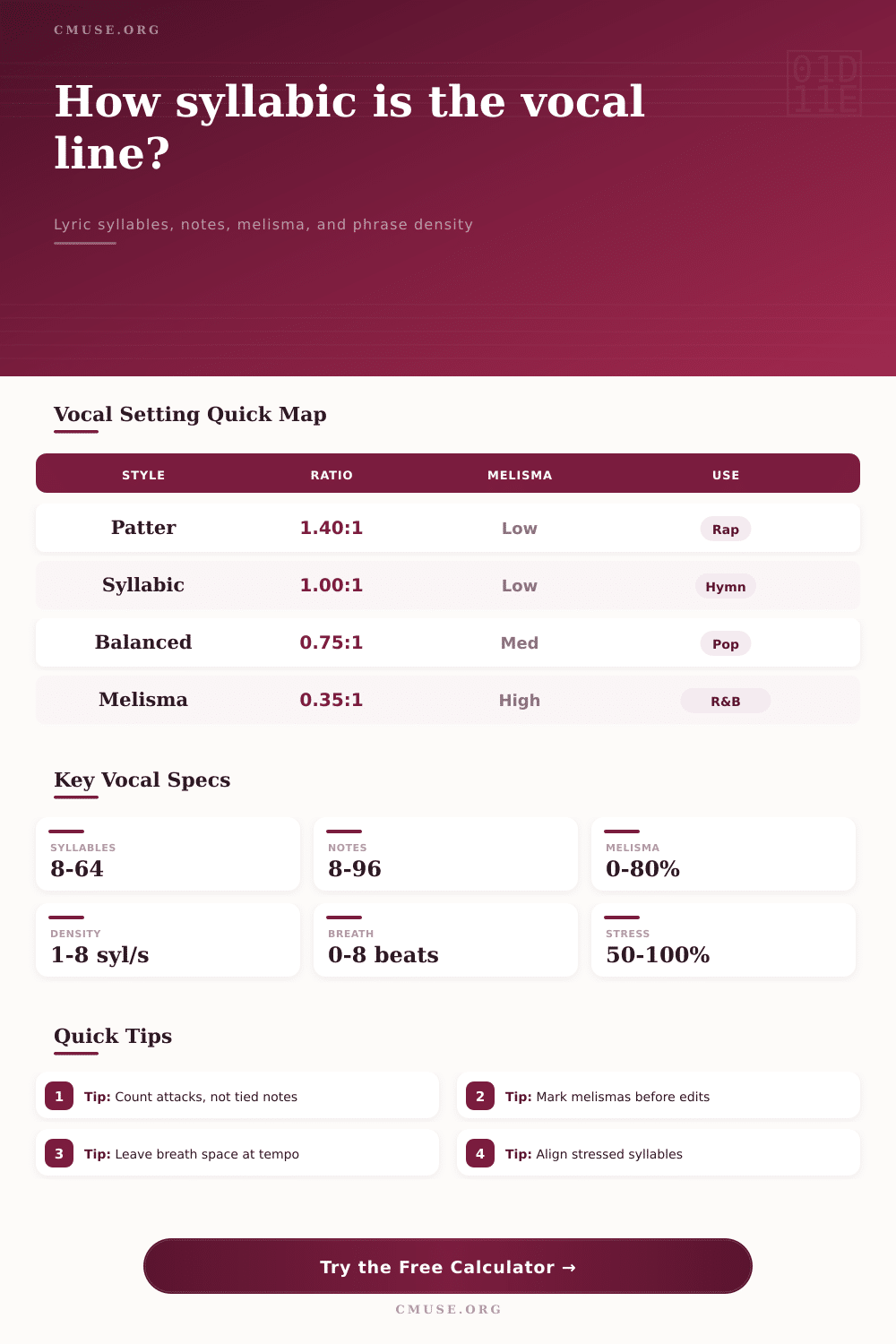
🎯 Vocal Setting Presets
Counting model: count lyric syllables, then count fresh sung note attacks. A tied note is one attack; a new pitch on the same syllable adds melisma weight.
⚙ Lyric and Melody Inputs
Calculation Breakdown
📊 Setting Comparison Grid
Patter
More syllables than notes, very speech-forward, low sustained vowel time.
1.20:1+Syllabic
One primary note per syllable, clear text, stable hymn or folk delivery.
0.90-1.20Balanced
Mostly syllabic with selected two-note turns and expressive passing tones.
0.60-0.90Melismatic
Many notes per vowel, higher ornament load, text clarity depends on placement.
0.20-0.60🎼 Vocal Prosody Tables
| Setting type | Syllable:note range | Typical note behavior | Best use |
|---|---|---|---|
| Strict syllabic | 0.95:1 to 1.10:1 | One note per syllable with few ties | Text clarity, congregational lines, direct hooks |
| Lightly ornamented | 0.70:1 to 0.95:1 | Small turns on key words | Pop verses, folk refrains, choral inner lines |
| Run-forward | 0.35:1 to 0.70:1 | Several notes on held vowels | R&B tags, gospel cadences, aria decoration |
| Patter or recit | 1.10:1 to 1.70:1 | Speech rhythm outruns pitch change | Rap-sung hooks, musical theatre narration |
Use ranges as arrangement guides, then adjust for singer comfort, diction speed, and the emotional weight of the line.
| Melisma load | Extra notes share | Prosody effect | Practical check |
|---|---|---|---|
| Low | 0% to 10% | Words remain dominant | Good for dense lyric information |
| Moderate | 10% to 25% | Melody adds lift without hiding text | Keep runs on open vowels |
| High | 25% to 45% | Vowel color becomes prominent | Place important consonants before the run |
| Showcase | 45%+ | Ornament is the foreground | Use sparingly unless the style asks for it |
| Phrase density | Syllables per second | Vocal feel | Adjustment idea |
|---|---|---|---|
| Open | Under 1.4 | Legato, spacious, easy breaths | Add motion only on emotional peaks |
| Moderate | 1.4 to 2.6 | Natural song delivery | Balance melisma with diction clarity |
| Busy | 2.6 to 4.0 | Fast lyric flow | Simplify consonant clusters or slow tempo |
| Extreme | Over 4.0 | Patter, rap, or virtuoso articulation | Mark breaths and strong syllables carefully |
| Stress alignment | Strong note match | Listener result | Composer action |
|---|---|---|---|
| Loose | Under 60% | Text can feel pushed against melody | Move stressed words to longer or higher notes |
| Workable | 60% to 74% | Meaning is clear with some weak spots | Check phrase endings and title words |
| Clear | 75% to 89% | Natural emphasis supports the line | Keep this balance through repeats |
| Very clear | 90%+ | Speech stress and melody reinforce each other | Reserve surprises for deliberate tension |
Lyrics are words that you think are perfect as they stand in your head, until you set them to music and find they don’t fit the melody. They race ahead, or the tune lingers on one vowel for what feels like an age waiting for the next thought to arrive. The problem arises because melody tracks time, and poetry tracks meaning. It’s about connecting those two elements with a sense of how many syllables can be slotted in the available musical space.
This balance are established by the number of note attacks compared to the number of syllables. The more note attacks per syllable, the denser the melody feels. The fewer the better for telling a story clear (syllabic).
How to Fit Words to Music
Melisma is adding of extra notes on held vowel sounds that add color to the music. Sometimes this is used to heighten emotions in song. These additional notes will thickens the vocal line and make it feel heavier. If not carefully controlled they can also hide words!
Once you know how many note attacks and syllables there are, you simply put them into calculator. It then turns those decisions into data. How does it sound? Does it sound lush or like speech? A singing style with many notes per syllable is essential, but it may conceal poor writing as well.
Trading a clear sense of how many words there are for an added splash of color is fair if intended. An overly heavy melisma count will be appropriate at an emotional climax such as gospel or R&B; here it’s the vowel that communicates the feelings. In a verse that is meant to convey story, it becomes dead weight.
So when to allow a melody to stretch and breathe? Allow it when it is expressing feeling; otherwise, keep the number of notes pretty much matched to syllables.
Another consideration is phrase density; this shows the number of syllables in seconds of the actual sung phrase. It takes into account the bar length and the tempo. Singing slowly with lots of melisma will feel quite breathy even though it is not technicaly so. Similarly, singing fast with one note per syllable can also leaves you breathless.
The denser the cluster of consonants, the more effort are required to say them correctly. This means the singer needs more air. Simplify your vowels, reduce the tempo to give yourself back some vocal air if the density is too great for the voice to cope.
Here’s a table of reference that plots various styles into their own density band.
Clarity also depends off stress alignment. The perfect ratio won’t sound right if the stressed syllables falls onto weak beats. This is called prosody, which means the linguistic accent should match musical accent. When it doesn’t, the listener has a harder job trying to figure out what words mean. Try this: tap out the beat and speak the lyrics along. Does it flow naturaly when you say it? If so, it will probably sing just as easy too.
These are like mapping tools but they don’t write your song for you. And breaking or bending those rules is what great songs often sound like. Maybe the emotion requires some urgency and you write a verse that is technicaly too dense. Maybe the singer’s voice can pulls off some flourishes and you load up the chorus with melisma. It isn’t about hitting a certain number. It’s about making informed decisions for the song.
Having an idea of how much each word weighs help you design not guess. That clarity turns a good melody into a memorabel one.