Swing Ratio Calculator
Turn any swing percent or long-to-short ratio into exact long-note and short-note durations, off-beat delay versus straight timing, and the simplified swing ratio at any tempo and subdivision
Full Calculation Breakdown
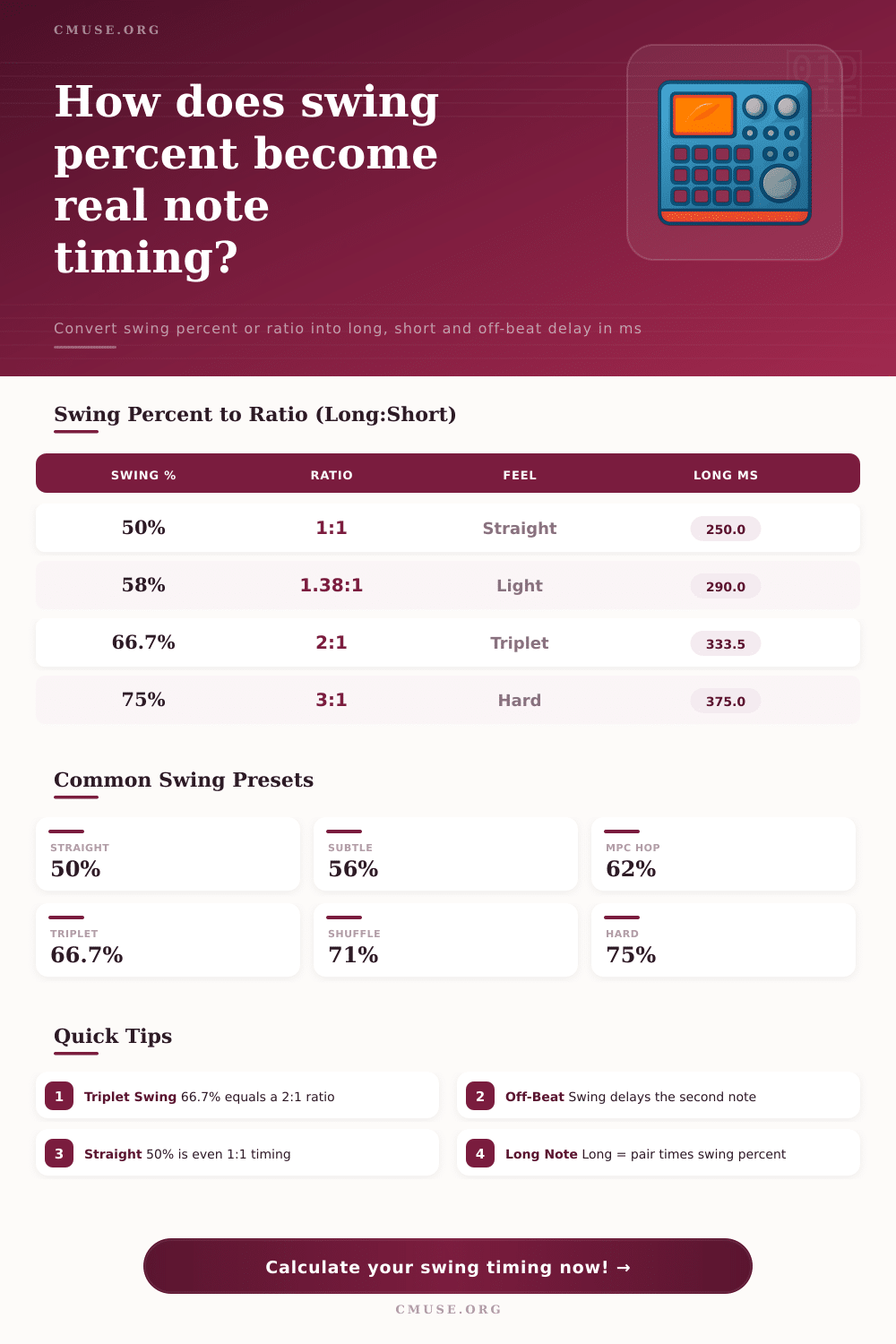
| Swing % | Long Fraction | Short Fraction | Ratio (Long:Short) |
|---|---|---|---|
| 50% | 0.500 | 0.500 | 1 : 1 (straight) |
| 54% | 0.540 | 0.460 | 1.17 : 1 |
| 58% | 0.580 | 0.420 | 1.38 : 1 |
| 62% | 0.620 | 0.380 | 1.63 : 1 |
| 66.7% | 0.667 | 0.333 | 2 : 1 (triplet) |
| 71% | 0.710 | 0.290 | 2.45 : 1 |
| 75% | 0.750 | 0.250 | 3 : 1 (hard) |
| Swing % | Long Note ms | Short Note ms | Off-Beat Delay ms |
|---|---|---|---|
| 50% | 250.0 | 250.0 | 0.0 |
| 54% | 270.0 | 230.0 | 20.0 |
| 58% | 290.0 | 210.0 | 40.0 |
| 62% | 310.0 | 190.0 | 60.0 |
| 66.7% | 333.5 | 166.5 | 83.5 |
| 71% | 355.0 | 145.0 | 105.0 |
| 75% | 375.0 | 125.0 | 125.0 |
| Style / Feel | Typical Swing % | Ratio | Character |
|---|---|---|---|
| Straight / Quantized | 50% | 1 : 1 | Even, mechanical |
| Subtle Pocket | 54–57% | ~1.2 : 1 | Gentle push |
| Hip-Hop / MPC | 58–62% | ~1.5 : 1 | Laid-back groove |
| Triplet / Jazz Shuffle | 66.7% | 2 : 1 | Classic swing |
| Hard Shuffle / Blues | 71–75% | up to 3 : 1 | Heavy lilt |
Ever had one of those moments where you’re listening back to something and you think ‘this sounds like a robot playing’ when in fact all the bars is on tempo? Often it’s not about the harmony, often it isn’t even the melody. What is nearly always the problem are that the timing just doesn’t feel right.
Human beings don’t play things with clockwork accuracy. They push some notes slightly late and pull others slightly early, that makes them sound alive. What you’re hearing is a subtle manipulation of time often called the swing. Knowing how to measure it make your tracks groove rather than feeling like stiff exercises.
How Swing Makes Music Sound Human
Producers typicaly refer to this as a swing percent, although it’s tricky to understand. Fifty percent is not a swing at all, every single note will sit squarely on the grid. You would of raise it to tell the sequencer to keep downbeats tight and delay off-beats to match.
Once you enter your chosen subdivision and tempo into the calculator above, it do the math for you, sparing you having to guess what delay value yields the specific pocket you’re hearing in your mind’s ear. Enter the ratio or percentage and out comes the precise duration in milliseconds for both long and short notes. Why? Because a mere 20-millisecond variation can make the difference between a stiff electronic track and one with a laid-back hip hop feel.
But what you should consider are ratios instead of percentages. Sixty-six point seven percent (a triplet swing) set up a two-to-one ratio: the short note is half the length of the long note. Our brain is hard-wired to split the beat into three parts, which makes for a natural sounding swing like this; it is the classic jazz shuffle feel.
Hip-Hop tends towards slightly lighter swings in area of fifty-eight to sixty-two percent. Smaller percentages mean a much subtler push that is barely noticeable next to straight quantization. Most people mistake this for less swing being bad, but really, too much swing mean you end up with chaotic music instead of something that grooves.
The difference is in the subdivision choice. Swinging sixteenth notes can be layered over the primary pulse to add more textural detail without throwing it. In contrast, swinging eighth notes affects the primary pulse. In the table on the page it is clear how that same percentage results in differing milliseconds of delay based off whether you are working with sixteenth notes or eighth notes.
A sixty-two percent swing on eighth notes at one hundred twenty beats per minute will create a perceptible but silky-smooth amount of delay between each off-beat snare or hi-hat ghost note. The same percentage on sixteenth notes at the same tempo will result in a far tighter energy.
One thing to keep in mind here is that swing is applied different by different DAWs and drum machines. In some instances, it’s global, meaning every track gets swing. And other times, it’s only applied on certain tracks. Knowing how your machine react to the swing gives you an idea of how much or little to add back if it doesn’t behave as the calculator suggests.
For example, say you’re looking for a hefty 75% shuffle; that’s effectively a three-to-one ratio. This means the off-beat note will be very short and played much later then it would be in straight time. This results in a loping, bluesy feel that sounds great at slower speeds but muddier at faster ones.
Swing ultimately is all about making the grid human. Even if you have a great melody, your music can still sound robotic if timing isn’t swung. You don’t ever have to remember what each millisecond is worth. All you have to know is that when you swing a note, it is later than a steady beat in the same bar.
Experiment to find out where to start and tweak it by ear until it sits well in the mix. The numbers are there as a guide but your ears makes the decision. Always try for a moderate percentage and change to match the genre. After all, perfect time is often boring time.